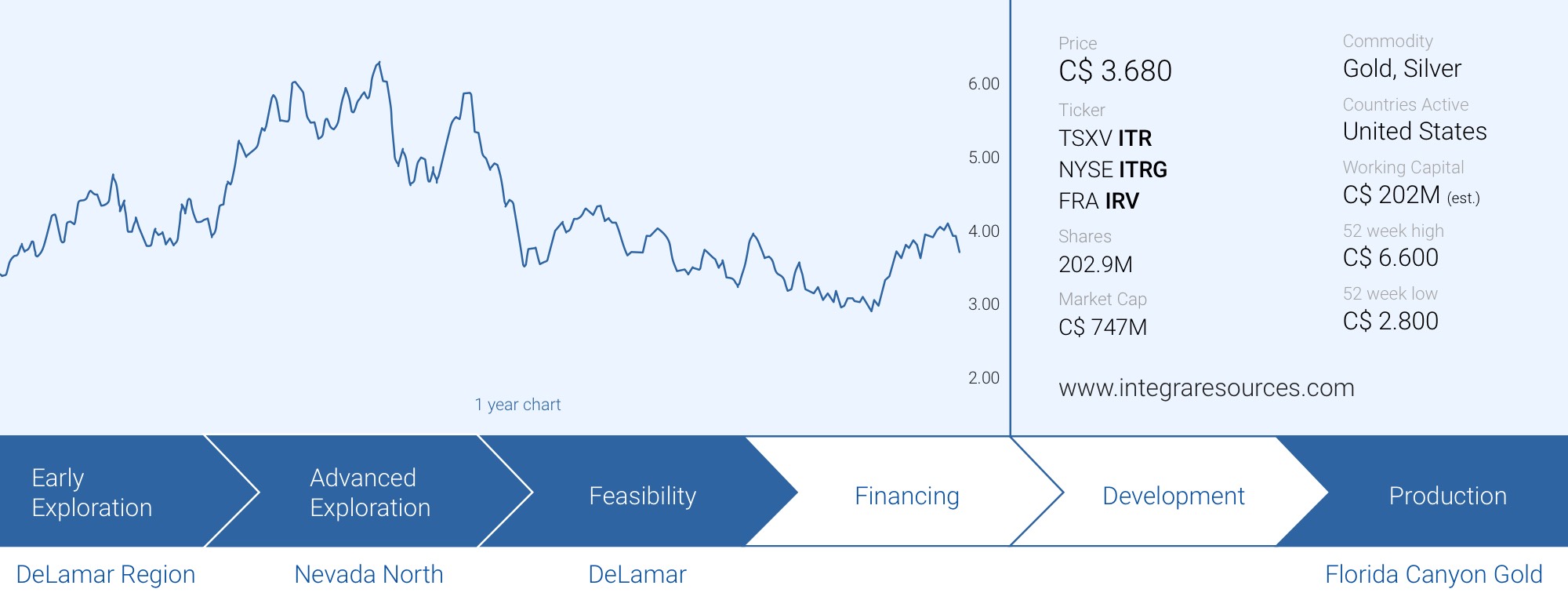
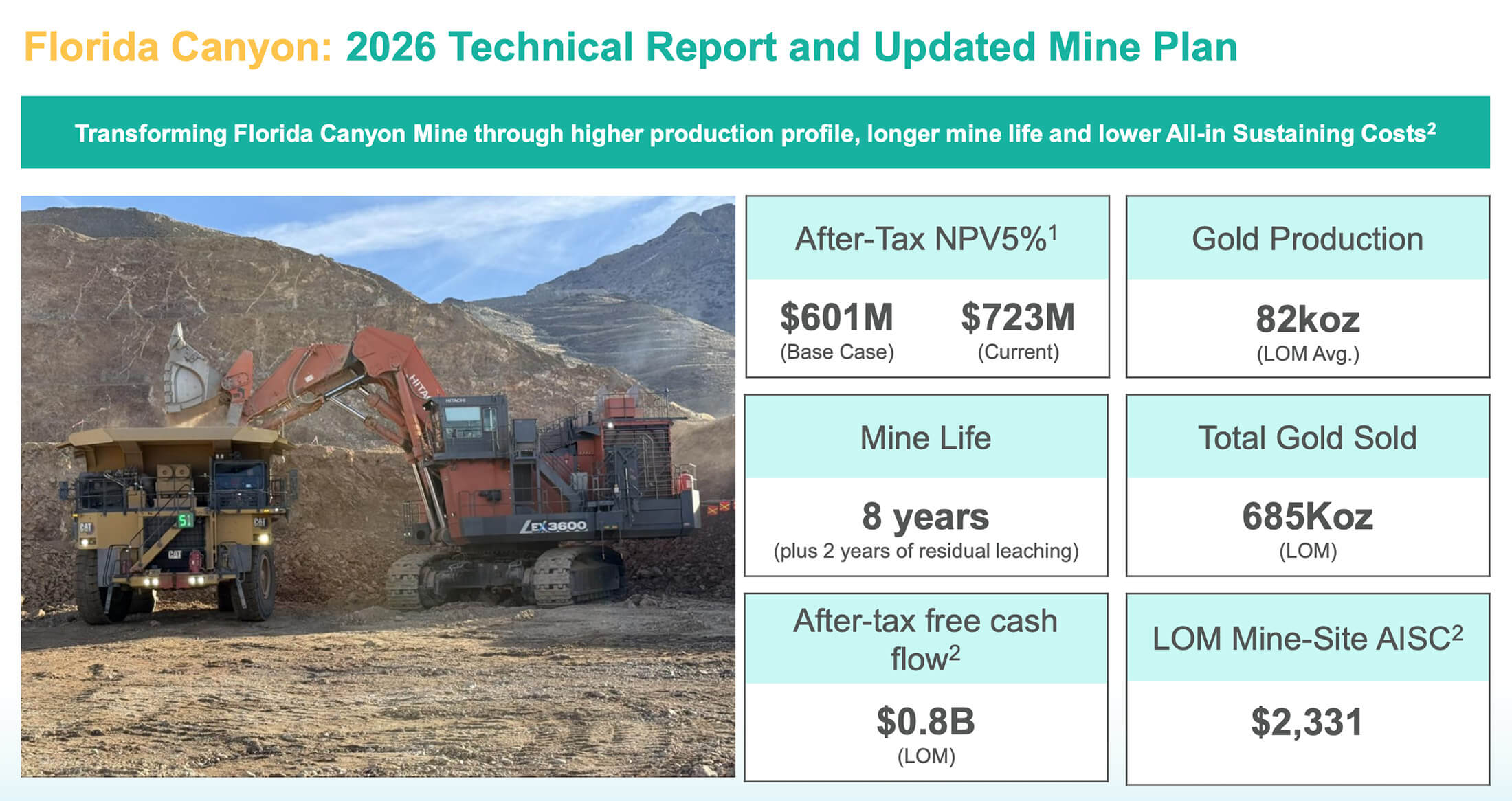
Integra Resources (ITR.V, ITRG) reported on the updated feasibility study on its producing Florida Canyon gold mine in Nevada during the summer. It was great to see that despite having a few additional years of production under the belt since the asset was acquired, the company was able to extend the mine life by a few years and increase the Mineral Reserves by 74%. In the base case scenario (which uses a decreasing gold price from 2027 on) Florida Canyon is expected to generate almost 800 million USD in after-tax net cash flow.
Meanwhile, activities at the DeLamar development project in Idaho are ongoing and the company expects to receive the Final Environmental Impact Statement and Record of Decision (read – Federal Mining Permit) in the second half of 2027 with construction anticipated to start soon thereafter.
Integra’s Q2 results were a bit light due to the (anticipated and previously reported) lower gold production in the first quarter in combination with elevated sustaining capex levels. But as the production rate should increase in the current semester, followed by a double digit percentage AISC decrease in 2027, the ‘worst’ should be behind us.
Revisiting the Q2 cash flow result
During the second quarter, the company has produced just under 16,400 ounces of gold, which represents a 30% quarter-over-quarter increase versus the pretty weak first quarter of the year. A total of 15,794 ounces of gold were sold and thanks to the average realized price of $4,426 per ounce, the total revenue in the second quarter came in at approximately US$71M.
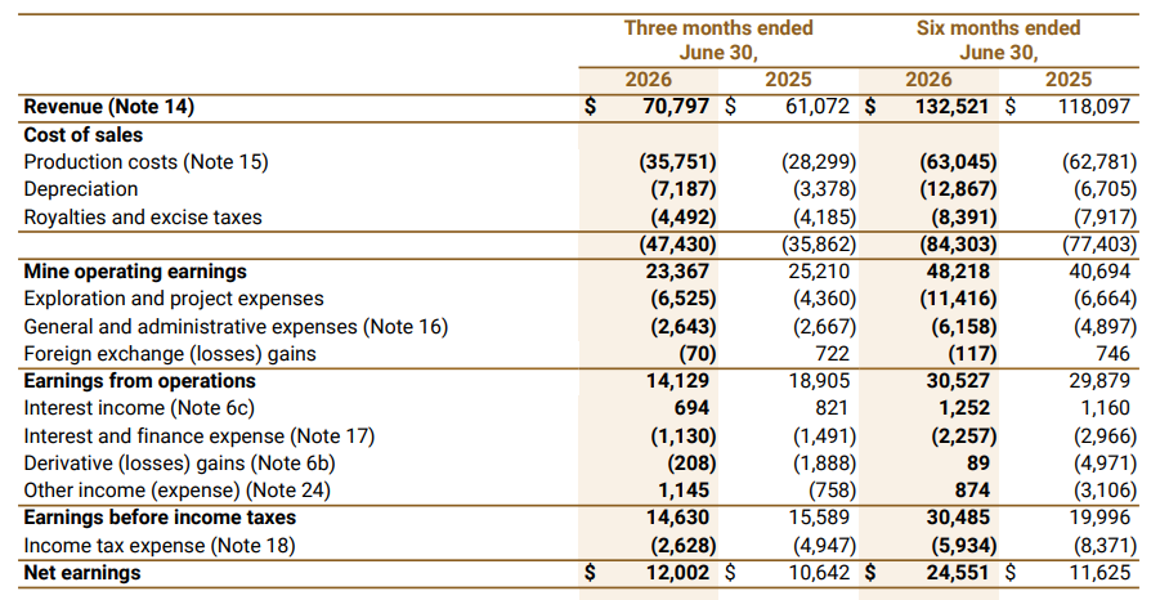
As the income statement above shows, this resulted in a mine operating earnings result of $23.4M which only represents a single digit percentage decrease compared to the same quarter a year ago. And while this may sound disappointing, the higher gold price really saved the day here, as the net amount of gold sold decreased by in excess of 13% and the higher sales price compensated for lower volumes.
Looking at the bottom line result, Integra Resources reported a net profit of approximately 12 million USD, representing an earnings per share of approximately US$0.06 or roughly C$0.083 per share using a 1.40 CAD per USD exchange rate.
Due to the lower amount of gold produced and sold in combination with higher capital expenditures the all-in sustaining costs per produced and sold ounce of gold was surprisingly high at approximately $3371/oz, but still at the lower end of revised guidance.
As the cash flow statement below shows, the reported operating cash flow was approximately $22.8 million, but this includes a net cash tax payment that was approximately $3.7M higher than what was owed, but we should also deduct the $5.3 million working capital release as well as the $3.5 million cash lease payments. This results in an adjusted operating cash flow of approximately $18.5M.
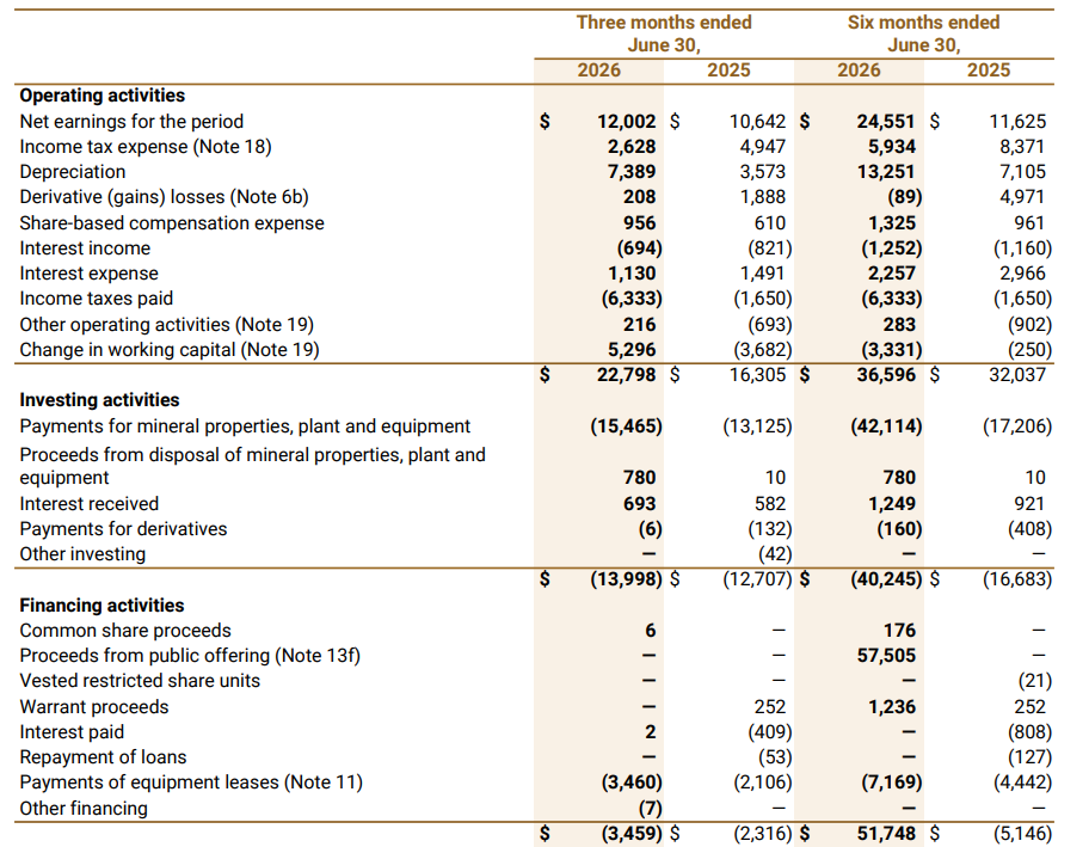
While this was still sufficient to cover the $15.5M capex bill ($14.7M net after taking the sale of certain equipment into consideration, and keep in mind the capex also included non-sustaining items, including $5.7M spent on DeLamar), it explains why the cash build was not as high as we would originally have anticipated.
But even more important than seeing the Q2 production numbers is seeing the company reiterate its full-year production guidance. As ‘significantly more ore’ will be placed on the heap leach pad in the second half of the year, the production rate should continue to increase throughout the year, and Integra maintains is full-year production guidance of 70,000-75,000 ounces of gold. This means that in order to reach the lower end of this guidance, Integra needs to produce just under 41,000 ounces of gold in the second semester. Not only does this imply an average quarterly production of in excess of 20,000 ounces of gold in Q3 and Q4, it also implies a much stronger operating cash flow.
That being said, as per the revised guidance for 2026, we should expect the all-in sustaining costs per ounce of gold (on a sold basis) to remain pretty stable above $3300. The current gold price is of course very forgiving and we continue to anticipate the company will be free cash flow positive and Integra will be able to add more cash to its balance sheet (subject to working capital changes).
This should set the company up to hit the ground running in 2027, as the recently updated mine plan calls for a higher production at a lower cost in 2027 and 2028 versus 2026. This also means that the current year should be the final year of ‘pain’. As the image below, pulled from the updated Florida Canyon feasibility study presentation, shows, the AISC should drop towards $2600-2700/oz in 2027 before continuing to decrease towards $2300/oz in 2029.
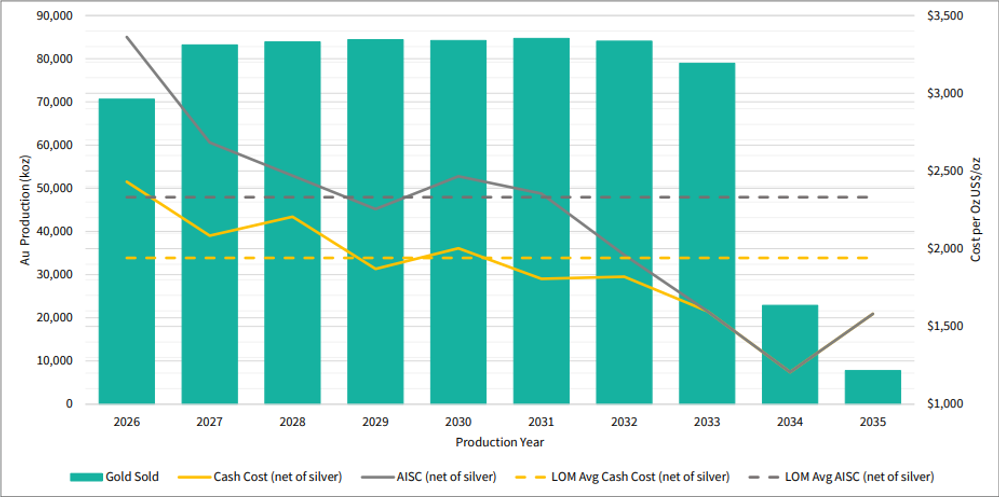
Fortunately, the gold price is cooperating this year, and at a stable or even slightly lower gold price in 2027, the margins and net free cash flow from the producing asset should increase. At $4000 gold and an AISC of $2600/oz, the margin will be $1,400/oz, on an anticipated higher production and sales volume of 80,000 ounces of gold.
And with a total of US$111M in cash on the balance sheet (and a US$146M positive working capital position), Integra is in an excellent financial shape to complete all improvements at Florida Canyon. This should increase the cash flows in 2027 ceteris paribus, and will allow the company to run up its cash position ahead of making a construction decision at DeLamar.


What’s happening in the background
We covered the updated feasibility study on Florida Canyon in a previous report, and in the base case scenario (a gradually decreasing gold price after 2027 and a flat $3,600/oz long-term price), the asset is expected to generate US$770M in after-tax net free cash flow on an undiscounted basis. This makes the Florida Canyon mine a well-established cash generator, and all eyes will be on the higher production at a substantially lower AISC from 2027 on.
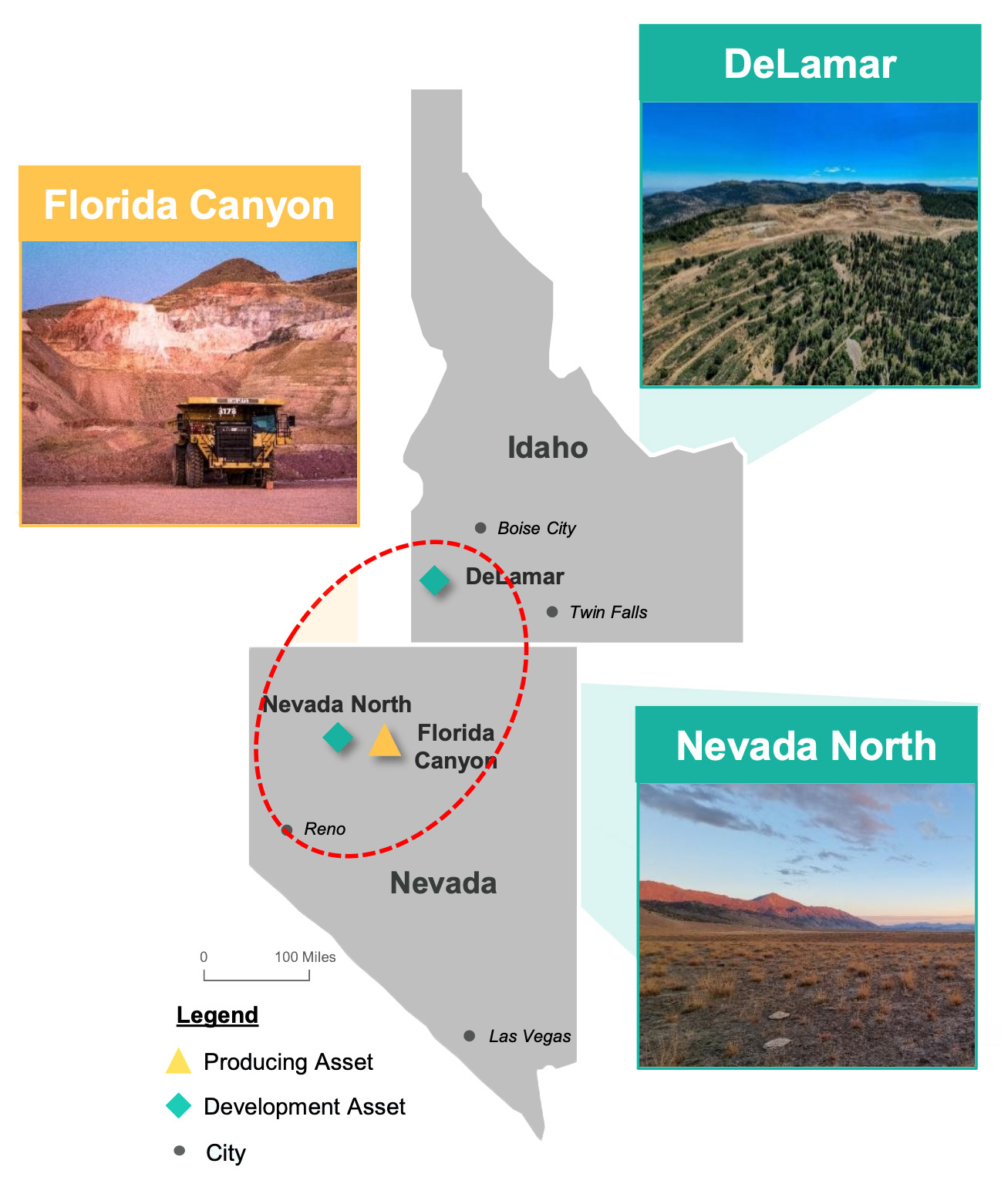
While a producing gold mine is a very attractive asset to own these days, Florida Canyon really is just a tool to unlock the underlying value of the other assets. Both DeLamar (Idaho) and Nevada North (Nevada) are populating the company’s development pipeline, and both assets can reasonably be expected to be in production (of course subject to economic studies, permitting, and formal investment decisions) before Florida Canyon shuts down.
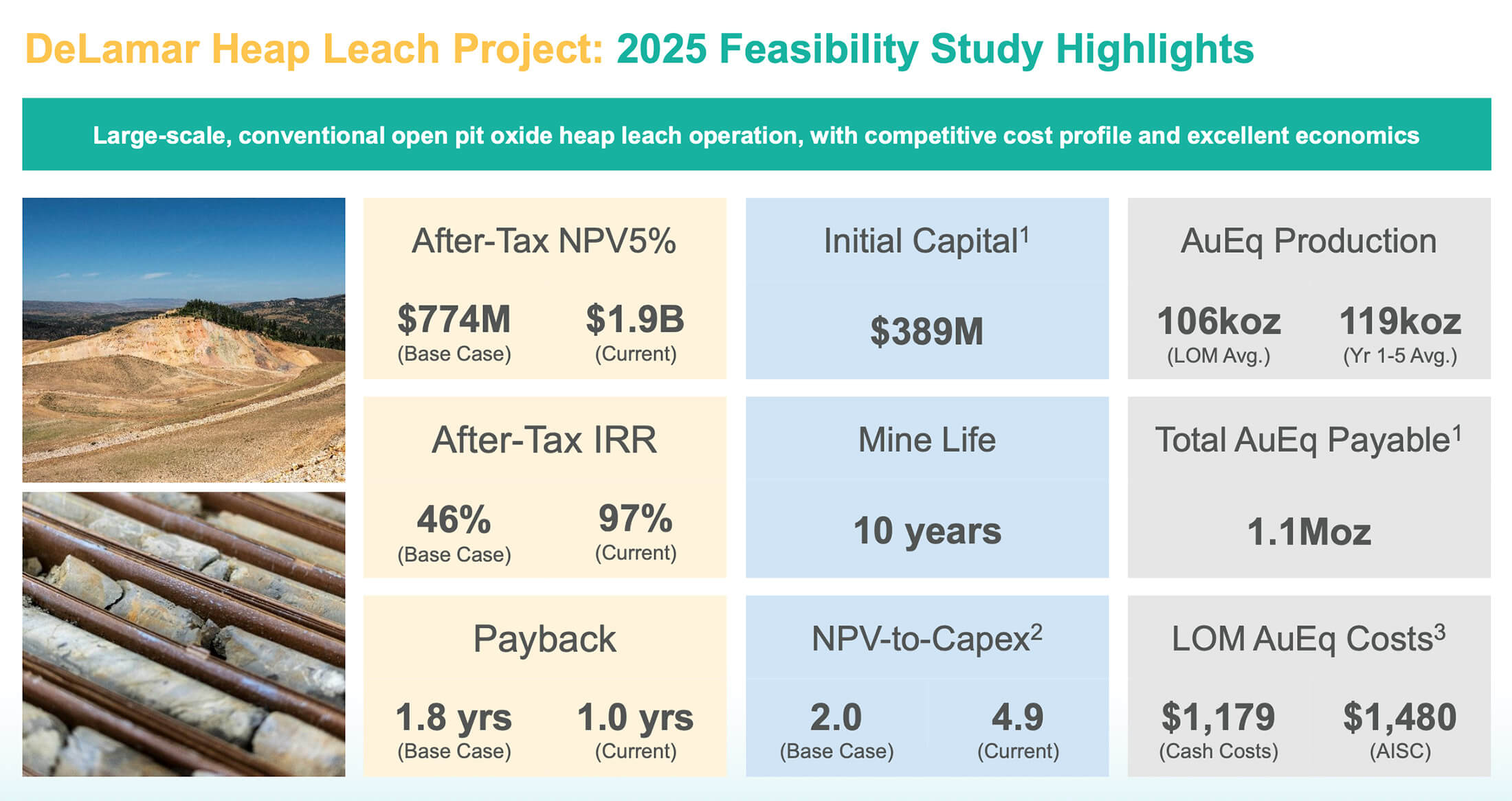
At DeLamar, Integra expensed about $5.7M, mainly on engineering and permitting work, as well as completing just over 700 meters of development drilling.Additionally, US$4.6M was capitalized (including US$1.7M spent on securing equipment).
Meanwhile, the permitting process at DeLamar is continuing and so far there are no reasons to assume the 15 month permitting schedule cannot be met. The Record of Decision for DeLamar is anticipated to be delivered in the second half of 2027.
As a reminder, at $4500 gold and $65 silver, this project boasts an after-tax NPV5% of US$1.9B (C$2.7B) while the after-tax IRR jumps to an astonishing 97%. And with an initial capex of less than US$400M (this will of course have to be adjusted to inflation-related cost increases by the time construction actually starts), this project is very financeable, especially if Integra can continue to build its own cash pile in the next eighteen months until the Record of Decision is established. Meanwhile, the cash generation from Florida Canyon will of course just continue throughout the construction process at DeLamar. We remain hopeful the company can fund the DeLamar construction without having to raise any more equity.
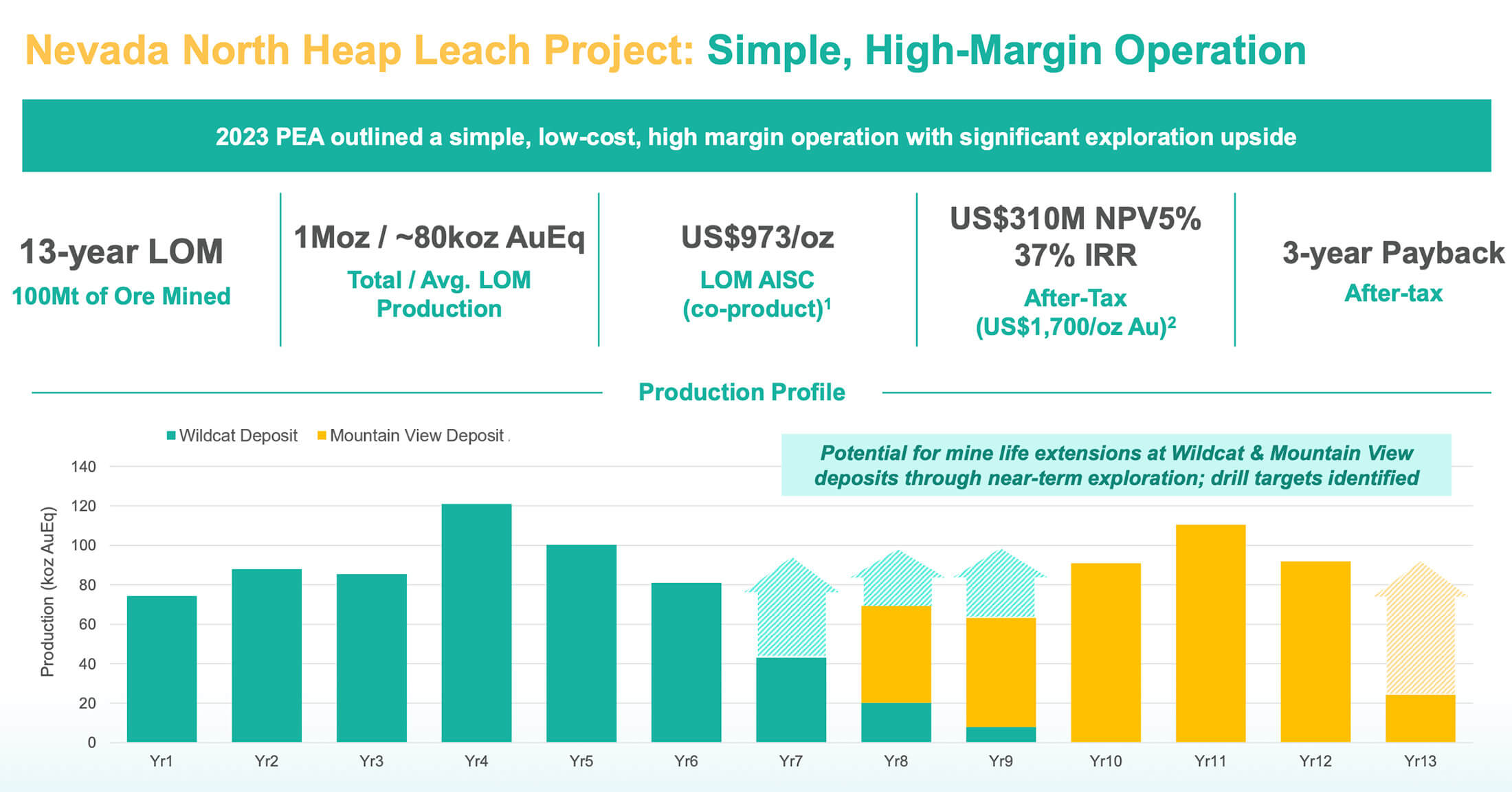
At Nevada North, Integra is anticipating the start of exploration drilling which will include some holes focusing on collecting hydrogeological data. These data points will be important to support the development of a hydrogeological conceptual site model and will be helpful to further assess the water management and supply issues while advancing the project.
Integra is working on advanced economic studies at Nevada North for 2027.
While the NPV sensitivity table for Nevada North maxes out at $1950 gold in the 2023 PEA (showing a US$465M after-tax NPV5%), it’s reasonable to assume the NPV5% now exceeds US$1B on an after-tax basis at $4000+ gold, notwithstanding the anticipated inflationary impact on the capex and opex.
Conclusion
The next few quarters should be the final quarters of elevated all-in sustaining costs at the operating Florida Canyon mine. Fortunately the gold price remained strongly above $4000 per oz which means the company remains cash flow positive despite the higher all-in sustaining costs and despite spending millions per quarter on the DeLamar and Nevada North development projects.
As explained in previous coverage, Integra Resources’ market capitalization barely justifies the sum of the after tax cash flows at Florida Canyon and its existing cash and working capital position. We are still of the opinion that all the development assets get thrown in for free at the current valuation. And that’s quite remarkable considering the combined after-tax NPV 5% of DeLamar and Nevada North at $4000 gold likely exceeds US$2.5B.
Disclosure: The author has a long position in Integra Resources and recently bought more shares on the open market. Integra Resources is a sponsor of the website. This post is for educational purposes only; be mindful investing in junior mining stocks is risky and you may lose your entire investment if things go wrong. Please read the disclaimer.