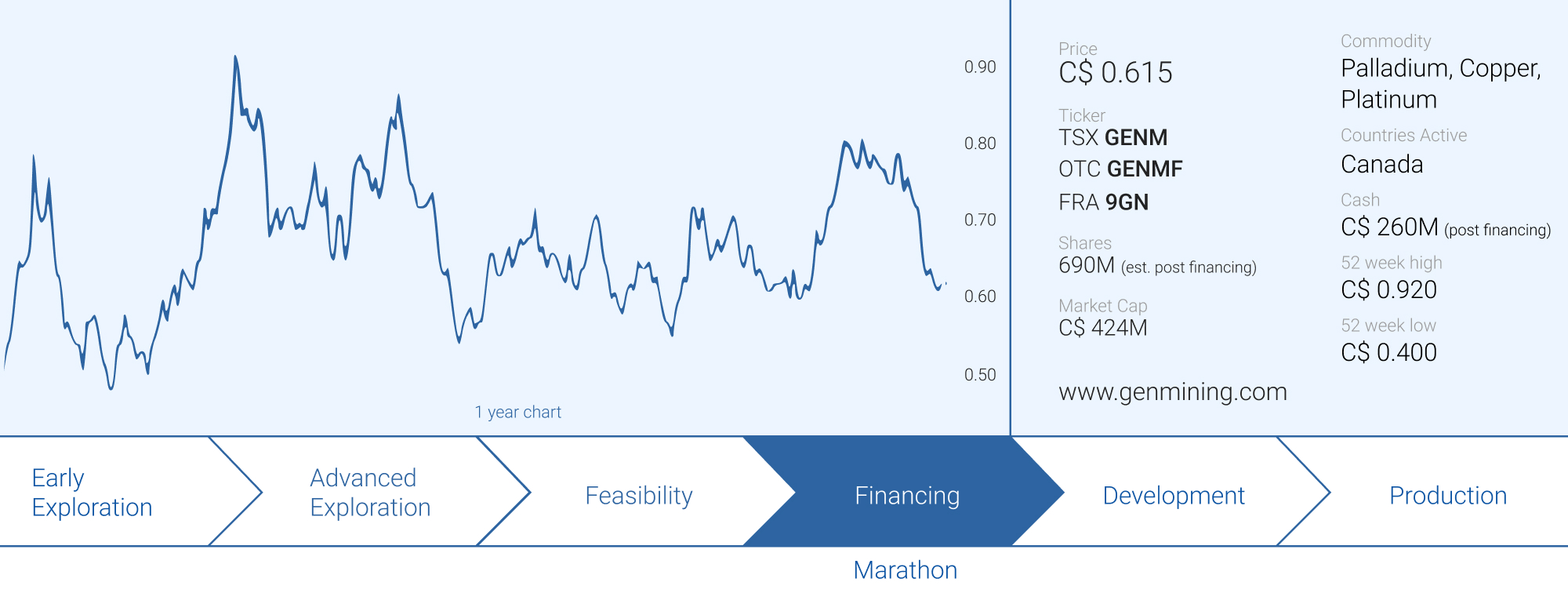
It took a while, but Generation Mining (GENM.TO) finally bit the bullet and pulled the trigger on a comprehensive financing package which should see the Marathon copper-palladium project being fully funded to production.
The company had previously announced certain pieces of the financing puzzle, but with last week’s update on the final C$340M of the financing package, it can now hit the ground running and commence the construction phase of the project within the next few weeks. In this update, we are providing a breakdown of the financing structure, and we will follow up with CEO Jamie Levy to discuss timelines and the future of the project once all the dust has settled.
At last, the complete financing package
Generation Mining announced the final elements of the comprehensive financing package last week, when a series of funding initiatives to the tune of C$340M were announced. The C$340M consists of C$240M in equity and C$100M in a subordinated convertible note.
The C$240M financing priced at C$0.64 per share is split up in two portions. C$200M is completed on a bought deal basis with about half of this amount taken up by the Canada Growth Fund, Wheaton Precious Metals and Glencore (the latter being Generation Mining’s offtake partner). The remainder of the bought deal was underwritten by the Bank of Montreal.
A second, smaller tranche of C$40M will be subscribed to by the Canada Growth Fund. It’s important to highlight the entire equity component happens on a warrant-free basis.
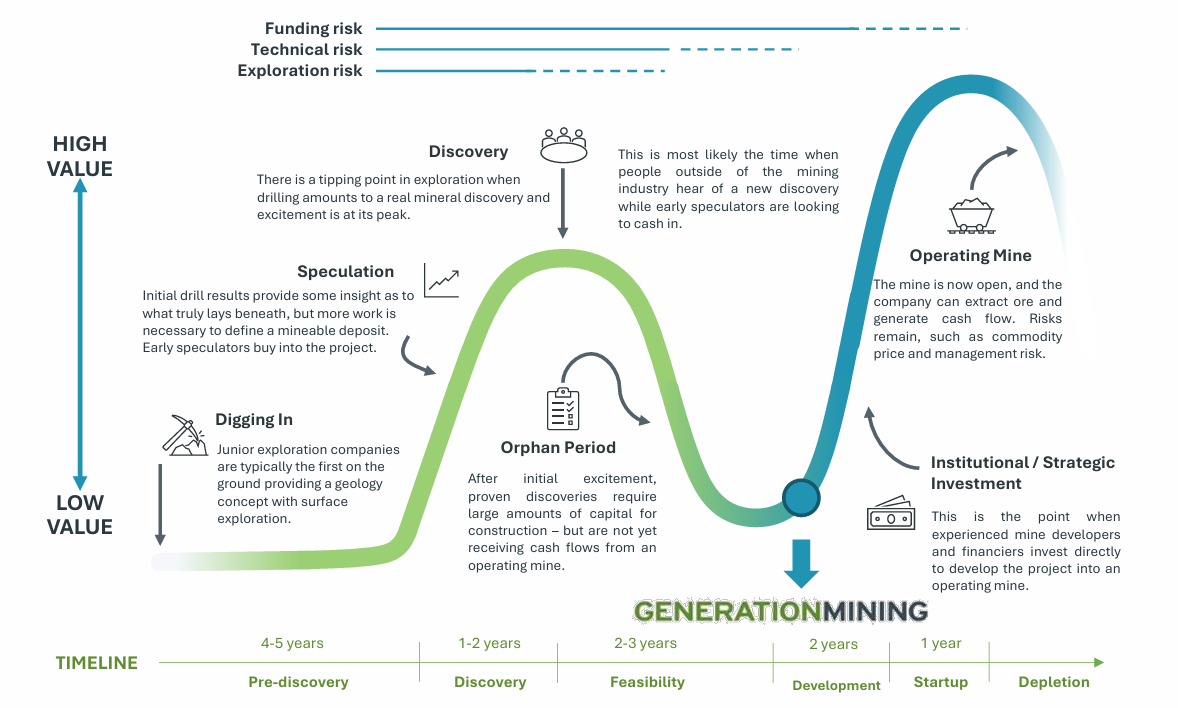
The final C$100M of the C$340M funding package that was announced consists of a subordinated unsecured convertible note. As this is a subordinated and unsecured debt security, the cost of debt is relatively high at 9%, but there are some good other features here.
First of all, the conversion price of the C$100M convertible debt has been established at a 40% premium to the private placement price, or C$0.64 * 1.40 = C$0.896 per share. This could result in a total addition of just over 111.6M shares. The repayment terms are the second interesting feature as this subordinated convertible note could have a term of up to 11 years (but an earlier repayment will be required within 12 months after paying off the senior debt facility and the CIB subordinated facility).
Thirdly, although cash interest payments are the standard, Generation Mining would be allowed to make the semi-annual interest payments in shares should the terms of the project finance facilities require so.
And finally, Generation Mining has a ‘forced conversion’ clause on this convertible debt as it can automatically convert the debt into equity of the share price trades above 130% of the conversion price (implying $1.1648 per share) at the closing bell for 20 days during any 30 consecutive day period.
This C$340M financing follows on top of the previously announced financing initiatives. As a reminder, the parts of the financing that were already in place totalled almost C$1B.
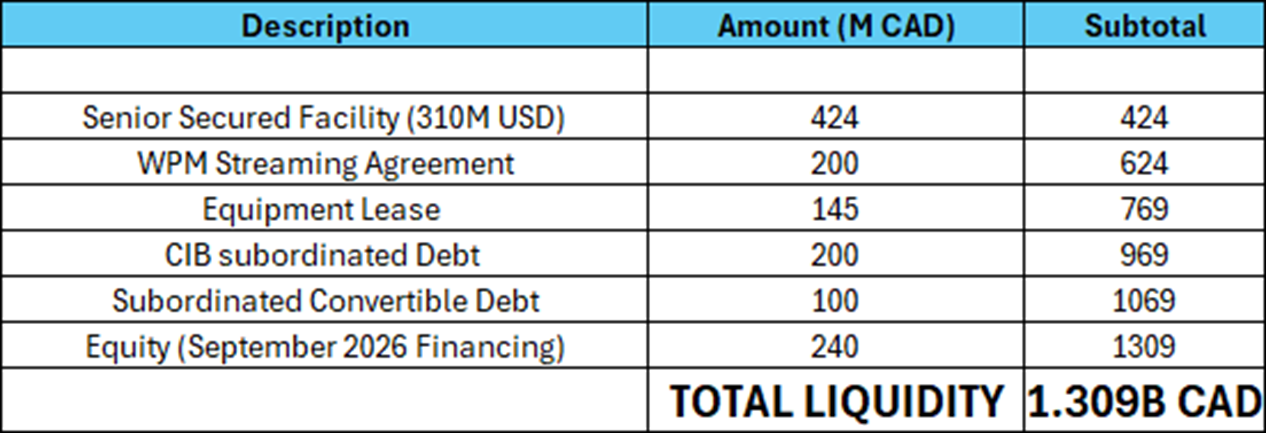
The additional C$340M indicates Generation Mining has now secured just over C$1.3B in funding (the net proceeds will be just under C$1.3B after all lawyers and bankers have received their pound of flesh) to cover a total capex of C$992M. the lenders also forced Generation Mining to raise an additional C$185 million Cost Overrun Facility, bringing the excess cash to more than C$300 million, reducing the risk of having to resort to an emergency financing if or when cost overruns would take place.
And just to be clear, although almost two years have passed since the 2025 feasibility study (which had an effective date of November 1, 2024), it’s encouraging to see that most of the items Generation Mining already had to deal with are coming in at or below the estimated price. This means that no cost overruns should be expected on about C$270M in capex and the expected equipment leases, which only leaves approximately C$500-550M ‘at risk’ for inflation-related cost increases. So, with more than $300 million in additional liquidity on top of the initial capex as per the feasibility study, the cushion to protect the company against overruns is still fully intact as of right now.
What does this mean for the pro forma valuation?
Using the base case scenario as per the 2025 feasibility study, the project sports an after-tax NPV6% of C$1.07B. The sensitivity analysis below provides us the tools to tweak the numbers and to see the outcome using different palladium and copper prices. We mainly care about the after-tax results.
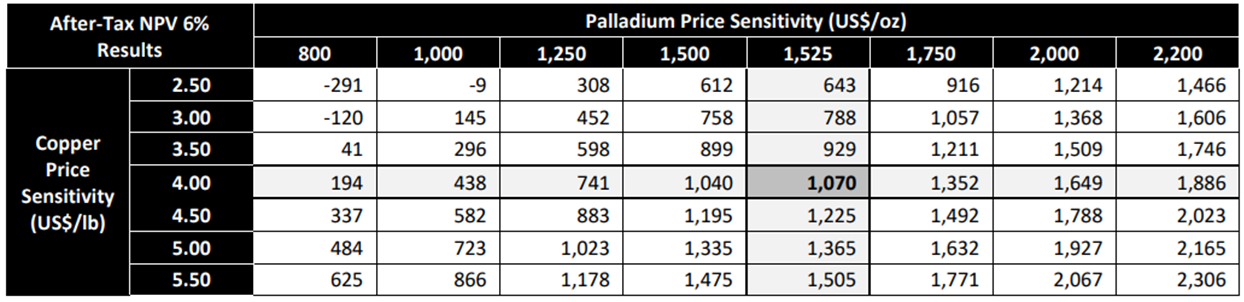
The base case scenario used $1525 palladium and $4 copper. Fair enough. The current spot price is approximately $1300 per ounce for palladium and about $6.50 per pound of copper.
Using $1250 palladium and $5 copper (a discount of respectively 4% and just over 20% to the current spot prices) would result in an after-tax NPV6% of C$1.02B. Not materially different from the base case scenario as the higher copper revenue will offset lower palladium revenue. Using $5.50 copper would add an additional C$150M, and $6 copper and $1250 palladium would likely result in a C$1.3B after-tax NPV6%.
But let’s use C$1.02B. Let’s also assume the real capex comes in at C$1.05B, and that Generation Mining uses the cash from the equity raises on the capex, and doesn’t tap into the C$90M cost overrun facility (we are assuming the additional C$95M as cost overrun cushion that was part of the recently announced final funding package will be spent either way). With access to C$1.3B in liquidity, it is entirely possible the cost overrun facility won’t need to be used.
This also means the equity-adjusted sum of the cash flows (after-tax NPV + the total amount of equity invested) is approximately C$1.25B. This is a more fair way to calculate the ‘after the dust settles’ sum of the cash flows. One could argue we could offset the incoming cash by using the enterprise value (market cap – net cash) of the company, but as pretty much all of the cash will be used on working capital and construction activities, we elect to add this portion of the capex back to the net sum of the cash flows.


Meanwhile, the net share count will increase to 750M shares (and we are assuming all 48M warrants will be exercised, this will yield just over C$30M in net proceeds (the majority of those proceeds will be related to the 24.5M warrants at C$1.00 expiring in Q1 2028) which we will assume to cover working capital needs and provide a portion of the exploration budget.
Using the aforementioned assumptions, this results in an after-tax NPV6% of C$1.7 per share.
In a more optimistic scenario using $1500 palladium and $5.5 copper, the net after-tax cash flow would come in at C$1.7B for a value of C$2.25 per share.
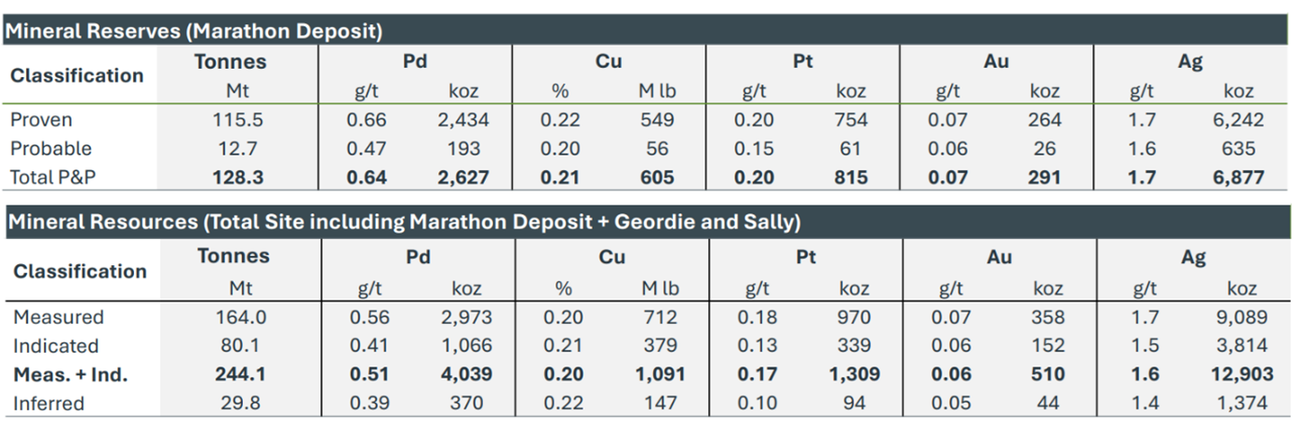
Note: these numbers don’t take the interest expenses into account, nor any additional exploration expenses. On the other hand, these numbers also completely ignore the exploration potential and the potential to extend the mine life beyond the 13 years that’s currently on the table. The project has enough additional measured and indicated resources (see below) to add up to 10 years to the mine life. At $4 copper they weren’t included in the mine plan but at recent prices they could be economic and could gradually make their way into the mine plan.
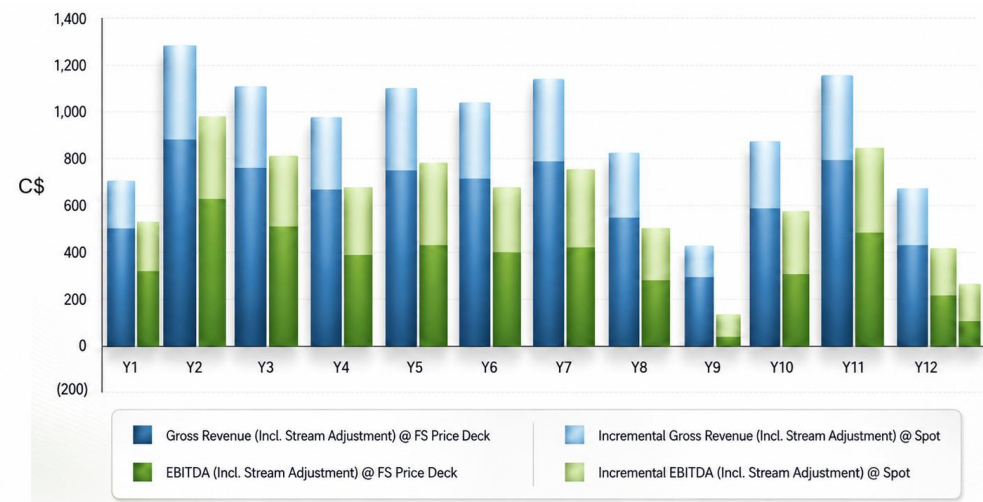
Additionally, it would be nice if the financial performance in Y9 of the mine life could be boosted as that will be the weakest year in the mine life with a near-zero EBITDA as per the base case scenario (compared to an EBITDA of C$266M and C$322M in Y8 and Y10 respectively), as per the feasibility study. Improving the Y9 performance would have an immediate positive impact on the NPV and the sum of the cash flows.
Conclusion
The C$340M financing is the long-awaited final piece of the puzzle. Once completed, we expect Generation Mining to disclose a detailed construction timeline towards the commissioning phase of the copper-palladium mine. At that point, the investment thesis will shift from planning a mine to the execution portion; Jamie Levy and his C-level executives will have to prove to the market they are able to build the mine on time, and preferably on budget. That will also be the key to unlock a higher NPV multiple, as we expect Generation Mining to be gradually re-rated by the market.
Right now, a multiple of 0.5-0.6 times the equity-adjusted NPV seems reasonable. As the construction is accelerating and as the company gets closer to production, one could reasonably expect the NPV multiple to gradually increase until the completion of the ramp-up phase when the mine is producing at nameplate capacity.
Now the financing puzzle has been completed (and we can reasonably expect an additional C$5M from warrant exercises hitting the treasury in the next few weeks as 9.9M warrants with a C$0.50 exercise price are expiring in November), we also expect Generation Mining to focus on exploration again. There are plenty of exploration targets at and around the Marathon Copper-Palladium project that have the potential to (hopefully) extend the mine life. Adding two years to the mine life at a similar output as in Y10-12 would add C$150-200M to the NPV.
The most important thing is locking all the financing needs (and then some) for the construction of the Marathon copper-palladium project. Now it’s up to CEO Jamie Lvy on his team to A) build the mine on time and on budget, B) keep the market engaged during the construction process and C) work on parallel paths to extend the mine life.
Disclosure: The author has a long position in Generation Mining. Generation Mining is a sponsor of the website. This post is for educational purposes only; be mindful investing in junior mining stocks is risky and you may lose your entire investment if things go wrong. Please read our full disclosure.