While commodity investors are mainly focusing on precious metals, copper and critical minerals, one would almost forget that agriculture-related commodities are in high demand as well. A substantial portion of the fertilizer supply chain is in the hands of super majors, but not only are there some smaller players in the field, there are also some geopolitical advantages by going down the pyramid in this sector.
The newest hobby in Washington DC these days seems to be slapping tariffs on pretty much every other country the United States of America is trading with, but there are cases or even the White House realizes it is not desirable to levy a tax on certain commodities. Oil imported from Canada, for instance, is not subject to any tariffs. And although not widely advertised, potash is also exempt from tariffs. The reason for this is very simple, the USA has to import about 95% of its potash needs, and applying a tariff would predominantly hit the American farmers.
It would be in the best interest of the country to start to develop a domestic supply chain for potash in order to at least reduce the reliance on other countries. And this could especially be helpful in an era where self-created trade barriers are not exactly benefiting the end user of the product, and where potash could potentially be ‘weaponized’ in the trade war.
Sage Potash (SAGE.V) fully owns the Sage Plains potash project in Utah. After a recent management change, the company is changing the approach to further advance this project. And rather than looking into developing a small scale production facility with a capacity of 300,000 tonnes per year, it is now shifting gears and is working towards a plan that would see the project satisfy the need of 10% to 15% of the domestic consumption. Potash was added to the list of critical minerals in the USA in 2025, so we can be quite certain the development of any potash project will be kept tabs on by the Federal Government and the relevant authorities.
A resource update is around the corner, and we expect the company to immediately kick off work on an updated economic assessment of the project, which hosts one of the highest grade potash resources in North America. The average potash grade in the upper bed is approximately 15% higher than the average grade in the measured and indicated resource of Intrepid Potash, a peer in the Paradox Basin.
In this report, we will discuss the current situation on the American potash market, the current status of Sage’s flagship project, and how this project is likely to evolve in the next twelve months thanks to the several catalysts that are on the horizon.
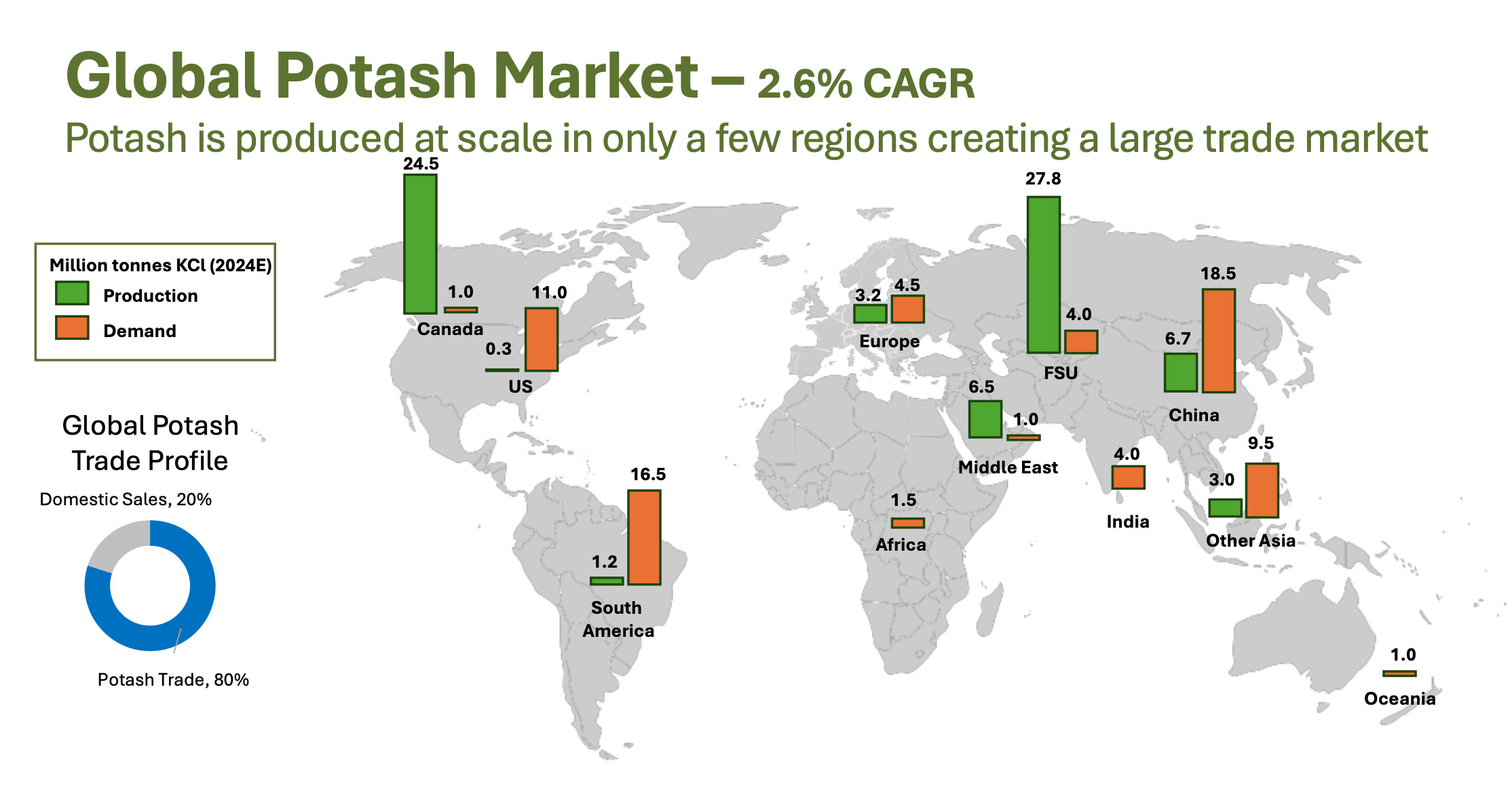
The USA is a major end user of potash, but barely has any domestic production
Potash is the name commonly used for all potassium-related fertilizer products with Muriate of Potash (‘MOP’) and Sulphate of Potash (‘SOP’) as two distinct products, each with their own main applications.
Sage Potash is focusing on MOP, the most common form of potash, and a product where the USA heavily relies on imports. As the official government of Canada records show, the USA imported approximately 12 million tonnes of Potash from its Northern neighbours, while its domestic production was just a few hundred thousand tonnes. This indeed confirms the country needs to import in excess of 95% of its MOP needs to cover the requirements of its domestic agricultural production.
And the beauty of potash is that there is no good substitution as you cannot just simply substitute one type of fertilizer with another. Phosphate-based fertilizer products have their own benefits and work well in combination with potash, but both products are not a substitute for one another.
And while it is certainly possible for farmers to use less potash on their crops, this will inevitably result in a weaker harvest due to lower yields so from an economical point of view, it tends to be better to bite the bullet and be a price taker. Of course the economic disadvantage outweighs the benefits at a certain potash price but with a current domestic price of around $450-650/t (depending on the end market), the cost per acre remains very reasonable.
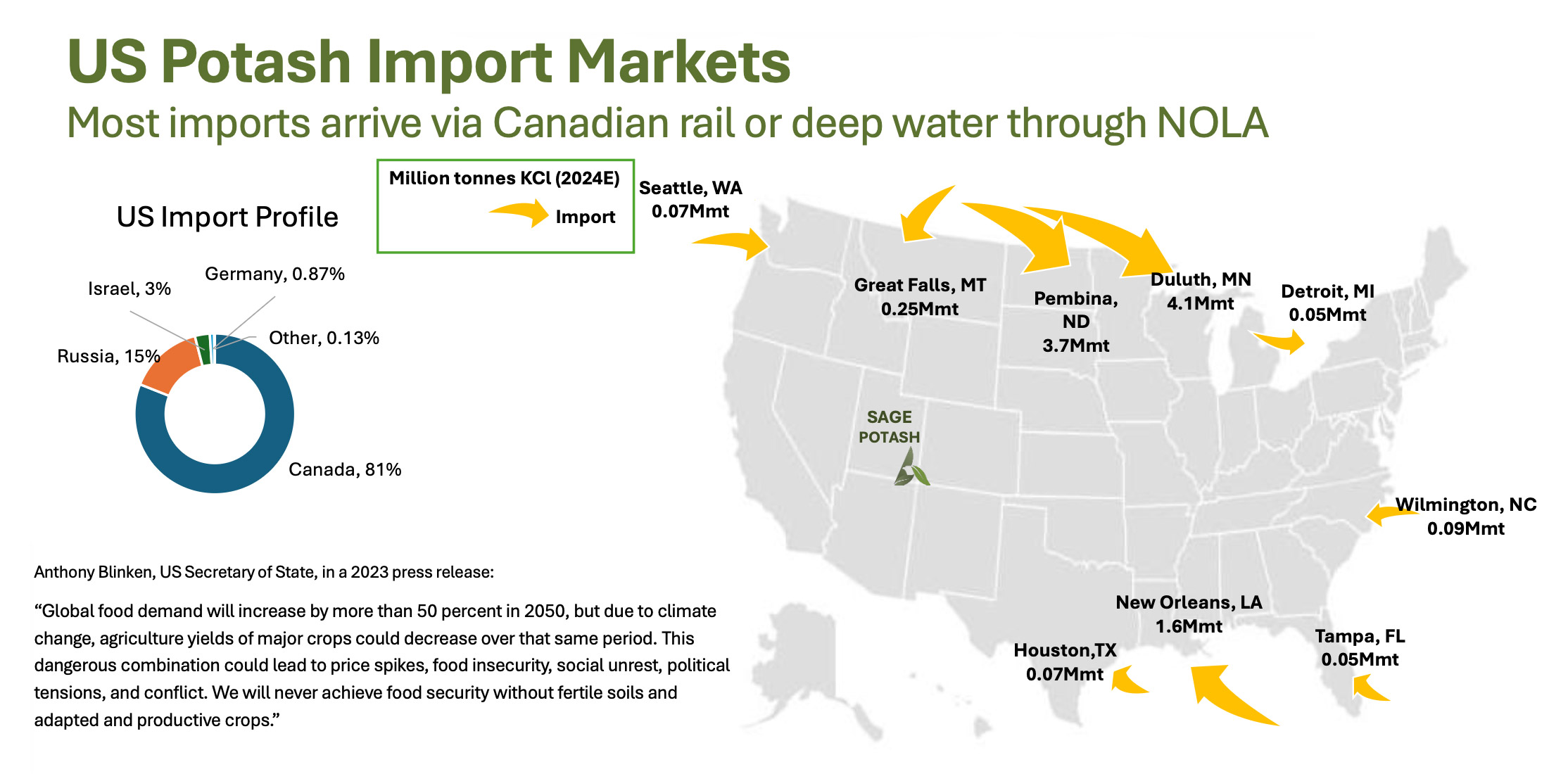
One of the key elements that sets Sage apart from its Canadian peers is its proximity to its end users. As you can see in the image above, as the vast majority of the potash is imported from the Canadian mines, there is a rather substantial transportation cost involved. While Sage Potash will certainly also incur transportation expenses to ship its product to the end customers, it should be able to do so cheaper, creating a cost advantage. If Sage’s product requires a transportation cost of $50/t versus the $100/t its Canadian peers are incurring, that still provides a competitive advantage of $50/t. We are not saying Sage will be able to capture that entire delta, but it is yet another reason why domestic production in the USA could and should be preferred over imported potash.
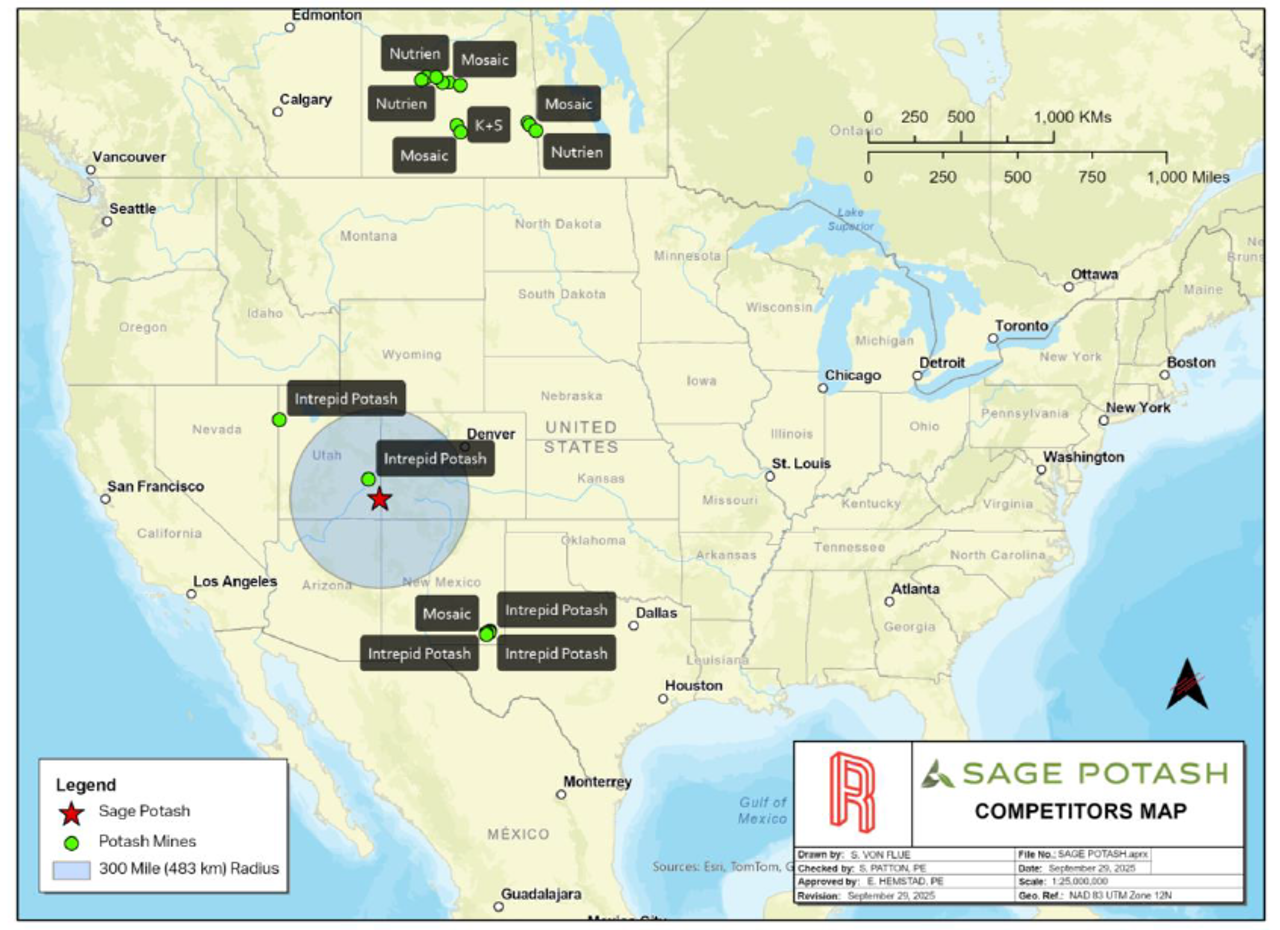
And just to back this up with numbers. Large Canadian producer Nutrien reports a ‘net’ sales price after deducting freight & transportation expenses in its financial reports. This net revenue per tonne came in at just $282/t in FY 2025, while the average reference price was approximately $350/t on an equal-weighted basis. Meanwhile, the average cost per tonne of potash in the USA never dropped below $400/t and tends to trade at about $80/t above the benchmark price. While potash majors keep their cards close to their chest and won’t share the ‘pure’ transportation expenses on a per-tonne basis, the 2025 Respec report on Sage’s flagship project highlights an average cost of $110-165/t for Canadian potash before it reaches the end-users, and puts the spotlight on Sage’s competitive advantage.
As the USA market is spread out over a large geographical area, and as Sage will likely only produce 1-1.5 million tonnes of potash per year (that is, assuming a larger mine scenario will be developed versus the 300,000 tpa scenario that was designed for the Preliminary Economic Assessment, we will explain this later in this report), it can focus on serving the regions closest to its projected mine. The table below shows the average MOP prices in those respective regions: the Green Markets price is on a FOB Pacific NorthWest basis, the Intrepid prices are gathered from Intrepid Potash, the only domestic potash producer. The final column is the average MOP price provided by the US Geological Survey.
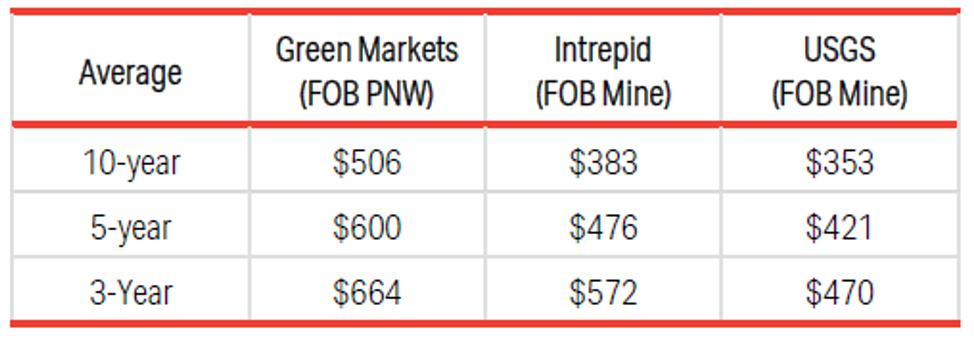
The 2025 technical report used a $450/t base case potash price FOB mine gate, which seems reasonable given the domestic sales prices in the USA. Additionally, MOP prices in the Pacific NorthWest tend to be substantially higher than in the MidWest (as also shown in the table above), further strengthening the economic thesis for a Utah-based potash project. Generally speaking, the PNW prices tend to be $100-150/t higher than the Midwest prices and the FOB Vancouver price (which is used as a standard price in the world).
The Paradox Basin in Utah: fertile hunting grounds for potash
Sage’s Flagship project is located in San Juan County in southeastern Utah not too far from the border with Colorado. The land package is part of the Paradox Basin which is located within southeastern Utah and extends into southwestern Colorado. This basin is part of the Colorado Plateau, and is characterized by cyclical successions of interbedded evaporite and clastic sediments deposited within a northwest to southeast trending, elongated basin.
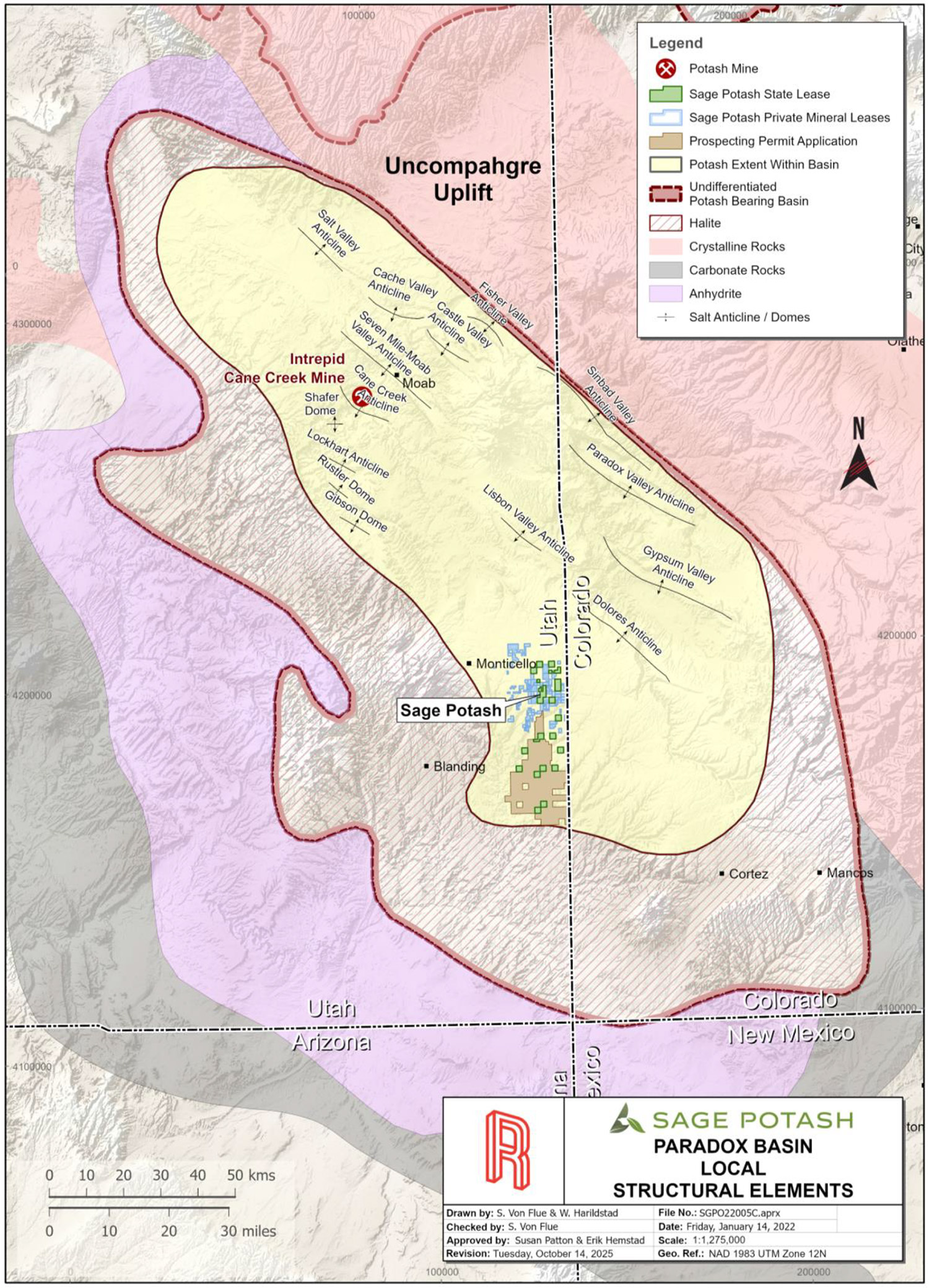
Potash was first discovered in the Basin in the Twenties, when oil and gas wells encountered thick layers of potash mineralization. This resulted in an actual underground potash mine in the Sixties where the Cycle 5 potash bed was mined. This potash bed had a thickness of approximately 3.4 meters with an average grade of 25-30% K2O. This mining operation was halted in the 70s as mining operations became difficult and the mine was intentionally flooded and converted into a solution mining operation.
Of course techniques and technology have changed drastically in the past 50 years and right now US listed Intrepid Potash (IPI) produces approximately 100,000 tons of potash per year from the flooded underground mine in the very same Cycle 5 potash bed, with an additional contribution from its activities in the Cycle 9 bed. The production rate is relatively stable at around 100,000 tonnes per year in the Paradox Basin, although Intrepid has confirmed it is becoming increasingly difficult to keep the production at the current level given the long history of the mining operations and the lower grade of the remaining mineralization in the beds.
These separate layers of potash mineralization in the Paradox Basin are called ‘cycles’, as they refer to the series of transgressive-regressive sea level changes which formed the Paradox Formation. A total of 29 of these ‘cycles’ have been identified so far (of which 17 are known to contain potash), and it is possible there are a few additional cycles unaccounted for.
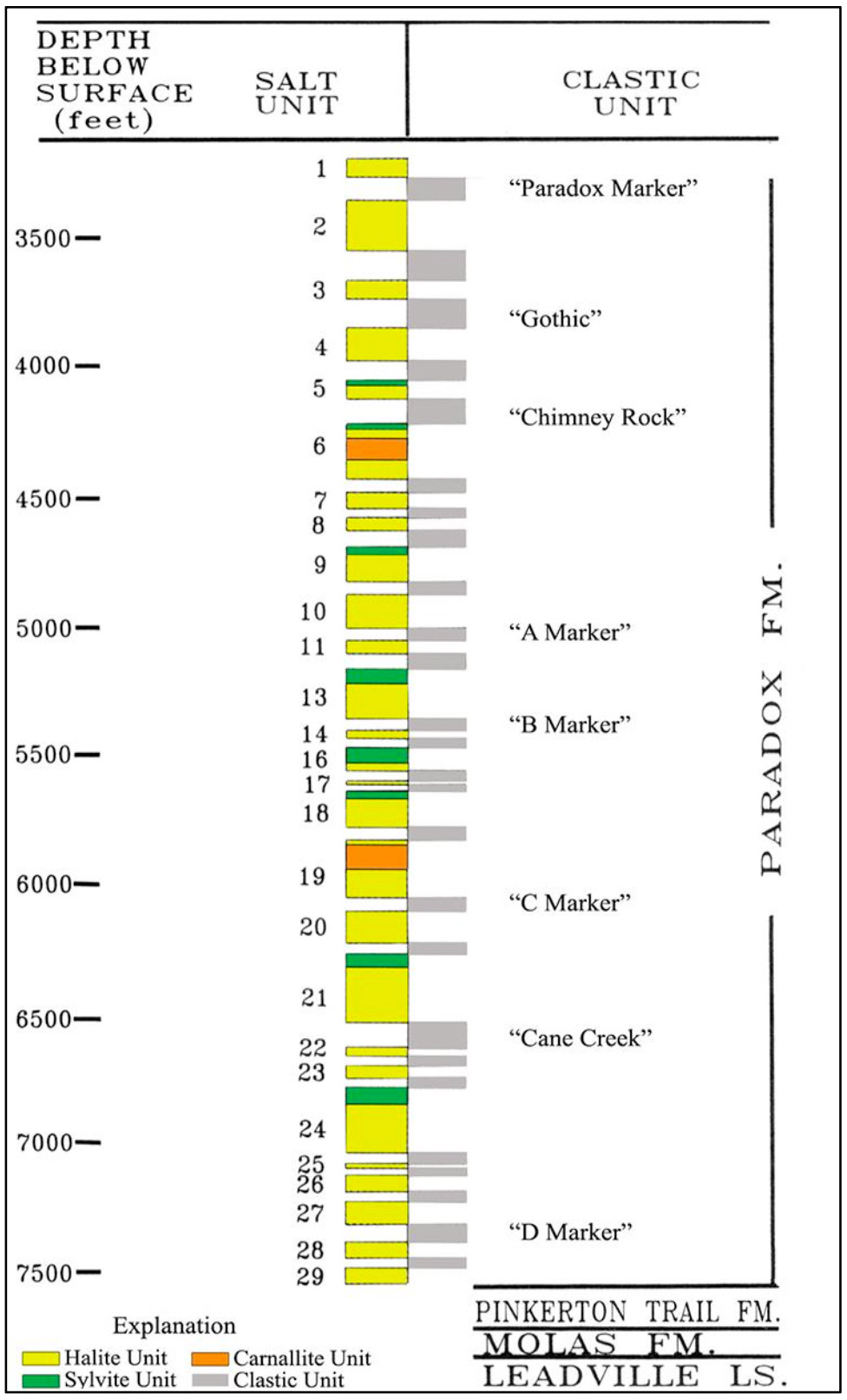
Stratigraphic Column of the Paradox Formation (Modified From Massoth and Tripp [2011]).
Sage Potash is focusing on Cycle 18 which contains an upper and a lower potash bed, separated by a barren halite zone that can be up to 10 meters thick. This was confirmed in the Johnson 1 Well, which was drilled by predecessor Sennen Potash and encountered the potash-bearing Cycle 18 Beds at a depth of approximately 2,100 meters. Additionally, the data from a historical natural gas well, located west of the Johnson 1 well, was used to improve the understanding of the geology in the area and allowed to put a resource together on the property. This resource calculation was also helped by the data provided by the 275 line kilometer 2D seismic survey, which was also completed in 2013. This seismic data was tied to historical drillholes to correlate seismic horizons with the local Project Area Stratigraphy.
Sage’s flagship project
As mentioned above, Sage’s ‘Sage Plain’ project is located in the Paradox Basin, and it’s important to realize this is not a pure early stage exploration project, but a potash project with an existing resource as well as an existing economic study. On top of that, the access to existing infrastructure makes the asset even more interesting. US Highway 491 cuts the northern portion of the property, providing easy access, while existing energy and natural gas distribution systems are nearby. Additionally, the project enjoys rail access in Moab, UT , located approximately 100 kilometers to the northwest, while there is an existing transshipment terminal in Gallup NM, about 300 kilometers to the south.
Also important: Just like Intrepid’s operations in the same basin, the project is anticipated to be mined using a solution mining method, which does not require fresh water. In fact, in order to improve mining efficiency, solution mining requires salt-saturated water, so the project could simply use brackish water for its operations. Sage Potash is permitted to draw up to 0.207 cubic feet per second (5.86 liters per second or 21 cubic meters per hour) or 150 acre-feet of brackish water annually until the end of July 2043. Developing a mine will of course require more water than what the current permit allows, but at least there is a precedent and permitting for additional water requirements should be straightforward. The 2025 PEA did not contain a whole lot of details on the water needs, but hopefully we’ll see more details in an anticipated updated study.
While both the resource and economic study will likely soon be outdated as the company is working on a new resource and economic study, it provides a tonne of data and background information and acts as a stepping stone for further improvements.
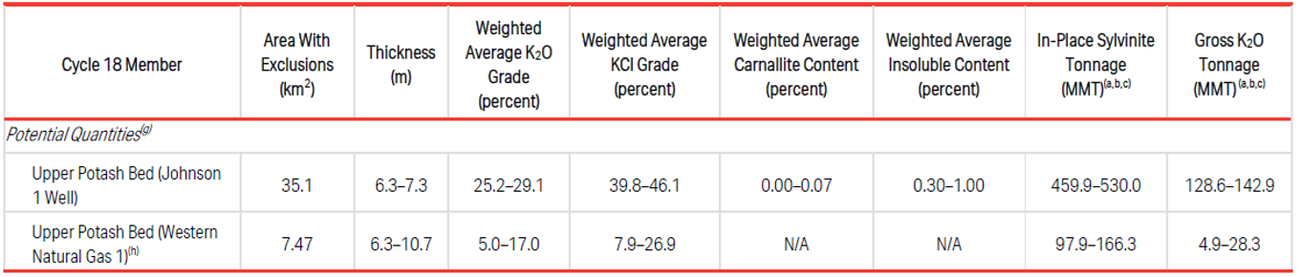
Given the consistency of the mineralized beds (and the low amount of carnallite and insoluble concentrations), only a few exploration wells are needed to bring mineralization into a resource, and as per the technical report, the Radius of Influence for the inferred resource was 0 to 2,400 meters around the Johnson 1 well, while the ‘potential quantity’ Radius of Influence stretches out to up to 5,000 meters. For resource calculation purposes, a 25% deduction was applied while a 5% K2O level was used as a cutoff grade for the resource.
The data from the 2014 hole along with 2-D seismic was used in the September 2025 resource estimate, which contains 170 million tonnes in the Upper Potash Bed and an additional 128 million tonnes in the lower potash bed at an average grade of 46.07% KCl and 35.77% KCL respectively.
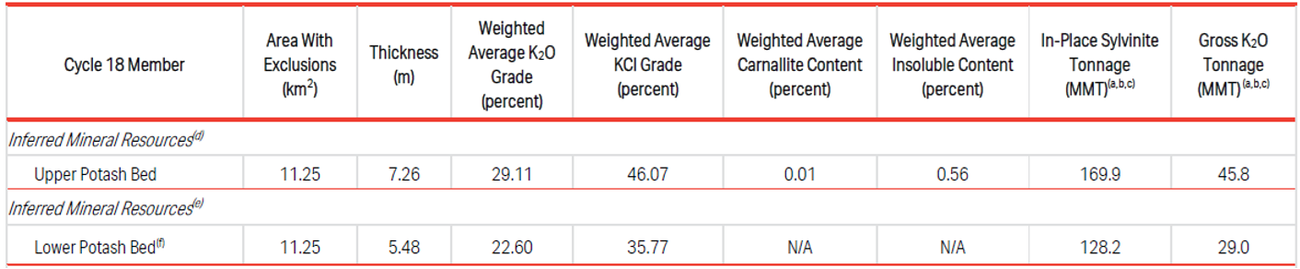
It’s perhaps worth emphasizing that a grade of 29.11% K2O in the upper potash bed appears to be one of the highest grades in North America. For comparison purposes: Intrepid Potash has an average grade of just 25% K2O which implies a KCl grade of just under 40% (as per its 2025 Annual Report). The KCl grade of 46.07% in the upper bed beats this handsomely. Additionally, the 22.6% K2O grade (or 35.77% KCl grade) in the lower potash bed has an average grade that’s nicely within a 10% variation of the average mined potash grade in the world which hovers around 33-38% KCl.
It goes without saying a higher grade provides an automatic competitive advantage over its peers.
As mentioned, a 2.4 kilometer radius was sufficient for the inferred resource calculation as per the parameters of the ‘Radius of Influence’. We also mentioned the ‘Potential Quantity ROI’ which uses a 5,000 meter radius, and this provides a total exploration target of 460-530 million tonnes in the Johnson 1 Well vicinity with an additional 98-166 million tonnes in the same bed, based on data from the Natural Gas well drilled west of Johnson 1.
That is exactly the reason why Sage Potash decided to drill a new well this year. Not only to further strengthen the confidence in the existing resource, but also to capture a portion of the exploration potential indicated above.
The location of the Peterson-1 well speaks volumes. Peterson-1 was drilled approximately 1.3 kilometers to the North-NorthEast of Johnson-1.
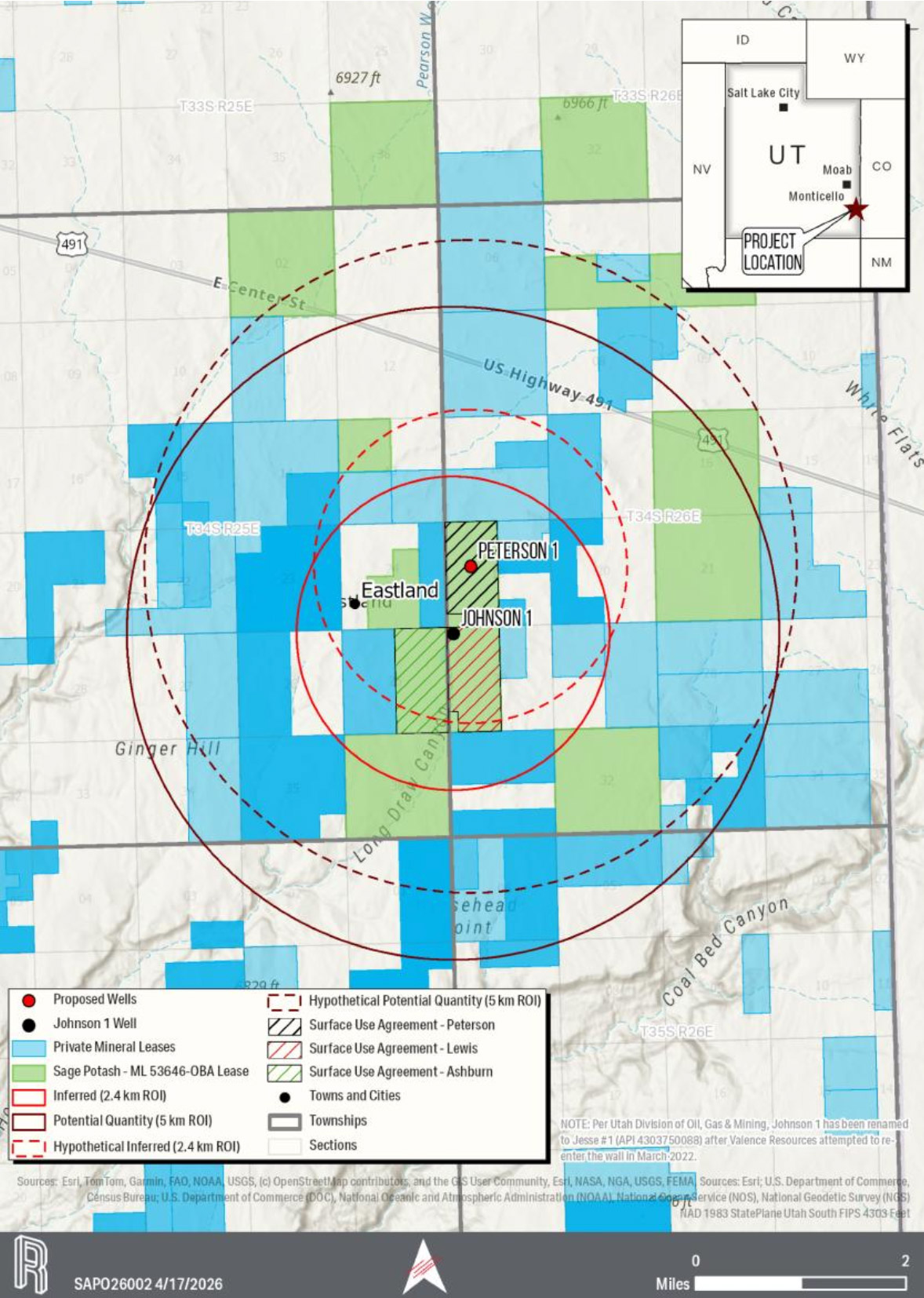
Not only will this extend the radius for an inferred resource by 1.3 kilometers towards the NNE, there also is a substantial overlap between Johnson 1 and Peterson 1 wells. This should be sufficient to upgrade a substantial portion of the current resource into the measured and indicated resource categories.
While the current PEA is based on an anticipated production rate of 300,000 tonnes per year, the new Sage Potash management is investigating the possibility to substantially increase the anticipated production rate, in order to have a more meaningful impact towards overall US domestic production numbers.
The previous management had entered into an agreement to acquire second-hand processing equipment for a total of 11M EUR, Sage Potash’s new CEO Patricio Varas renegotiated this agreement and was allowed more time by the vendor to establish its development plans and associated budget. We anticipate the 300,000 tpa processing equipment may be integrated within a production setting with a higher throughput.
In its publicly available documentation, Sage Potash mentions an anticipated resource increase and upgrade, but it also mentions it could go straight to a pre-feasibility study instead of completing another PEA. That’s indeed possible as the additional well should be sufficient for a substantial percentage of the total tonnage to end up in the measured and indicated categories, a prerequisite to distillate a reserve calculation based on the economics of the project.
Taking a step back, and looking at the outcome of the Preliminary Economic Assessment that was completed in H2 2025, the anticipated initial capex for a 300,000 tpa operation was estimated at US$155M for a standard solution mining operation, including a 17% contingency.
While this sound absurdly low, keep in mind this will be a solution mining operation. There isno need to dig shafts to reach the 2,000 meter deep mineralized zones. Production caverns are created by injecting minimally salty water to dissolve the whole sylvinite potash bed (consisting of NaCl and KCl). Once the cavern has reached the desired size the injected fluid is switched to a salt-saturated brine at a 60°C temperature to preferentially dissolve and recover the potash (the KCl). This is a much easier and cheaper way to recover the potash from the beds. This technology is used worldwide and is well-proven.
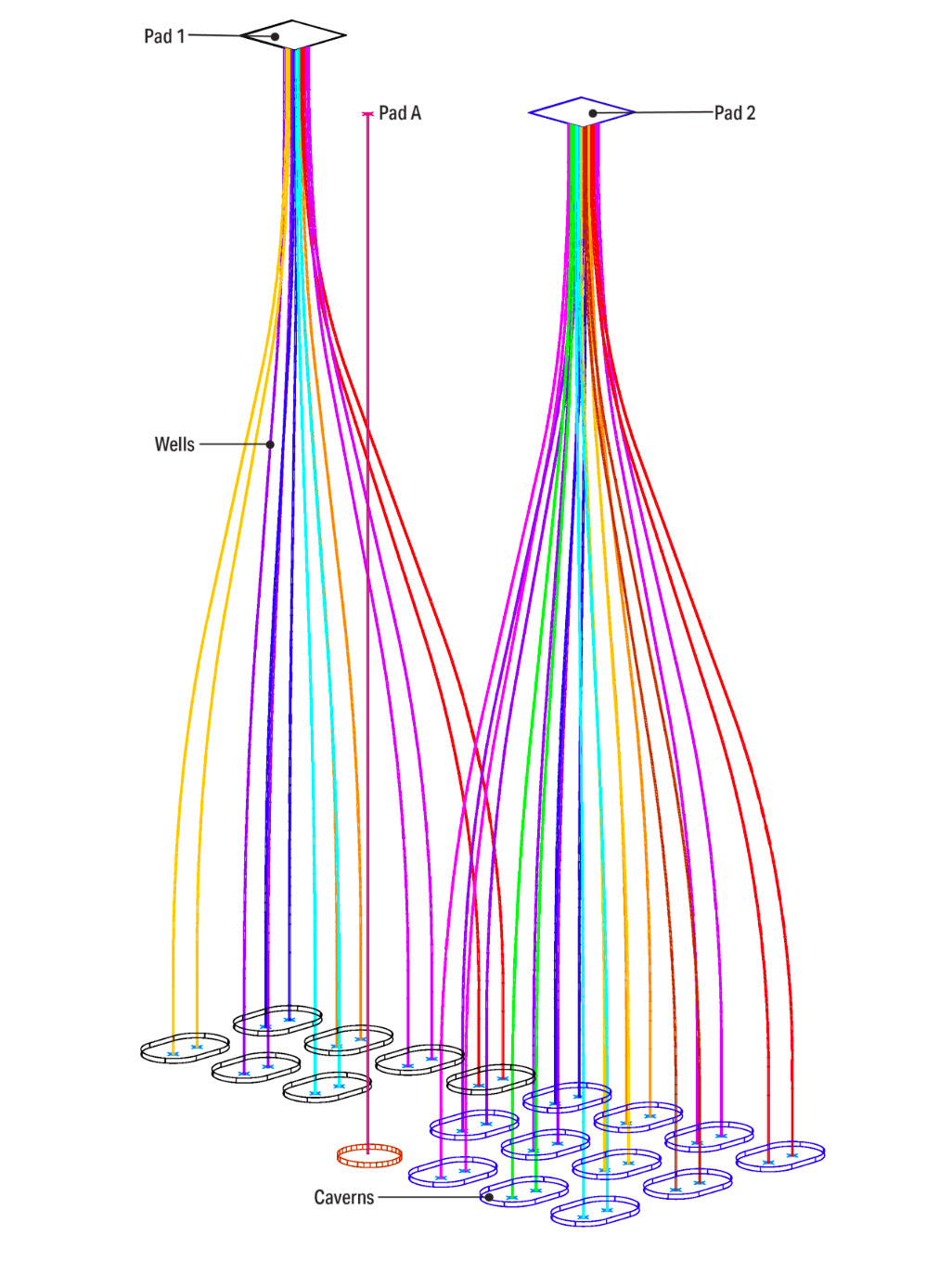
Well Pad Cavern Section Layout Showing Directional Drilling Profiles
Based on a steady state production rate of 300,000 tonnes per year, this represents a capital intensity of just $520 per tonne of annual production. That’s less than a quarter of what Nutrien describes as $2,300/t being the expected cost for a greenfield project using shaft access and mechanical mining (as per its FY 2025 MD&A), highlighting the benefits from a solution mining operation. Even very large projects with substantial economies of scale like Jansen are coming in at a capital intensity of in excess of US$1800 per tonne of capacity, as per BHP’s own website. BHP expects a payback period of 8 years at consensus potash pricing while Sage Potash indicated a 5 year payback period in its 2025 PEA.
Economies of scale should also have a (smaller) impact on the anticipated operating expenses, but given the low-cost nature of a solution mining operation, the anticipated production cost per tonne of potash is just $143.24 (with energy accounting for over half of the cost), as per the 2025 PEA. Note: this includes the impact of a 5% royalty based on a $450 sales price. Should the potash price be $100 lower or higher, there will be a $5 delta on the production cost as well.
With an anticipated sales price of $450/t on a FOB mine site basis in the base case scenario, the net margin is anticipated to exceed $300/t once the project reaches its design throughput.
Even if we don’t anticipate any additional cost savings and even if we would round up the opex to $150/t and assume a mine gate sales price of $400/t (a 10%+ discount versus the $450/t base case scenario), a 1Mtpa operation would generate US$250M per year in net operating cash flow (on a pre-tax and pre-sustaining capex basis). While this is of course just an arbitrary example and the pre-feasibility study (or perhaps feasibility study, depending on what the company’s board of directors decides to do) which should be completed in 2027 will provide more details, it’s important to realize Sage Potash isn’t starting from scratch. After bringing in Pat Varas as its new CEO, the focus has shifted towards moving this project forward as fast as possible, and we are looking forward to seeing an updated resource calculation, and an updated economic study.
Management
Patricio Varas, CEO & Director
A Professional Geoscientist and Mining Executive with over 39 years’ experience in mineral exploration, mine development and corporate management. He has extensive experience in developing precious and base metal exploration and mining projects around the world. He has played integral roles in the discovery of world class mineral deposits and mines (Santo Domingo Sur Cu-Fe in Chile, Diavik Diamonds – NWT, and Milestone Potash – Saskatchewan), delivery of major feasibility studies and has overseen significant mineral asset sales and corporate transactions.
Martin Burian, VC Corporate Development
Mr. Burian, CPA, ICD.D has 35 years of experience in finance, investment banking, and operational strategy. He has great depth of experience in financing mining exploration and development companies having done so as Managing Director of Investment Banking for the firms Canaccord Capital, Bolder Investment Partners, Haywood Securities and RCI Capital Group. His management acumen is demonstrated through his tenure as President of Bolder Investment Partners and as CFO of Heffel Gallery Limited. Mr. Burian holds the designation ICD.D from the Institute of Corporate Directors and obtained his Chartered Professional Accountant and Chartered Business Valuator designations early in his career at KPMG where he advised on mergers, acquisitions and divestitures as a member of the corporate finance advisory services group.
Greg Vogelsang, VP Project Development
Greg Vogelsang, P. Geo, P.Eng. is sole practitioner and owner of consulting firm Earthview Environmental Engineering Ltd. He is registered as a Professional Geoscientist and Professional Engineer and has over 35 years’ experience in the mining and oil and gas industries in Canada and internationally He has extensive experience related to mine developments in the potash, uranium and gold sectors while working in both the public and private sectors. Greg was actively involved in all aspects of the Western Potash Milestone selective solution mining project and gained valuable experience during the exploration, environmental assessment and construction phases of the project.
Bill Grossholz, CFO
Mr. Grossholz, CPA, CA has been a Chartered Accountant for 40 years and has a strong financial management, administration, accounting and tax background. He is the interim Chief Financial Officer of Sage Potash Inc. Mr. Grossholz has been involved in the listing of numerous private companies on public stock exchanges. He has been a director of publicly listed companies Rift Valley Resources Corp, (RVR:CSE), Caiterra International Energy Corp. (CTI:TSXV) and Lions Gate Lighting Corp. (LGLC:OTC). He has also been a founder and Chief Financial Officer for businesses in the mineral exploration, power development, real estate development and telecommunications sectors.


Balance sheet
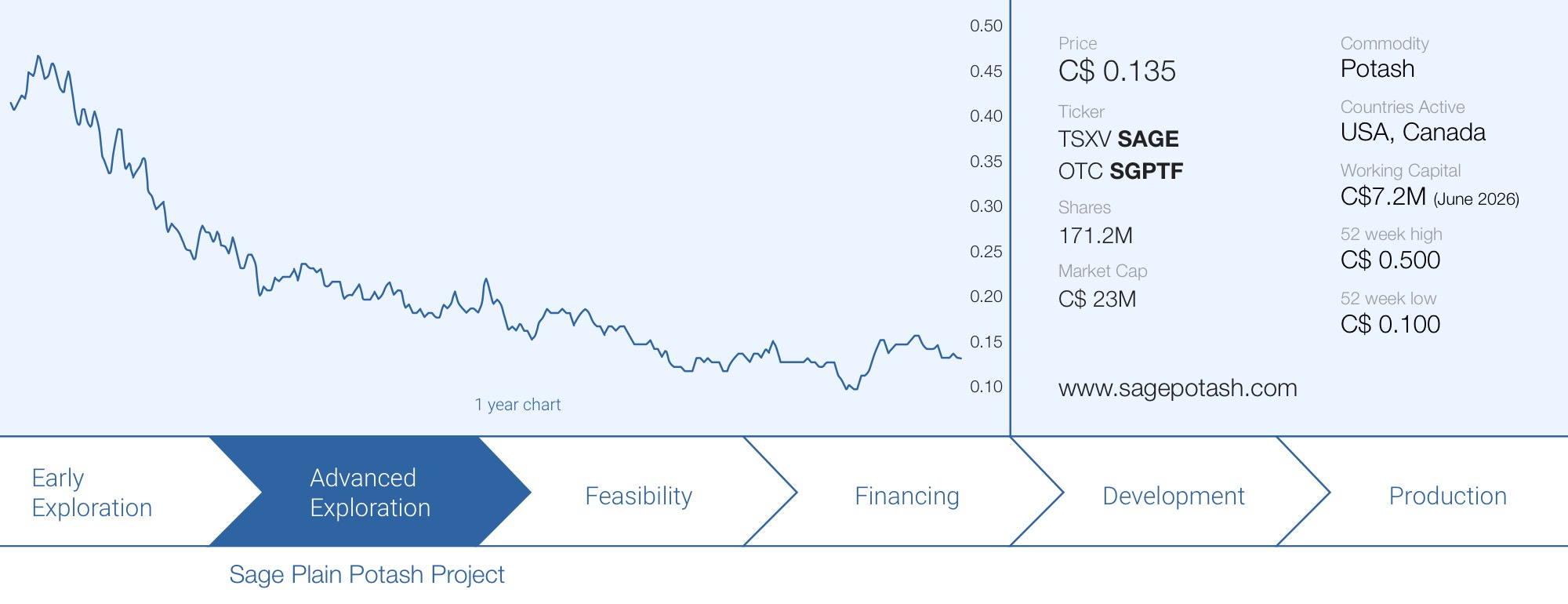
Sage Potash is in good financial shape. At the end of June, the company had a positive working capital position of C$7.2M and C$5.3M in cash. The working capital position also includes C$3.46M in deposits made on the processing equipment that is to be acquired as part of the 11M EUR agreement, mentioned earlier in this report.
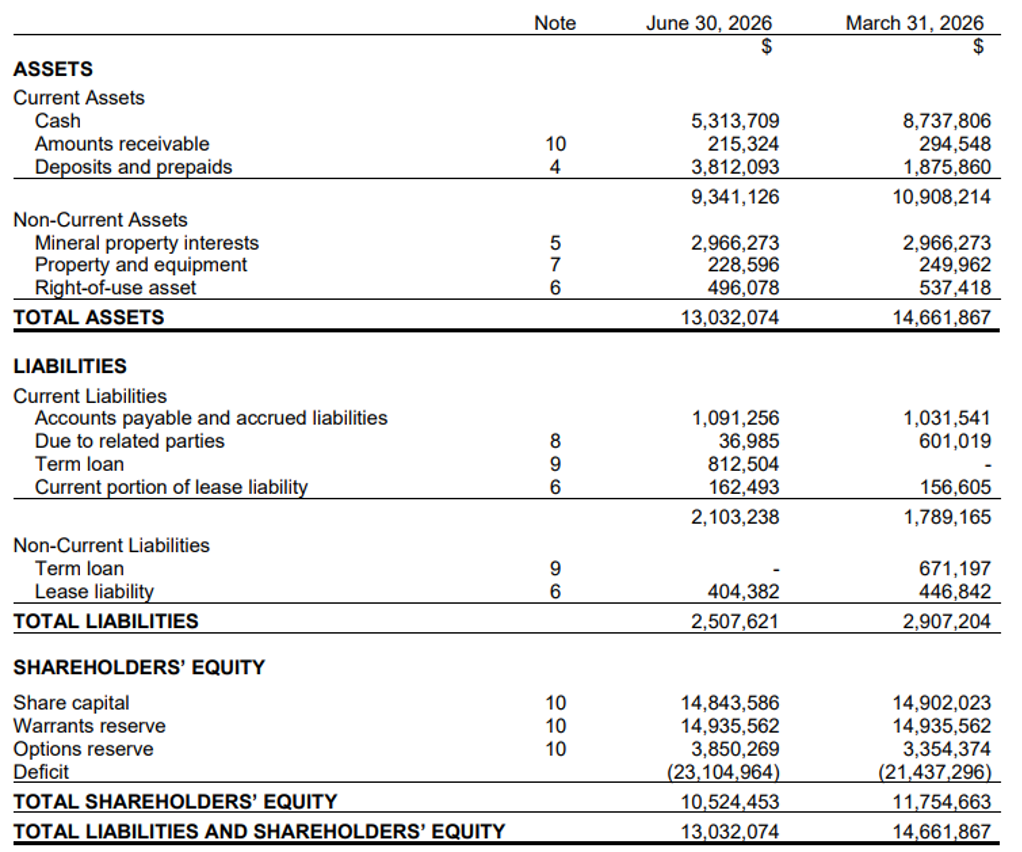
The healthy working capital position was achieved thanks to a C$13M raise completed in two tranches in December 2025 and January 2026. 65.03 million units were issued at C$0.20 per unit with each unit consisting of one common share and a full warrant. Each full warrant allows the warrant holder to acquire an additional share at C$0.30 during a three year period. If exercised, this would bring in C$19.5M in extra cash, but the share price first needs to (more than) double before these warrants are in the money. There are also 16.65 million options outstanding at a weighted average price of C$0.22 per option(with the bulk of the options having a C$0.20 exercise price. As of right now, all 104.6M ‘dilutive’ instruments (options and warrants) are out of the money.
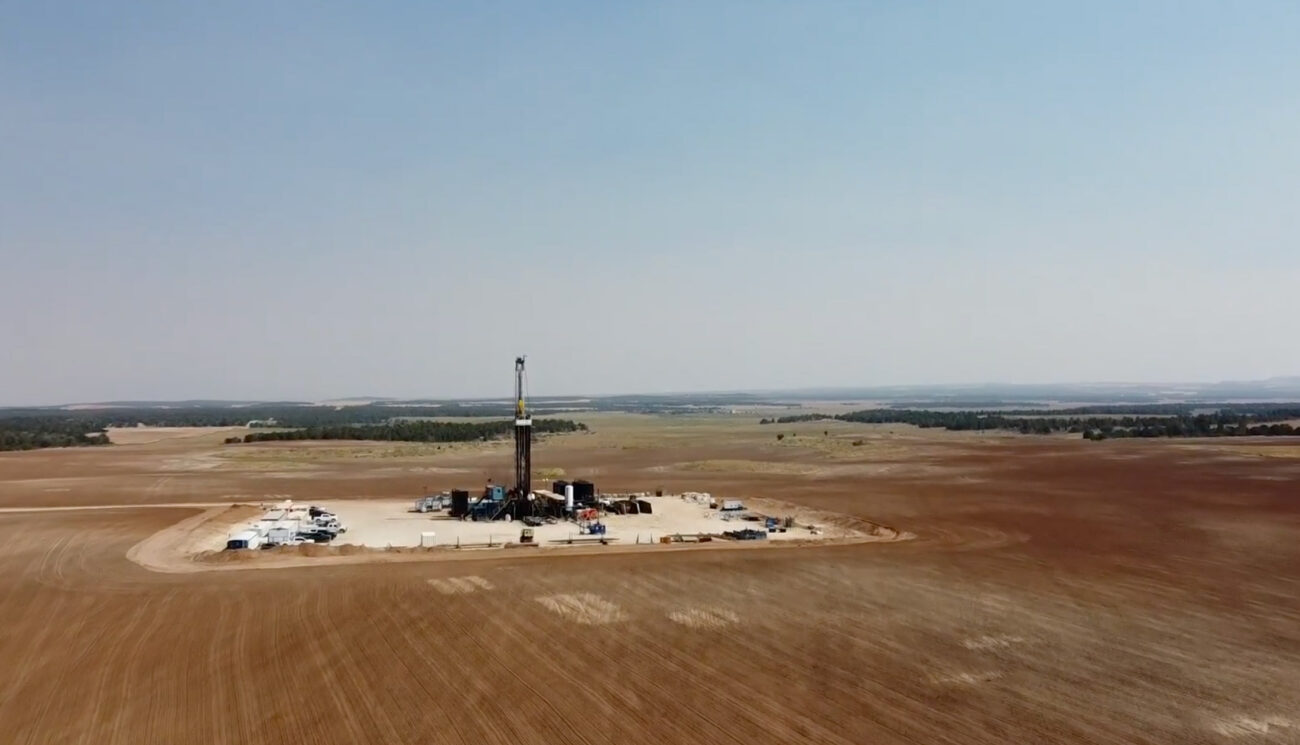
While the June balance sheet contains plenty of cash, drilling a 2,100+ meter deep well isn’t exactly cheap and will likely consume a good portion of this cash. We anticipate the company to go back to the market to raise money in the fourth quarter, and hopefully it can catch a tailwind from its catalyst-rich period.
Conclusion
Sage Potash is sitting on what appearsto be not only the highest grade potash deposit in the United States but also the most rapidly advancing project owned by a junior mining company. While there is an existing resource estimate as well as an economic study on the property, we expect the storyline to change drastically in the next year or so as the company is working towards an updated resource calculation.
Sage Potash doesn’t really keep it a secret it expects the existing resource to grow rather substantially, and this should underpin an updated economic study where the focus will be on developing a larger potash mine than the 300,000 tonnes per year that was anticipated in the 2025 PEA.
As the plans are being developed and as more progress is being made on the project, we hope to see additional political support for a domestic source of potash, which has in fact already been designated a critical mineral in the United States. We have seen substantial political support, grants, and domestic partners in for instance the US lithium space, so there definitely are templates available to provide critical mineral projects that are worth developing a welcome push in the back.
The next three to six months will define the future for Sage Potash, and the company’s ambition is to advance the project through the required studies to hopefully prove the economic viability of what would be the largest potash mine in the USA. The high-grade nature of the deposit in combination with the closer proximity to end-users in the Pacific Northwest provides the company and project with two competitive advantages.
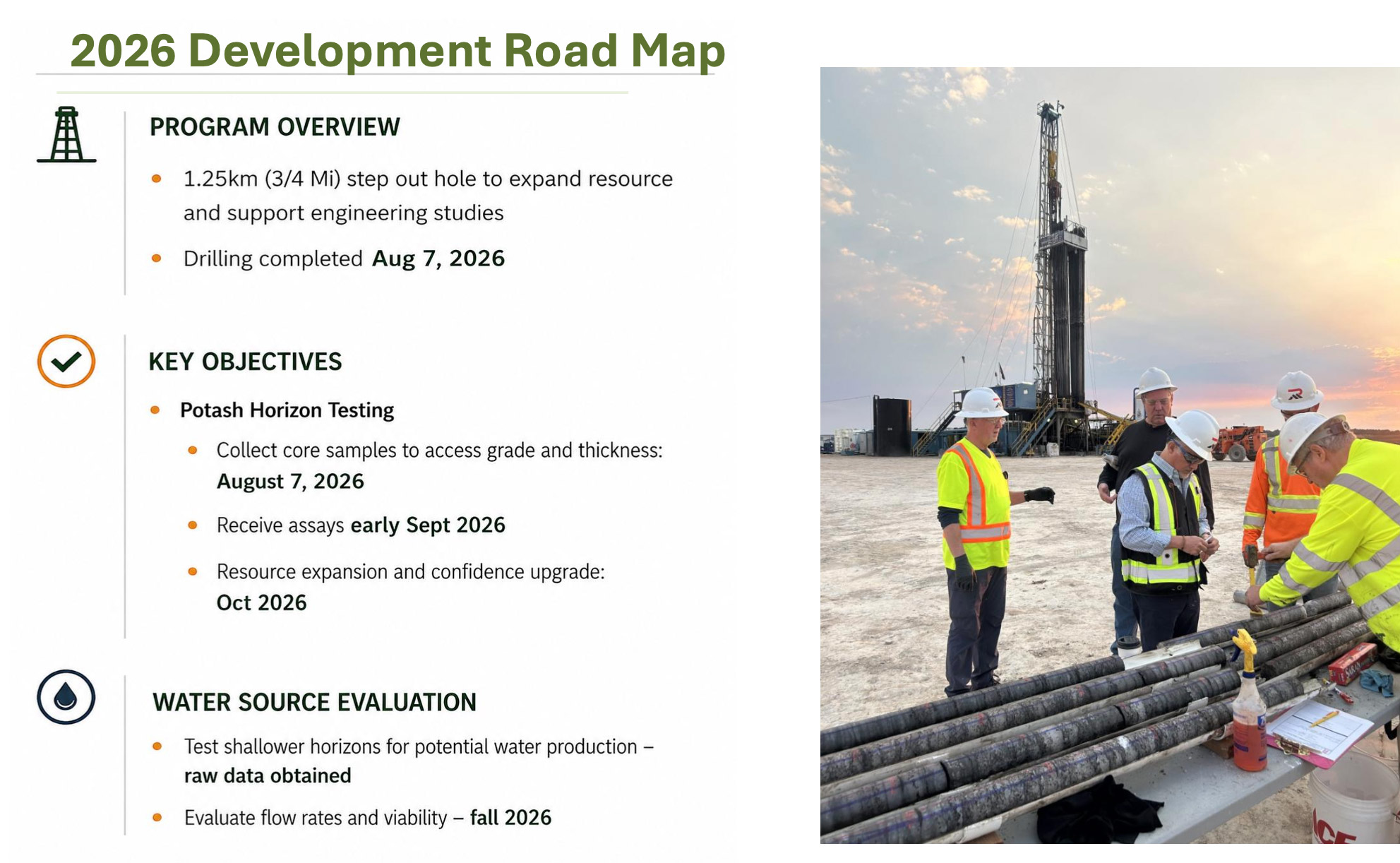
The next few catalysts will be to see assay results from the Peterson-1 well, which will result in an updated resource calculation. The updated resource will subsequently be the backbone of a new economic study on the Sage Plain project.
Disclosure: The author has a long position in Sage Potash. Sage Potash is a sponsor of the website. This post is for educational purposes only; be mindful investing in junior mining stocks is risky and you may lose your entire investment if things go wrong. Please read the disclaimer.