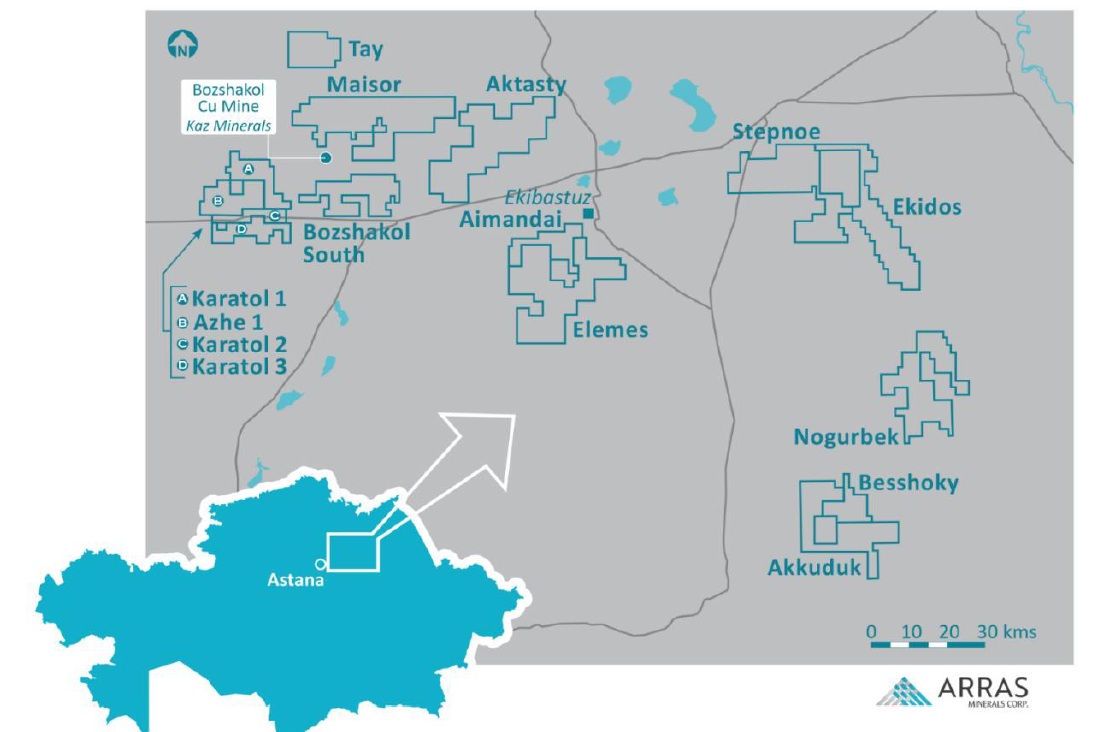
Although the copper component of the recent exploration success at Arras Minerals (ARK.V) is one of the key reasons why we are interested in the company, in last week’s update, Arras provided an update on its K-Ozek gold target, located directly east of the Berezski trend.
The headline result was impressive: the drill bit intersected 22.8 meters of 5.37 g/t gold, including an even higher grade zone with 6.1 meters containing 17 g/t gold. Not all holes encountered mineralization with this very high grade, but with 229 meters of 0.3 g/t gold starting at surface and 40 meters with an average grade of 0.83 g/t gold (including 2 meters containing 12.65 g/t gold), it is clear Arras Minerals is onto something at K-Ozek. Not only is the presence of high-grade gold in the epithermal system confirmed, the mineralization also appears to be more widespread than initially thought as the gold mineralization occurs across several broad areas and is not confined to a single isolated structure.
This also has consequences for the exploration approach at K-Ozek; the company’s technical team now believes there may be another porphyry system preserved at depth beneath K-Ozek. This theory will obviously have to be drill-tested to see if the theory that K-Ozek is a down-dropped block between Berezski North and Berezski Central holds. If that’s the case this could pave the way to drill some deeper holes to drill-test the porphyry zone.
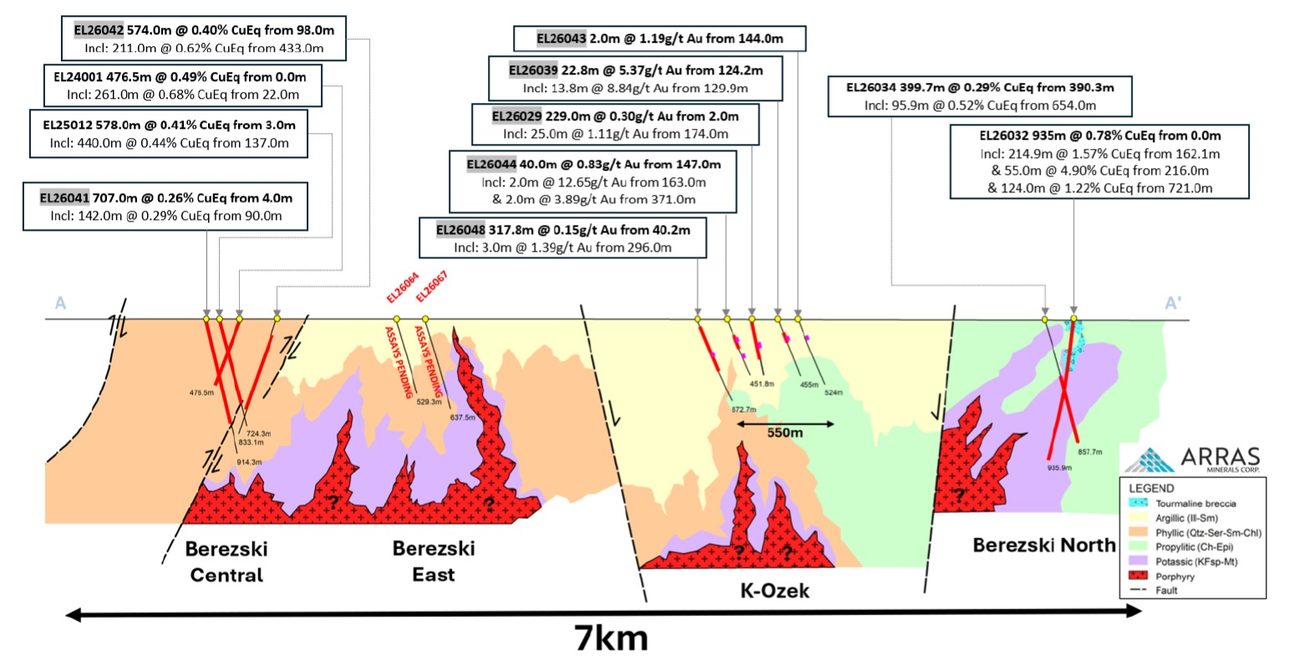
As CEO Tim Barry stated in his management commentary; the results are starting to bring the Berezski trend together geologically and the company has now outlined three substantial porphyry systems at or near surface over a 7 kilometer strike length.
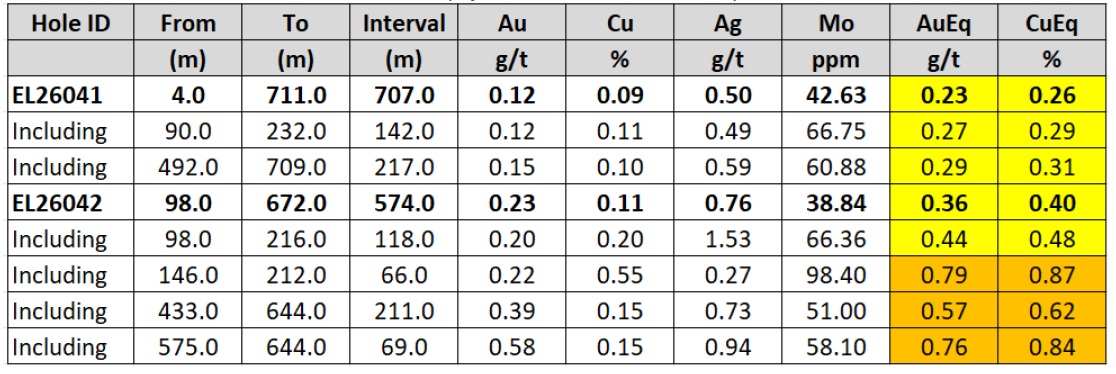
We would almost forget the company also released the assay results from two holes at Berezski Central. Hole EL26042 yielded 574 meters at an average grade of 0.40% copper-equivalent (0.11% copper and 0.23 g/t with a small 39 ppm molybdenum credit). This hole also contained higher grade mineralization with for instance 66 meters containing 0.87% copper-equivalent and 211 meters at a 0.62% copper-equivalent grade.
Meanwhile, hole EL26041 hit 707 meters containing 0.26% copper-equivalent (consisting of 0.09% copper and 0.12 g/t gold). As the table below shows, this interval also contained slightly higher intercepts such as 142 meters of 0.29% copper-equivalent and 217 meters of 0.31% copper-equivalent.
These gold-copper holes represent more of the same, and further confirm the mineralization is widespread all over the district. While the grade is relatively low, as explained in our previous report (which you can re-read here), the low cost of power in Kazakhstan makes even lower-grade deposits economical. Neighbor KAZ Minerals, for instance, is quite profitable processing a similar type of copper-gold rock.
Arras Minerals currently has four diamond rigs working at Elemens, but unfortunately the labs used by Arras Minerals are backed up with turnaround times taking up to 5 months (!). There is some improvement in sight, but it looks like the news flow might be a bit slower than we initially had anticipated and hoped for.
Patience is a virtue though, and we believe the current four rig, 40,000 meter drill program will provide the company with a tonne of data that will help to further refine the exploration approach at this district-scale gold-copper opportunity.
Disclosure: The author has a long position in Arras Minerals. Arras is a sponsor of the website. This post is for educational purposes only; be mindful investing in junior mining stocks is risky and you may lose your entire investment if things go wrong. Please read the disclaimer.