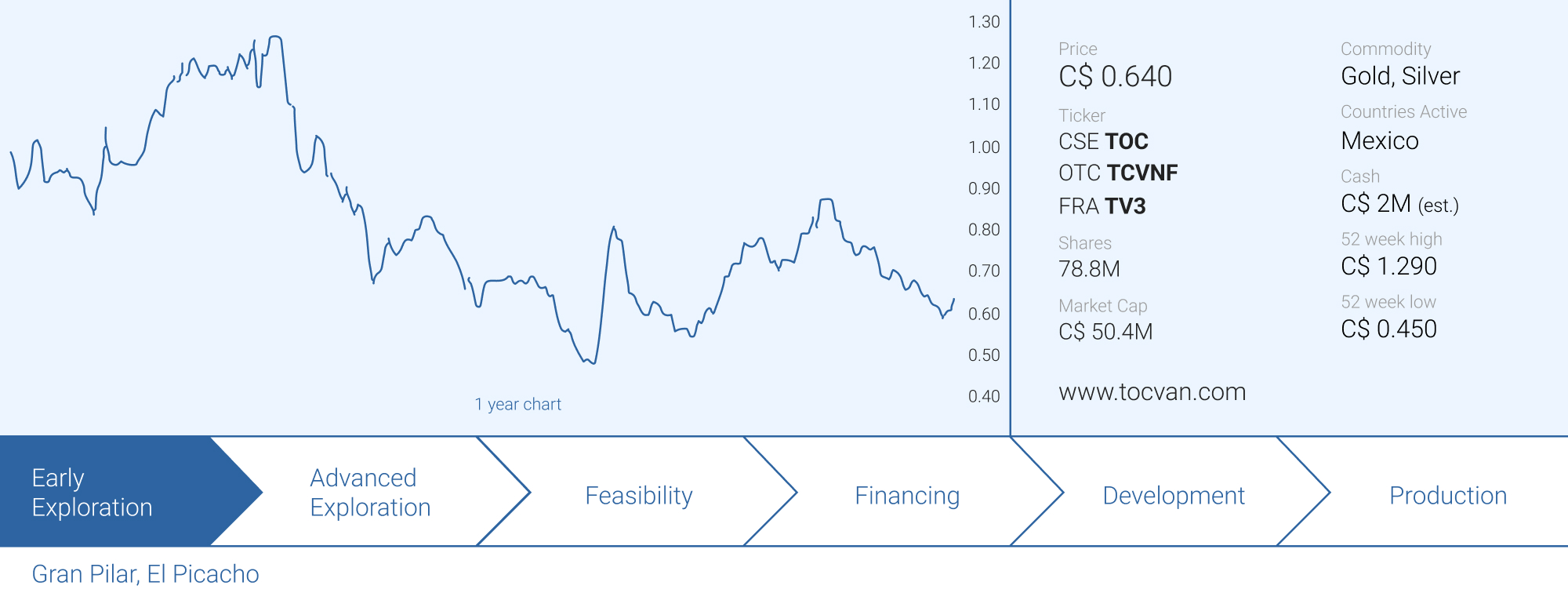
Tocvan Ventures (TOC.C) is in the final stages of completing its pilot plant on the Gran Pilar flagship project in Mexico’s Sonora state. The 50,000 tonne bulk sample program should be completed in the first half of next year and provide the company with valuable information and data on recovery curves as this will be a real-world test to replicate the results of column leach test results.
Meanwhile, the company will continue to drill. While we were initially expecting the company to work on a maiden resource estimate at Gran Pilar, recent encouraging drill results at the newly discovered El Mezquite zone could change the perception of the project as a whole. As the market tends to be backward-looking it wouldn’t benefit nor the company nor its shareholders to prematurely release a resource that will be outdated by the time it gets published.
Tocvan recently appointed a new CEO, and we sat down with Chris Gordon to discuss the plans for Tocvan Ventures, and his reasons to join the company.
Sitting down with CEO Chris Gordon
GRAN PILAR
Let’s discuss the pilot plant first. How are the construction activities going, and can you elaborate on the timeline towards production, and by when you’d consider the test work on the 50,000 tonnes to be completed?
Construction is progressing well, and we’re still targeting completion of the pilot facility in November, with our first production run expected to begin shortly thereafter.
We’ve made significant progress on the heap-leach pad, solution ponds, and associated infrastructure, while continuing to prepare and stockpile mineralized material for processing. We’re now moving through the final stages of construction as we prepare for commissioning.
It’s important to distinguish between first production and completing the entire 50,000-tonne pilot program. Our initial production run will be a significant milestone for Tocvan, but the broader objective is to demonstrate the project’s metallurgy at a meaningful scale and establish actual operating costs, recovery rates, and processing efficiencies.
Our recent column testing involved approximately 77 days of active leaching, which provides a useful reference for the initial processing cycle. However, the timeline for completing the full 50,000-tonne program will depend on operating conditions and the information we gather as production progresses.
You recently announced recovery rates of 82% gold and 58% silver from a column leach test program, indicating recovery rates increase sharply using a finer crush size. Are you planning to apply a similar crush size in your pilot plant to confirm these recovery rates on a larger scale?
We were very encouraged by the column leach results, particularly the strong gold recoveries achieved at both crush sizes.
At a ¾-inch crush size, we achieved approximately 75–76% gold extraction, while the finer ⅜-inch crush increased extraction to approximately 82%. These results compare favourably with our earlier bulk testing and provide us with greater confidence in the metallurgical characteristics of the material.
For the initial pilot operation, we’re currently leaning toward using a ¾-inch crush size. Although the finer crush delivered approximately six percentage points of additional gold extraction, we need to consider the additional crushing costs and the potential impact on heap permeability and leach performance.
Another particularly encouraging result was that agglomeration did not materially improve recoveries. Eliminating that processing step could simplify operations and reduce reagent consumption, which would be beneficial when evaluating a larger commercial facility.
Ultimately, the pilot operation will help us evaluate these results at a much larger scale. Our objective isn’t simply to achieve the highest possible recovery percentage, but to determine the processing configuration that delivers the best overall economics.
What is your game plan after completing the pilot plant phase?
Our primary focus has always been, and will continue to be, resource growth. We believe the greatest opportunity to create shareholder value lies in demonstrating the full scale of the gold and silver potential across our 22-square-kilometre Gran Pilar property.
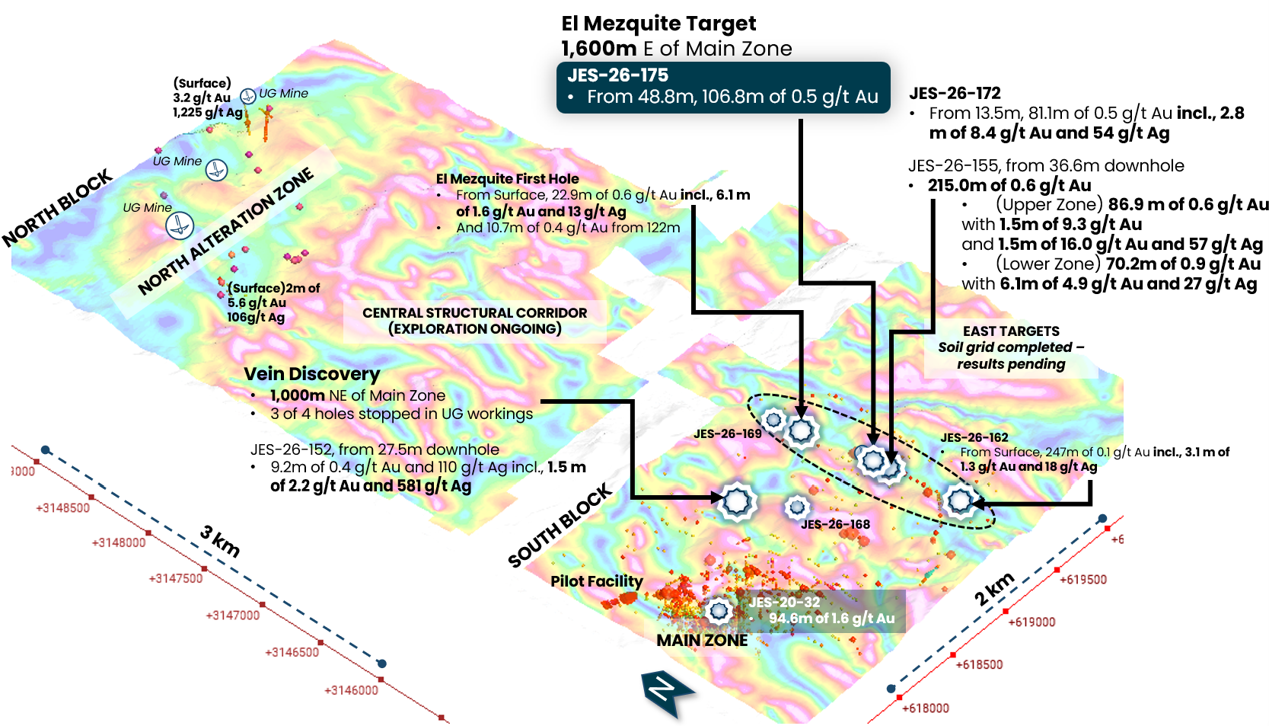
What’s particularly exciting is that we now have multiple areas where we see significant opportunities to expand the known mineralization. At El Mezquite, we have identified a mineralized trend extending approximately 1.4 kilometres, with broad intervals of near-surface gold mineralization. We’re still in the early stages of understanding the full extent of this system, and additional drilling will be a major priority as we work toward defining a substantial resource.
Equally important is our recent consolidation of 100% ownership of the original Pilar concessions. There are several promising targets within the approximately one-square-kilometre Main Zone that we’ve wanted to drill for some time. However, while the previous joint venture was in place, we made the strategic decision to hold off on additional drilling rather than invest capital in adding value to an asset we didn’t fully own. Now that we have consolidated ownership, we’re excited to return to those targets and pursue opportunities to expand the known mineralization beyond the existing Main Zone footprint. We believe there is considerable potential to add meaningful ounces in an area where we already have a strong understanding of the geology.
Beyond the Main Zone and El Mezquite, we’re seeing encouraging signs of additional discoveries across the property. Our initial rock sampling in the Central Corridor has already identified a new mineralized trend extending over one kilometre in strike length, approximately four kilometres north of the Main Zone. Early samples returned values of up to 2.4 g/t gold and 67 g/t silver, and we’re looking forward to receiving additional soil and rock sampling results to further refine our targets for follow-up drilling.
We also see considerable potential in the North Alteration Zone, which covers an area approximately 3.2 kilometres by 1.5 kilometres for almost five square kilometers. Early exploration has identified several prospective targets, and we intend to continue advancing exploration across this largely underexplored area, including drilling as targets are refined.
When you consider these additional targets alongside the Main Zone and El Mezquite, you begin to appreciate just how much exploration potential remains across our 22-square-kilometre property. We’re not simply looking to expand a single deposit. We have multiple opportunities to add ounces across what we believe could become a district-scale gold and silver system.
The pilot mine complements this strategy. The heap-leach pad we’re constructing has the capacity to accommodate approximately 250,000 tonnes of material, and we envision the possibility of operating the facility approximately once per year, subject to securing the necessary approvals for additional processing campaigns.
We’re targeting approximately 1,000 ounces of gold from the initial 50,000-tonne program. If we’re able to increase permitted tonnage to 100,000 or 150,000 tonnes in subsequent campaigns, the potential revenue could provide meaningful capital to help fund continued exploration and development.
Ultimately, resource growth is what we believe will drive the greatest long-term value for shareholders, and the pilot mine gives us an opportunity to help fund that growth while reducing the technical risks associated with a future larger-scale operation.
In your press release you mention that more test work will be conducted ‘at the request of several major buyers evaluating your material’. What do you mean with ‘major buyers’? Low-grade oxide-hosted gold mineralization cannot easily be shipped, so who would want to buy ‘your material’?
That’s a fair question, and I think it’s important to clarify what we’re referring to.
We’ve had discussions with a couple of groups interested in purchasing loaded carbon from our operation, rather than unprocessed, low-grade mineralized material.
The objective is to process our mineralized material on-site through the heap-leach operation, recover the dissolved gold and silver onto activated carbon, and potentially sell that loaded carbon to a third party for further processing and precious-metal recovery.
This could provide an alternative to completing all of the downstream processing and refining ourselves, depending on the commercial terms and economics.
The additional testing is intended to provide potential buyers with the technical information they require to evaluate the product and establish appropriate commercial terms.
Ultimately, we’re evaluating different options to determine the most efficient and economically attractive way to recover and market our gold and silver production. Having potential buyers interested in a loaded-carbon product gives us additional flexibility as we move toward production.
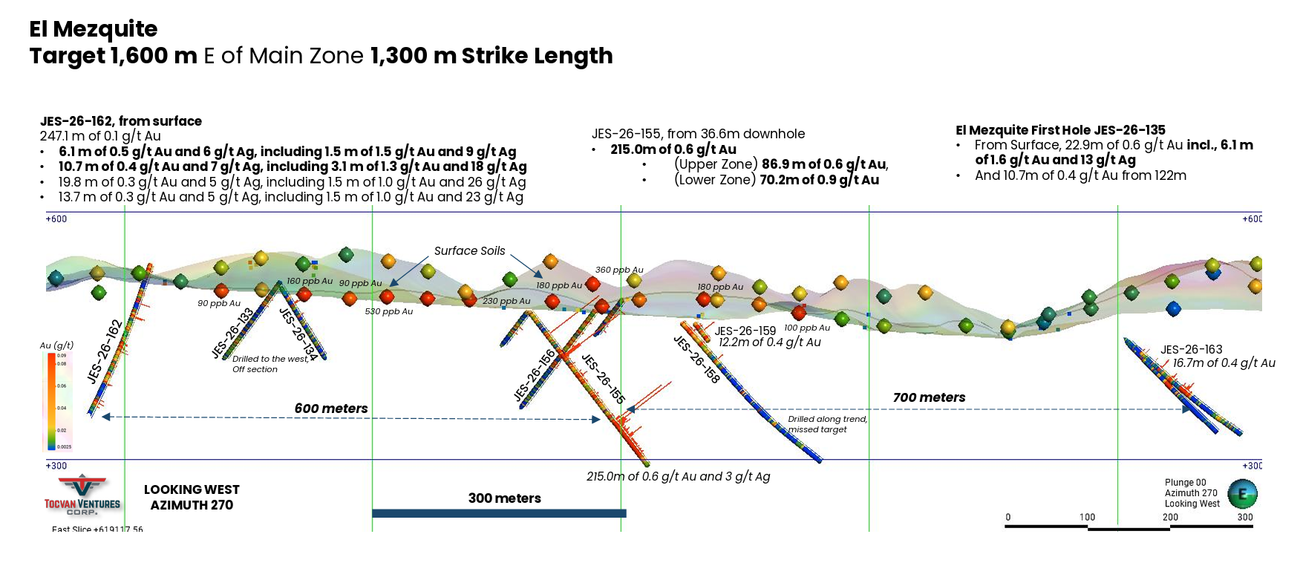
Let’s talk about exploration for a minute. Your new 1.4-kilometre-long El Mezquite trend is starting to look promising (48 metres of 0.8 g/t gold, 107 metres of 0.5 g/t gold). Can you elaborate on the next steps on this zone to put more meat on the bone there and further increase your confidence in the mineralization?
El Mezquite has quickly become one of the most exciting developments at Gran Pilar.
The results we’ve seen so far suggest we’re dealing with a substantial mineralized system, and what’s particularly encouraging is the scale of the trend we’re beginning to identify.
We already have some very compelling drill intercepts, including broad intervals of near-surface gold mineralization, but we’re really only beginning to understand the full extent of the system.
Our next steps involve systematic drilling to better establish continuity, grade distribution, geometry, and depth potential. We’re also continuing geological mapping and geochemical sampling across the broader property to identify additional targets. We’ve been preparing access and drill locations at El Mezquite to support the next stage of exploration.
What really excites me is the broader implication of this discovery. The original Main Zone represents a relatively small portion of our approximately 22-square-kilometre land package. If we can continue demonstrating meaningful mineralization at El Mezquite and other targets across the property, it has the potential to fundamentally change how investors view the scale of Gran Pilar.
Again, we are not simply trying to expand a single deposit. We’re exploring what we believe could be a much larger, district-scale gold and silver system.


Former CEO Brodie Sutherland was moving in the direction of publishing a resource estimate after this year’s drill program. How do you feel about that? Is a maiden resource one of your top priorities, or do you first want to drill out El Mezquite?
Brodie, who now moved to an Executive Chairman position, and I have had a number of discussions regarding the timing of our maiden resource estimate, and we’ve ultimately decided that additional drilling is warranted before moving forward with its publication.
The results we’re seeing at El Mezquite are very encouraging, and I think the market is beginning to recognize the potential scale of this emerging discovery. With a mineralized trend extending approximately 1.4 kilometres, we believe there’s a significant opportunity to add meaningful ounces to the overall resource potential at Gran Pilar.
Equally important is our recent consolidation of 100% ownership of the original Pilar concessions. We haven’t conducted significant drilling at the Main Zone for several years, as we were focused on resolving the previous joint venture ownership structure. Now that we’ve acquired the remaining interest, we’re in a position to return to the Main Zone and aggressively pursue opportunities to expand the known mineralization.
A maiden resource estimate remains an important milestone, but we don’t believe there’s a compelling reason to rush into publishing a smaller initial resource when we see significant opportunities for growth at both El Mezquite and the Main Zone.
Our objective isn’t simply to establish a resource. It’s to build a substantial gold and silver resource that better reflects the potential of Gran Pilar and positions Tocvan for the next stages of development. We believe the additional drilling could ultimately result in a more meaningful maiden resource estimate and create greater long-term value for shareholders.
CORPORATE
Chris, we have known you since your Integra Gold & Integra Resources days. What made you decide to join Tocvan?
I spent approximately 12 years with Integra, and that experience provided me with a tremendous understanding of what it takes to build a successful exploration company and create meaningful shareholder value.
Being part of the Integra Gold story, which ultimately culminated in the company’s approximately C$600 million acquisition by Eldorado Gold, was particularly rewarding.
One of the biggest lessons I took away from that experience was the importance of combining a strong geological opportunity with disciplined execution, access to capital, and a clear corporate strategy.
When I began looking closely at Tocvan, I saw a number of those same ingredients. We have an established gold discovery, a large land position in one of Mexico’s most established mining jurisdictions, an emerging second discovery at El Mezquite, and something relatively unusual for a junior exploration company: a fully permitted pilot operation approaching production.
That combination really stood out to me. I also saw an opportunity to bring my corporate development and capital markets experience to a company entering what could be a very important period of growth.
What attracted me wasn’t simply the opportunity to join another exploration company. It was the opportunity to help build a much larger business around an asset that I believe has considerable unrealized potential.
As the teams in the field are working towards getting the pilot plant up and running, what is your main focus point? Getting the word out on the exploration and production potential here?
Investor awareness is certainly an important part of my role, but I look at my responsibilities much more broadly than simply telling the story. My primary focus is ensuring Tocvan has the capital, technical expertise, strategic relationships, and corporate direction necessary to execute our plans.
We have an excellent technical team in Mexico, led by Rodrigo Calles-Montijo, and Brodie continues to provide valuable leadership and geological insight as Executive Chair.
That allows me to concentrate a significant amount of my attention on corporate strategy, financing, institutional investor relationships, and evaluating potential strategic opportunities.
One of the things I believe the market has yet to fully appreciate is how much the Tocvan story has evolved. We’re not simply an exploration company drilling an early-stage gold target. We’re advancing a permitted pilot operation toward production while simultaneously expanding what we believe could become a substantial gold and silver resource.
My responsibility is to make sure we have the financial and strategic foundation to advance both opportunities successfully. Of course, communicating that progress effectively is important, but ultimately I believe the best way to build investor confidence is through execution and delivering meaningful results.
While being allowed to run a 50,000-tonne pilot plant operation is great, may we assume there still is some reluctance towards investing in open-pit mining in Mexico? How have you seen the political climate change in the past few quarters?
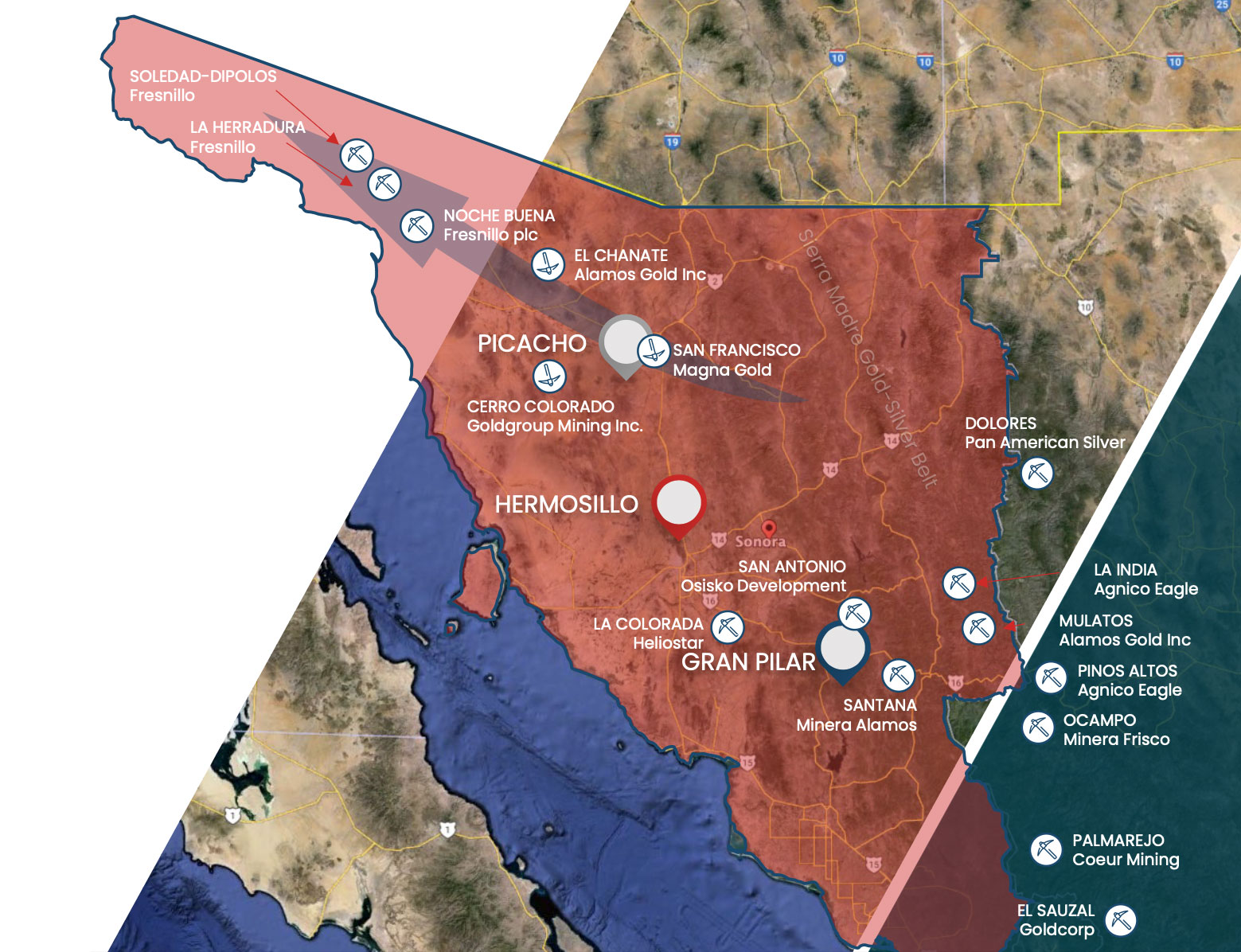
There’s no question that Mexico has experienced regulatory uncertainty in recent years. However, we’ve seen some very encouraging developments over the past couple of years, with permitting activity accelerating and a number of mining companies receiving approvals for new construction, mine expansions, and restarts throughout Sonora and other parts of Mexico.
Our own experience at Gran Pilar has been very encouraging. We received the infrastructure permit for our pilot mine in approximately 30 days, and that permit is valid for 10 years. We subsequently received approval for the 67 trenches that will supply material for our initial 50,000-tonne processing campaign in approximately two weeks.
We’re also seeing positive developments elsewhere in Sonora. Heliostar has received permits to expand its La Colorada operation and commenced open-pit mining. Axo Metals received a major environmental approval for its San Antonio project, and Silver Tiger received the environmental approvals required to advance construction of its El Tigre gold-silver project.
These are tangible examples of mining companies receiving approvals and advancing development in Sonora.
At the national level, there are also encouraging signs. Recent industry reporting indicates that over 80% of an identified backlog of mining-related environmental permitting cases has now been addressed, demonstrating meaningful progress in resolving an issue that has weighed on the sector.
Of course, a larger commercial operation at Gran Pilar will require additional permits, and we recognize that the process involves rigorous technical and environmental review. However, we have a strong working relationship with our local communities, established mineral rights, and a successful track record of obtaining the approvals required to advance our project.
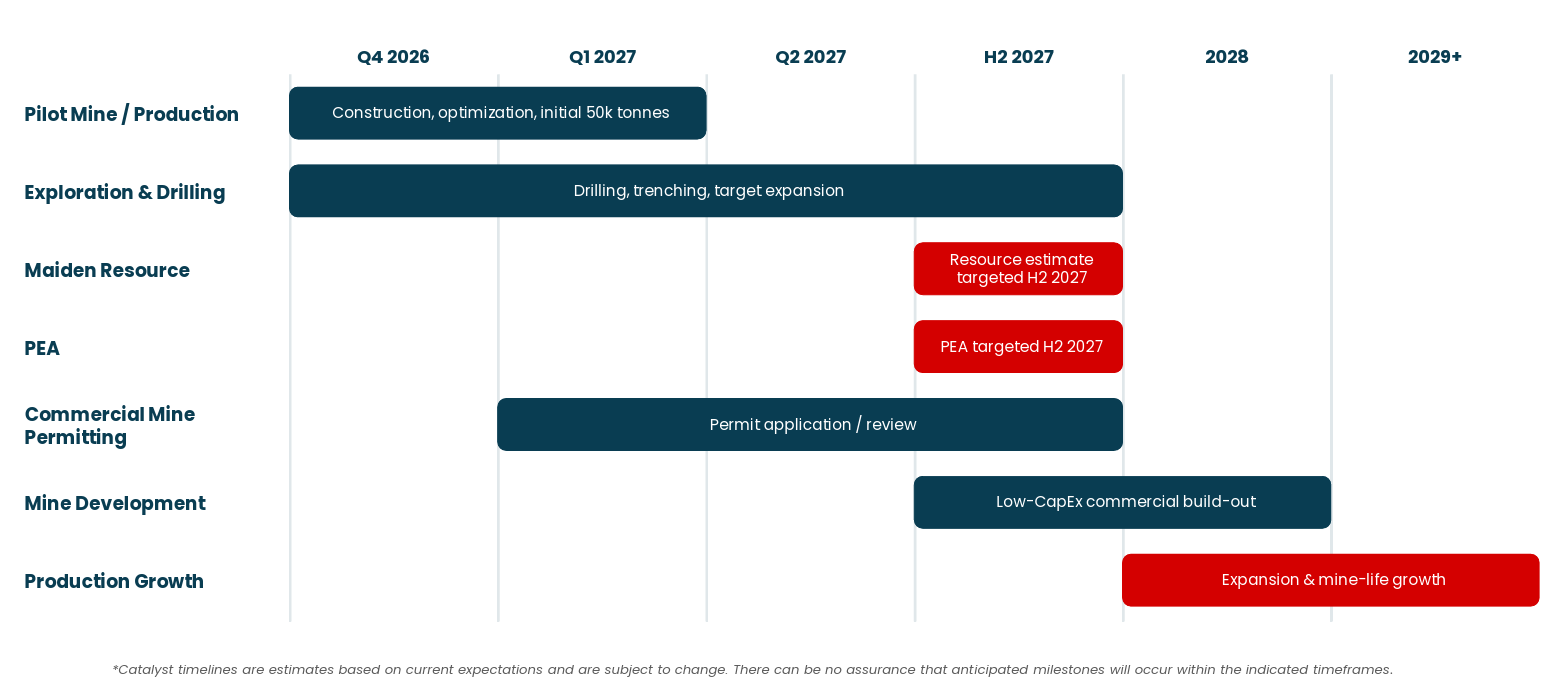
We’re encouraged by both our own experience and the progress being made across Sonora, and we expect to submit our application for full-scale mining permits during 2027.
What is your current cash position and how much runway does this give you?
We currently have approximately C$2 million in treasury, putting us in a position to complete our pilot facility and move into our first production campaign. We’re targeting approximately 1,000 ounces of gold from our initial 50,000-tonne processing campaign, and we anticipate generating meaningful cash flow from that operation before the end of this year.
With cash currently available and the expectation of additional proceeds from pilot production, we believe we’re well positioned to meet our near-term capital requirements while continuing to advance our exploration and development plans.
What can we judge you on in 12 months from now?
Over the next 12 months, investors should expect to see considerable progress across several areas of Gran Pilar.
First, we expect to have completed our initial 50,000-tonne pilot production campaign and potentially be approaching or completing a second campaign, subject to securing the necessary approvals. This will provide us with valuable operating data and the opportunity to demonstrate the potential for recurring production and cash flow.
Secondly, we anticipate completing a significant amount of additional drilling at both El Mezquite and the Main Zone. With our recent consolidation of 100% ownership of the original Pilar concessions, we’re now in a position to aggressively pursue expansion of the Main Zone while continuing to define the potential scale of El Mezquite.
We’re also awaiting results from our soil sampling and rock-chip programs across the Central Corridor and North Alteration Zone. These are exciting, relatively underexplored areas of the property, and we’re hopeful the results will generate additional drill targets. Given the size of our land package and what we’ve discovered to date, I certainly wouldn’t be surprised if we identified additional mineralized zones.
Looking slightly beyond that 12-month window, we’re currently anticipating a maiden resource estimate in Q4 2027 or Q1 2028. We would then look to advance a preliminary economic assessment within approximately three to four months of completing that resource estimate.
We also expect to submit an application for a full-scale mining permit during 2027. Importantly, that process can advance independently of our maiden resource estimate and preliminary economic assessment, allowing us to pursue permitting, resource growth, and economic studies in parallel.
Ultimately, our primary objective remains resource growth. If, a year from now, we’ve demonstrated successful pilot production, substantially expanded our drilling database, advanced new exploration targets, and made meaningful progress toward a resource estimate and larger-scale permitting, I believe shareholders will have plenty of tangible accomplishments on which to evaluate our performance.


Conclusion
Tocvan Ventures raised money at the right time in the first quarter of the year, and this allowed the company to kick off its substantial 20,000 meter drill program at Gran Pilar. It still is in the early stages of figuring out the mineralization at the newly discovered El Mezquite gold zone, and we expect another round of drilling to occur before Tocvan will put a resource estimate together.
We are also looking forward to seeing how the pilot plant performs, as the data gathered from the pilot plant program will be very helpful to continue to advance the project; initially with a resource calculation, likely to be followed by a Preliminary Economic Assessment.
Disclosure: The author has a small long position in Tocvan Ventures. Tocvan Ventures is a sponsor of the website. This post is for educational purposes only; be mindful investing in junior mining stocks is risky and you may lose your entire investment if things go wrong. Please read our full disclosure.