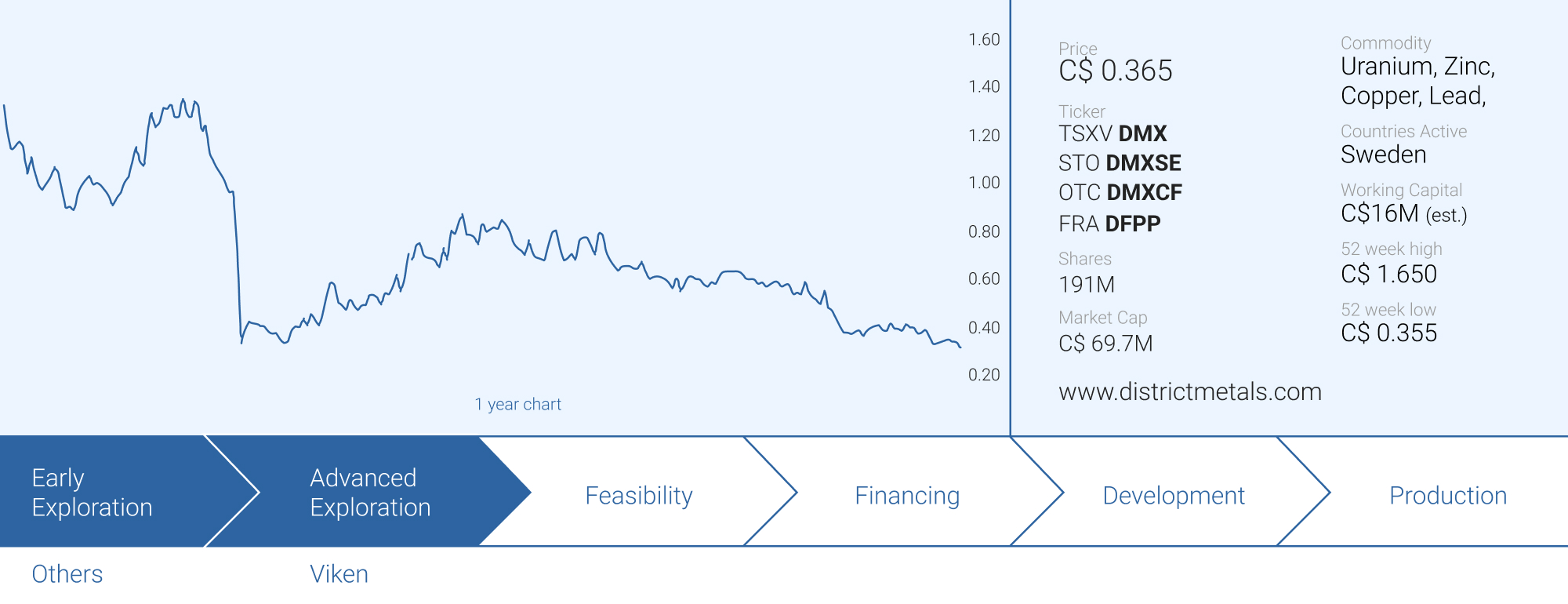
District Metals (DMX.V) has aggressively advanced the flagship Viken energy metals project in Sweden in the past few years. This resulted in an updated mineral resource estimate and economic studies, and the attention and focus is now shifting towards drill testing the numerous MobileMT conductive anomalies whilst advancing the project towards permitting.
While the moratorium on mining and producing uranium in Sweden was lifted earlier this year, there still are some regulatory hoops the company will have to jump through. Right now, the government inquiry into mining alum shales is the next hurdle to overcome on the road to hopefully develop the Viken project. The recent elections in Sweden resulted in a win for the opposition parties. But that win was by a much smaller margin than originally anticipated and this has complicated the coalition negotiations. So far, no new government has formed, and this could potentially result in a snap election further down the road.
We’ll cross that bridge when we get there, and new elections would not be positive nor negative for District Metals. The most important thing for the company is to not be held up in advancing its flagship project.
Drilling at Viken is ongoing, and recent initial results confirm the presence of alum shales at exploration targets that actually look juicier than the area that currently hosts the 4.8 billion tonne (456Mt in the indicated resource and 4.33Bt in the inferred resource) Viken deposit.


The Flagship Viken project: an economic powerhouse that could benefit the region
We already discussed the economics of the project in previous coverage on District Metals, and we would encourage you to re-read that report here.
Of course, there’s more to a project than just the economics. In an ideal world, a mining project also results in a substantial contribution to the local economy. And that’s indeed the case for the Viken project in Sweden’s Jämtland province.
In July, District Metals published the results of an independent economic study of its Viken deposit, completed by BDO Canada. This study looked at the wider benefits of a proposed first phase of mining, lasting about 13 years based on the mine plan in the preliminary economic assessment, which was published shortly before.
The company says the project would add roughly US$7.66 billion (about 74 billion SEK) to the economy over its 13 years, with nearly all of that, US$7.63 billion, staying in Sweden. Several pieces make up that total:
- Taxes: about US$1.58 billion in corporate income tax, paid to the Swedish state.
- Jobs: around 1,065 direct and indirect full-time positions during operations. Income tax on those wages comes to roughly US$200 million as an estimate based on the current parameters.
- Spending: about US$1.48 billion in construction and operating spending within Sweden.
- Fees: Less important in the greater scheme of things, but still relevant: District expects to pay mining fees totalling about US$29 million, split three to one between landowners and the state.
The total net economic benefit is nicely summarized in the table below.
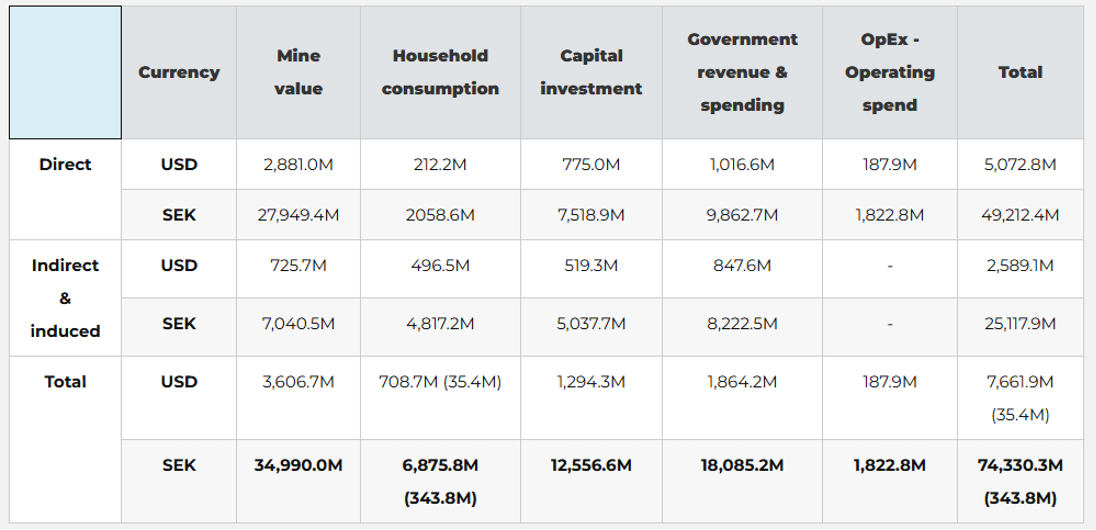
Needless to say the Viken project is more than just an NPV and an IRR as it would create over a thousand jobs and generate close to US$1.8B in tax revenue. And that’s based on the base case scenario wherein only ~3% of the total amount of mineralized material (across all categories) of the current Viken resource is used. Odds are the contribution of the Viken mine to the Jämtland and Swedish economy could be a multiple of the currently anticipated economic benefits.
And just as a reminder: Using a base case uranium price of $85 per pound (perhaps a bit high, but in line with or even on the lower end of the base case uranium prices used by its peers in recent studies), the after-tax internal rate of return (‘IRR’) comes in at just under 46% while the after tax net present value (‘NPV’) discounted by 8% per year comes in at an astronomical US$2.9B, which is roughly C$4B at today’s exchange rate. And we would like to emphasize once again that the total amount of resources included in the mine plan represents ~3% of the total mineral resource estimate on the Viken project.
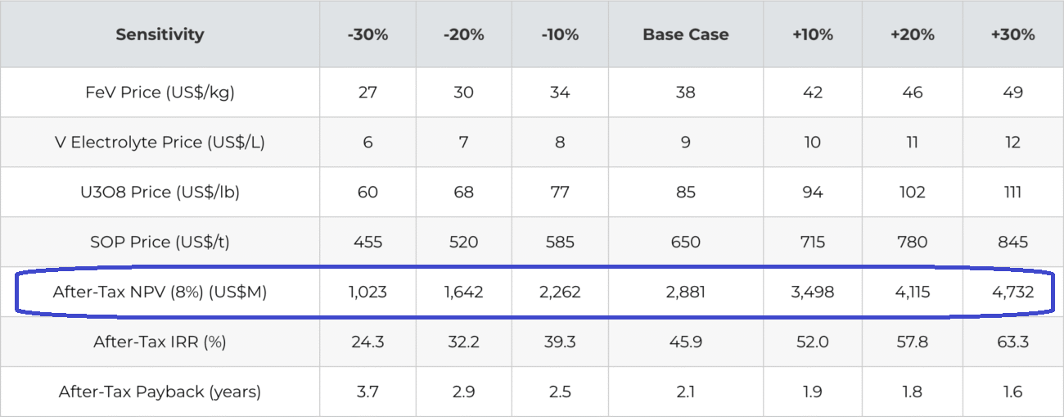
And the sensitivity analysis in the table above also confirms the project would still work using metal prices that are about 20% below the base case scenario as even using those assumptions, the after-tax IRR would still exceed 30%.
Drilling has restarted, and the alum shale is omnipresent in the area
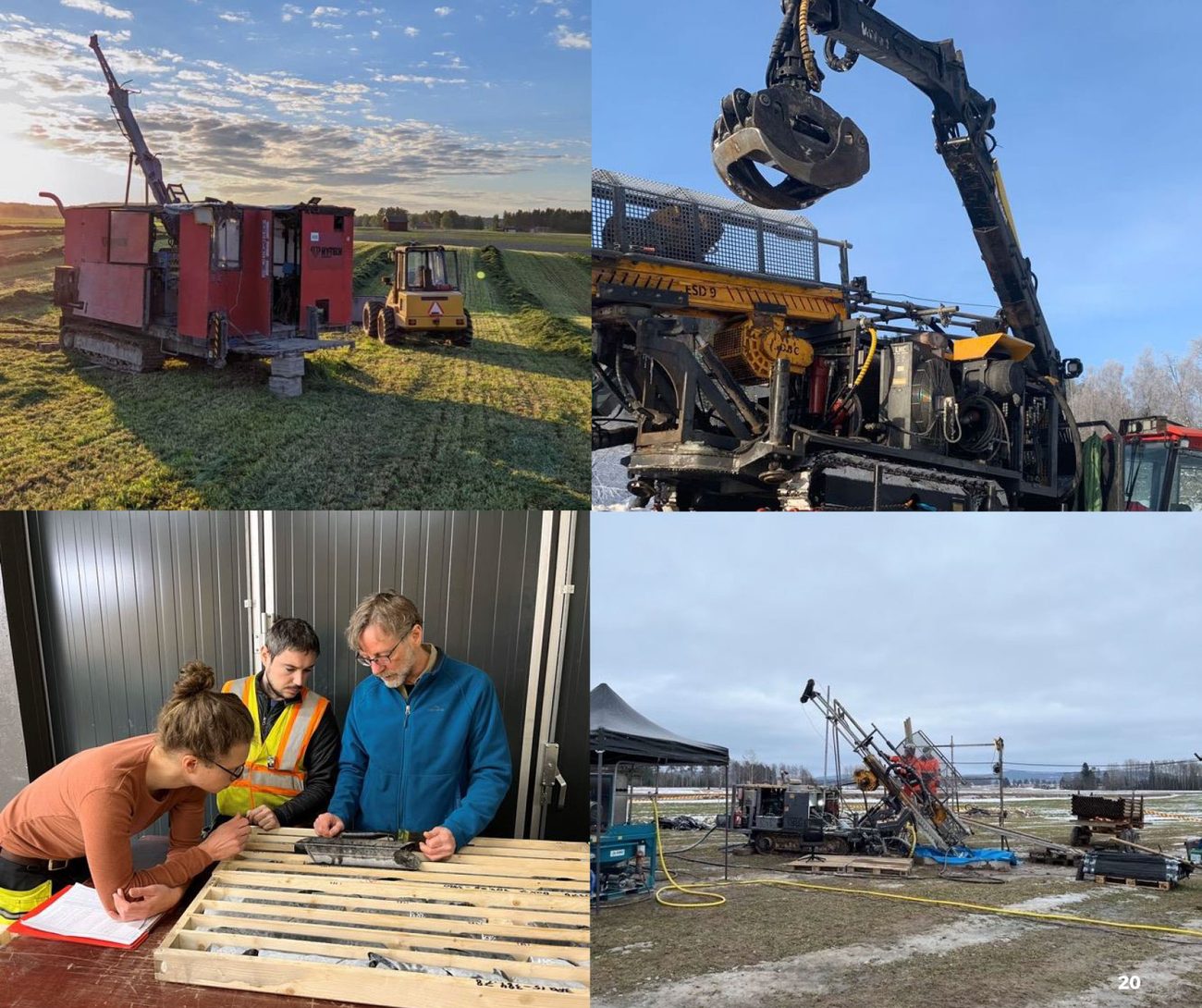
Earlier this fall, District kicked off a diamond drill program on the Target Areas A and B on the flagship Viken uranium-critical minerals project in Sweden. These two targets represent two large conductive anomalies that were identified in the 2025 airborne MobileMT survey, and remain largely untested (with a 2008 drill program mainly focusing on the periphery of the anomalies. There is no pre-determined amount of meters that will be drilled on these targets, but drill-testing these two prospects is part of the 5,000-7,000 meter drill program across the alum shale properties that has been budgeted for this year.
The two targets are located 1.7 and 7.5 kilometers to the north and northwest of the Viken Energy Metals deposit, and represent conductive signatures that are actually larger and stronger than the 4.8 billion tonne (456Mt in the indicated resource, 4.3 Bt in the inferred resources) Viken deposit.
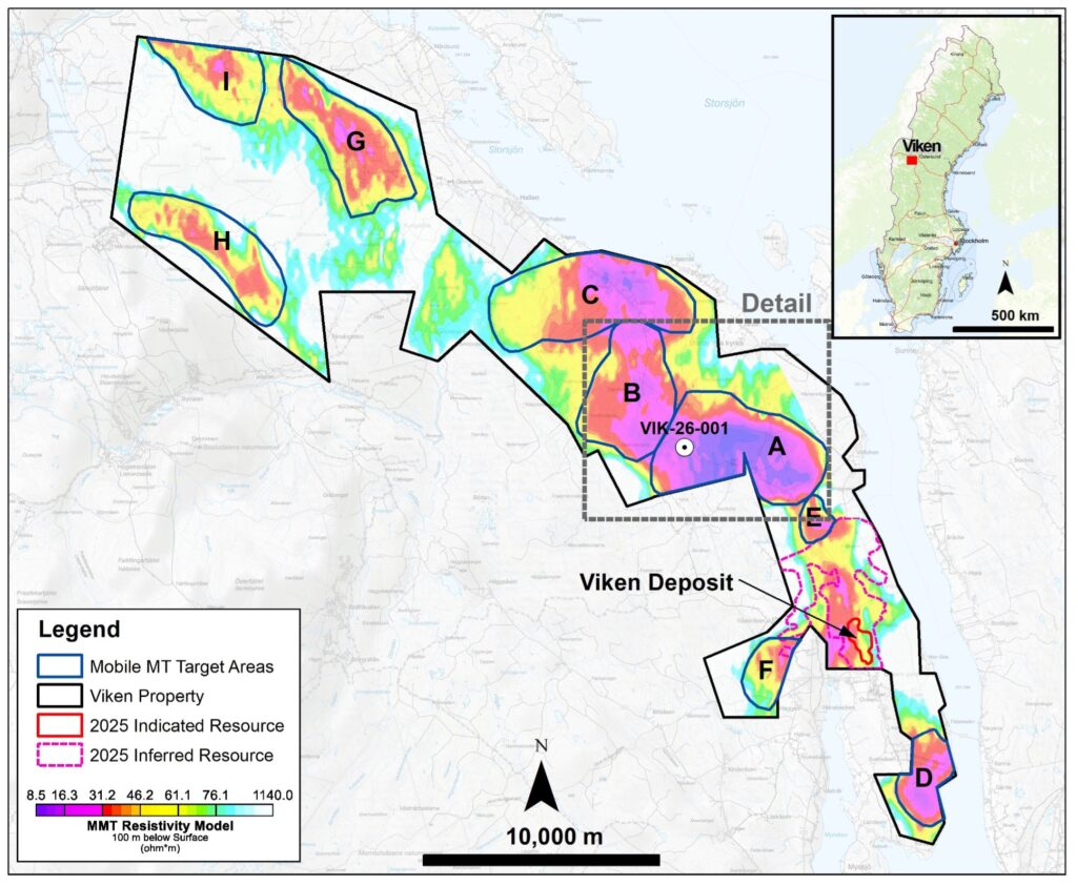
The first hole drilled at Target A (VIK-26-001 shown on the map above) on its Viken Property in Jämtland County, central Sweden, hit a thick layer of alum shale. Drilling intersected alum shale at a depth of about 44 metres and continued to about 199 metres, a core length of roughly 155 metres. The hole went down to about 300 metres in total. And in a more recent update, District confirmed more holes intersected a thick layer of alum shale, up to almost 200 meters in thickness, starting close to surface.
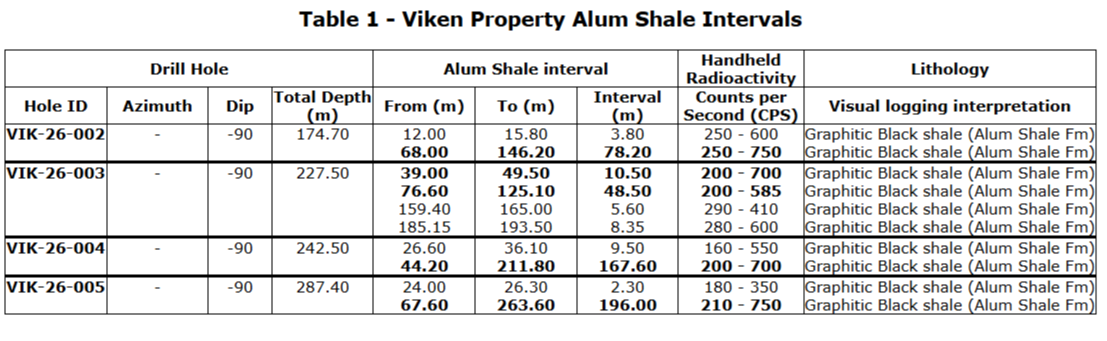
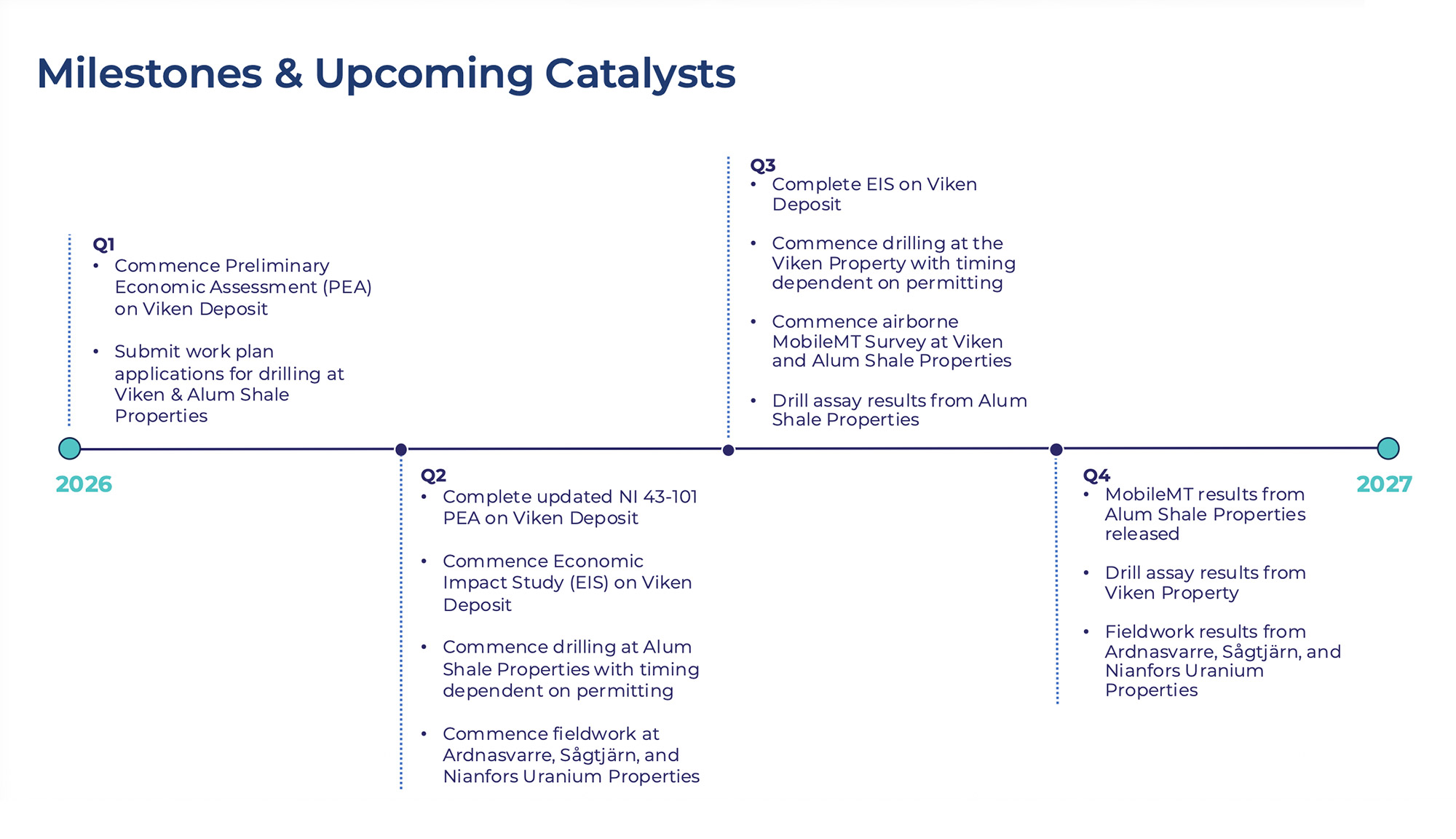
As visual drill core logging does not necessarily confirm the presence of mineralization, we still have to wait for the company to publish the assay results once it receives the data from the lab. We anticipate seeing results on this in December or early 2027.
The political situation in Sweden
Sweden voted on 13 September 2026, and six weeks on there is still no new government. The race was extremely tight, much tighter than the polls before the elections had predicted. The preliminary results gave the centre-left bloc 176 seats against 173 for the centre-right bloc (and only around 50,000 votes separated the two sides). The Social Democrats remained the largest party but had their worst result in over a century. The incumbent prime minister is now leading a so-called caretaker government while coalition talks are underway in order to form a fully functional government rather than a caretaker government.
As the win is a very narrow win for the centre-left bloc, it’s not easy to form a government. It is our understanding the Centre Party has said it will oppose a government that gives cabinet posts to the Left Party. Andersson (Social Democratic Party) has ruled out the Left Party in government but wants its parliamentary support, and the Left Party has insisted on having a minister. This created a stalemate, and Magdalena Andersson, who was tasked to form a government, subsequently proposed to form a minority government. While that is not unheard of in Nordic countries, especially in Sweden where in excess of half of the governments since the Second World War actually were minority governments, the Riksdag (the Swedish Parliament) voted against. In fact, only Andersson’s own party voted in favor of the Social Democrat-led minority government. Back to the drawing table.
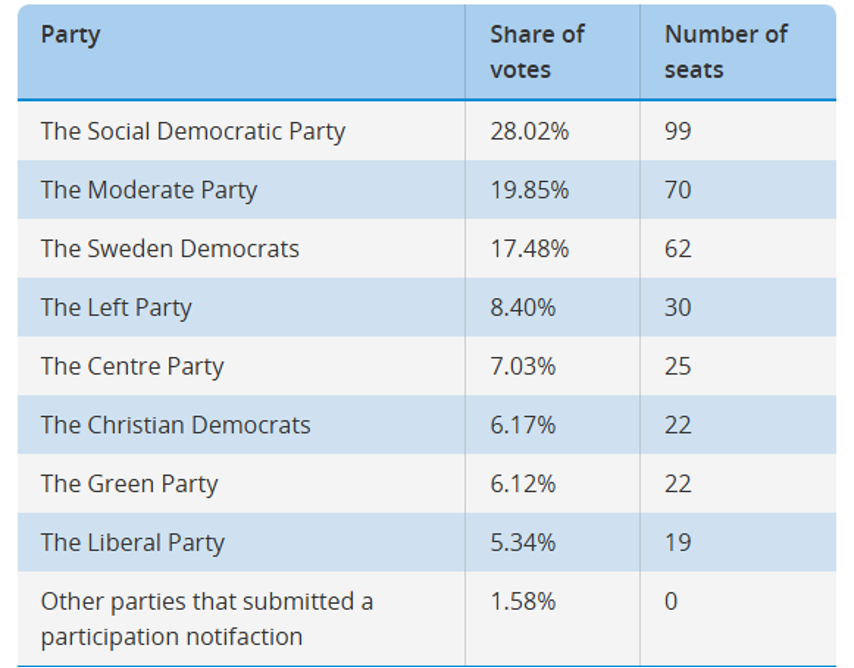
Interestingly, the Centre Party (good for 25 seats) holds the key to a government formation. Nor the centre-right nor the centre-left bloc can form a government without the key support of the Centre Party. The complicating factor is that the Centre Party does not want to form a coalition with either the Left Party nor the Sweden Democrats, making a majority block virtually impossible. And so far, no solution has been found.
It is now starting to look like the Speaker of the Riksdag may have to exhaust the maximum amount of four proposed candidates for the PM post. And as per the Swedish constitution, after four failed attempts, new elections must be organized.
The situation can of course change fast, but for now it looks like it won’t be easy to form a new government without some parties making sacrifices by conceding on some elements.
While new elections could perhaps paint a clearer picture of the Swedish political landscape, it’s interesting that only 77 of the 349 seats in the Riksdag went to parties that were against lifting the ban on uranium mining. The Social Democrats were initially against lifting the ban, but have recently changed their tune towards nuclear energy, and are now fine with mining uranium as a by-product of other minerals. That’s a positive evolution for District as revenue-wise, the uranium at Viken would technically be a by-product credit to the Vanadium production which, revenue-wise, is the primary commodity. So we are quite confident that whatever the end result will be, whether a successful coalition formation or having new elections, the perception of allowing uranium mining (as a by-product credit) has shifted.
This only leaves one important regulatory element outstanding. As mentioned before, earlier this year, the government confirmed plans to declassify uranium mining as a nuclear facility, which would remove the municipal veto that applied to it (the veto was effectively removed in the past summer). But at the same time, it announced an inquiry into alum shale mining, including whether a specific municipal veto should apply to that geology. And this is an important development for District Metals as the Viken project is hosted in said alum shales.
The inquiry is still ongoing, and will be completed on February 17, 2027.
Work on the other projects in Sweden is continuing as well
While Viken obviously is the company’s main project, let’s not forget District Metals has plenty of other irons in the fire, and exploration activities are ongoing there as well.
Nianfors
District recently announced results from its summer 2026 reconnaissance program at the fully owned Nianfors Property in Gävleborgs County, Sweden. The program followed up on strong uranium radiometric anomalies found in the company’s 2025 drone-based radiometric and magnetic survey, with the aim of moving priority areas toward drill targeting. The completed work included geological mapping, prospecting, radiometric surveying, and sampling of outcrops and boulders while a Handheld scintillometer program completed readings at 111 field stations. Additionally, 34 rock samples were sent for analysis, returning:
- Uranium (U₃O₈): 4 to 937 ppm
- Yttrium (Y₂O₃): 7 to 667 ppm
- Molybdenum: <1 to 509 ppm
The highest uranium values encountered in this program came from the Majsaberget uranium-yttrium-molybdenum occurrence. Historically, 889 mineralized boulders have been documented there across an area measuring roughly 500 m by 200 m, with earlier assays averaging about 1,600 ppm U₃O₈. Swedish Geological Survey data from 1982 showed boulder values as high as 14,000 ppm U₃O₈. Majsaberget has never been drilled, so there might be an opportunity to test for bedrock mineralization underneath the boulder field.
These results support Nianfors’ uranium polymetallic potential and show the 2025 drone anomalies merit further follow-up. The company is now combining the geochemical, mapping, and radiometric data to refine its interpretation and prioritize drill targets.
Sågtjärn
And just last week, District wrapped up a first round of fieldwork on its wholly owned Sågtjärn uranium property in central Sweden. This deposit was discovered in the 1970’s by the Swedish Geological Survey. There is a historical resource estimate of 756,000 tonnes at an average grade of 0.068% U₃O₈, for a total of just over 1 million pounds contained uranium. A negligible resource, but it confirms the project has its merits.
The field team was following up on uraniferous radiometric hot spots that last year’s drone survey had flagged. They took readings at 163 locations and collected 32 rock samples from outcrops and loose boulders. The initial interpretation of the results is interesting as it could potentially indicate the known deposit may be bigger than initially thought. Uranium-bearing pegmatite showed up along a strike length of approximately 2 kilometers, stretching past the zone the Swedish Geological Survey drilled decades ago. Boulders there assayed as high as 1,179 ppm U₃O₈, while elsewhere, the boulders also contained other minerals. One boulder near Staverberget hit 5,250 ppm molybdenum, and another contained 333 ppm cobalt and 1,800 ppm copper.
More work is obviously needed, and it will be interesting to see District’s next steps.
District Metals is cashed up
While we still have to wait to see the company’s balance sheet as of the end of September (which is the first quarter of District’s financial year), the company made the right move earlier this year to fill up its treasury.
At the end of June, District Metals had a positive working capital position of approximately C$16M, with roughly C$16.2M in cash. That’s a very comfortable position to be in, thanks to the decision to raise money in May. District Metals raised C$10M in a warrant-free financing priced at C$0.68, a level that’s approximately 86% higher than where the stock is currently trading at.
As the company has been drilling and working on studies, the cash position can reasonably be expected to decrease throughout the year. But the cash bleed will likely be compensated for by the exercise of warrants and options that are in the money. Last month, 1.96M options with a C$0.25 exercise price expired in the money, and we can reasonably expect all those options have been exercised, bringing in almost C$0.5M into the treasury. But more importantly, we are now less than three months away from the expiration date on 6.05M warrants with an exercise price of C$0.30. This should result in an additional cash inflow of C$1.8M. Additionally, this is the last batch of warrants District Metals will have to deal with. Once these C$0.30 warrants are exercised or expired, the capital structure does not contain any warrants anymore.
Conclusion
As 2026 draws to a close, District Metals is turning its attention from proving Viken’s economics (the result of the preliminary economic assessment published right before the summer was pretty clear) to getting the project permitted. The numbers on paper are impressive. The base case gives an after-tax NPV8% of about US$2.9 billion and an IRR just under 46%, and the IRR still tops 30% if metal prices come in 20% lower. The independent study puts the broader economic contribution to the local and Swedish economy at roughly US$7.66 billion, with more than 1,000 jobs and nearly US$1.8 billion in tax revenue, and that is from a mine plan that taps just a small slice of the mineral resource (~ 3% of the total resource base).
What stands in the way now is regulation and politics, not geology or engineering. Sweden has lifted its uranium moratorium on January 1, 2026, and removed the municipal veto on processing of uranium on July 15, 2026. Two important elements. But the big unknown is the ongoing alum shale inquiry, on which we should see an update in the first quarter of 2027. Meanwhile, the country still has no new government, and fresh elections can’t be ruled out. Neither scenario obviously helps or hurts the company, though delays are the main danger. One encouraging sign is that the Social Democrats have softened their stance in the past two years and now accept uranium as a by-product, which suits Viken, where uranium would act as a credit against vanadium, the main product with Sulphate of Potash as an interesting additional useful output.
On the exploration front, the first hole at Target A went through around 155 metres of alum shale, backing up the geophysical targeting. Drill assay results due in December or early-2027 will show whether that alum shale is mineralized. Nianfors and Sågtjärn offer additional opportunities. With roughly C$16 million in working capital at the end of June and more cash expected from warrant exercises, District looks well funded to keep drilling and advance its Swedish project portfolio.
Disclosure: The author has a small long position in District Metals. District Metals is a sponsor of the website. This post is for educational purposes only; be mindful investing in junior mining stocks is risky and you may lose your entire investment if things go wrong. Please read our full disclosure.