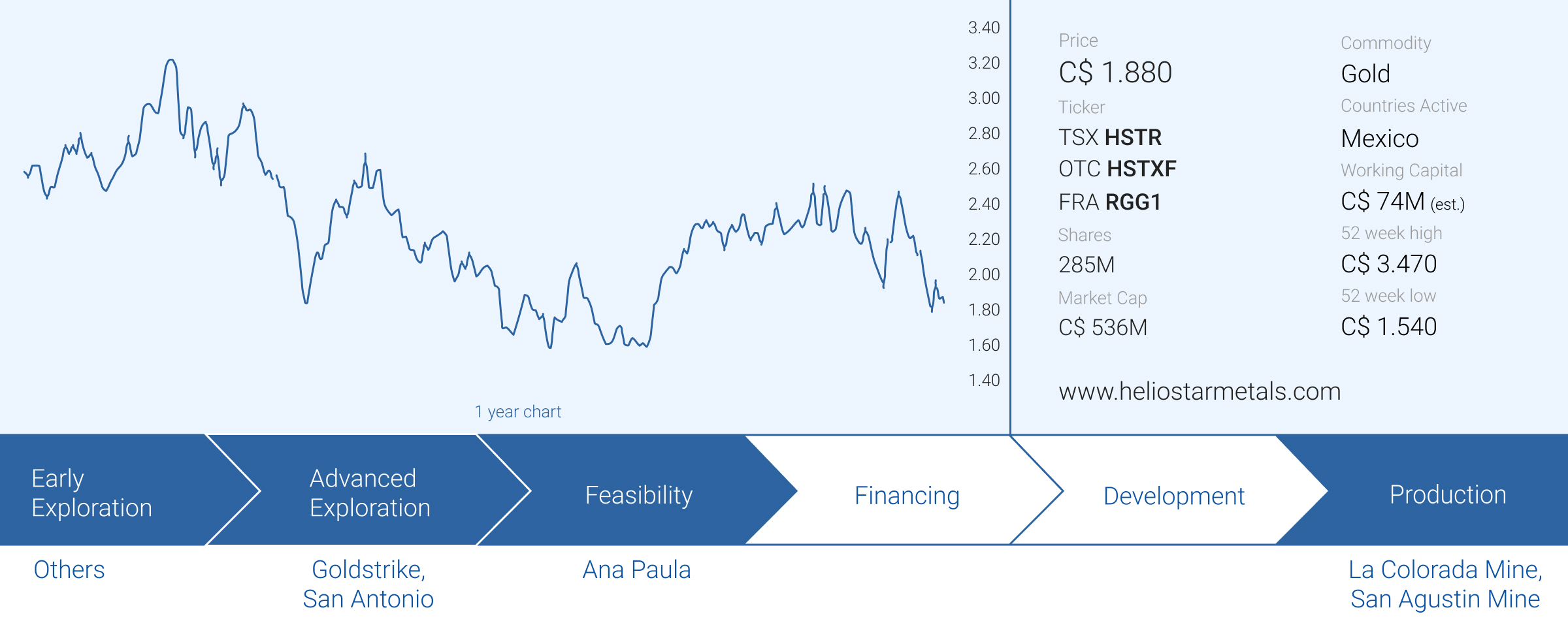
Heliostar Metals (HSTR.TO) is diligently working on the feasibility study for the Ana Paula project. That study is expected to be published in the second quarter of 2027, and a construction decision for this high-grade high-margin gold project should follow shortly there after. This would keep the company on track to produce first gold by the end of 2028, which is just 24 months from now.
Meanwhile, the smaller producing mines (La Colorada, San Agustin), are nicely humming along. The Q3 production and cost performance was good, and the strong gold price environment and some of the lowest production costs among its peers results in Heliostar generating sufficient revenue and cash flow to cover all capital expenditures, overhead expenses, exploration expenses while still adding cash to the bank (subject to changes in the working capital position).
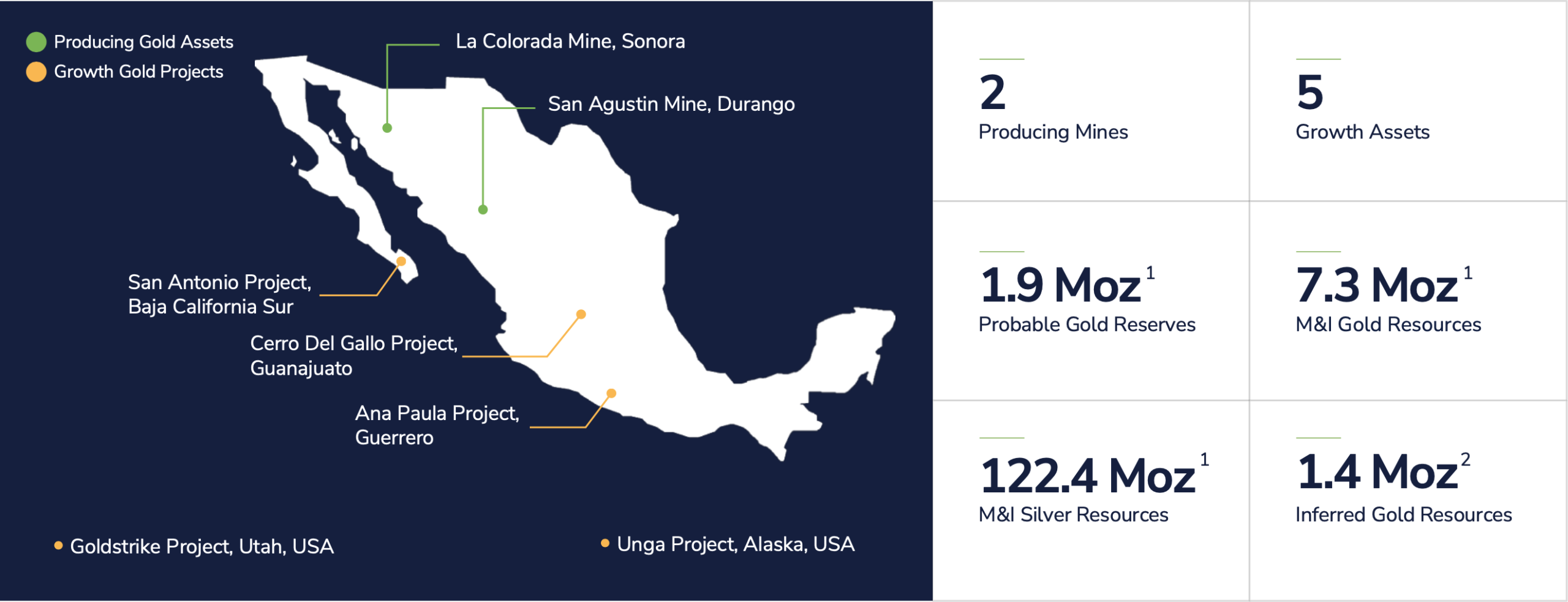
Over the course of the past few years, Heliostar Metals has assembled an intriguing portfolio of assets. Starting out with just the Unga project in Alaska and the flagship Ana Paula project in Mexico, Charles Funk and his team have added two producing mines to secure cash flow, while two advanced stage exploration assets (Cerro del Gallo and Goldstrike) are likely next in line to be further developed after bringing Ana Paula online (of course all are subject to positive feasibility studies and investment decisions). On top of that, the San Antonio gold project in Baja California Sur is a lottery ticket we don’t attribute any value to right now.
CEO Funk has always been clear that he wants to build Heliostar Metals out to a 500,000 ounce per year producer by 2030. The current asset base will go a long way towards that target.
The Q3 results: on track for the full-year deliverables
Heliostar reported robust production and financial results in the third quarter of 2026. The total gold production came in at just under 14,500 ounces while the company also produced just over 83,000 ounces of silver. This compares quite well to the output in the second quarter of the year and with a total gold production of just over 41,000 ounces in the first nine months of the year, Heliostar is tracking nicely towards its full-year guidance of 50,000-55,000 ounces of gold. While the company has not narrowed down its production guidance, we are anticipating the full-year production to come in at the upper half of the range.
Thanks to the low-cost nature and low capex intensity of the producing assets, Heliostar Metals has been able to keep its operating expenses low. The Q3 all-in sustaining cost came in at just under US$1950/oz, which helped to reduce the YTD average to US$2,072/oz on a by-product basis (meaning the revenue generated from the silver sales is incorporated in the AISC per ounce of gold).
As Heliostar recorded an average realized gold price of $4,243 per ounce, its net margin still exceeded US$2,000/oz, even after incorporating the sustaining capital expenditures.
Heliostar reported a total revenue of US$66.3M, of which approximately US$5.1M was generated from the sale of silver. This resulted in a mine operating earnings of just over $36M while the operating income was roughly $25.8M.
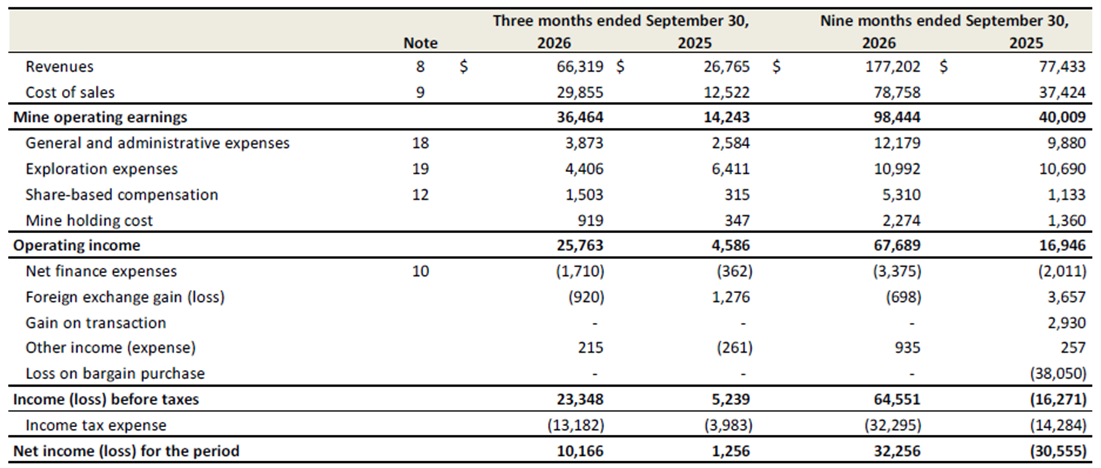
As the net finance expenses are still next to nothing (the $1.7M in net finance expenses included just $0.2M in interest expenses while the other items were predominantly the accretion of provisions and deferred payments), Heliostar was once again profitable as it reported a $10.2M net profit. This represents an EPS of US$0.04 (rounded) while the EPS in Canadian Dollars was approximately C$0.051. This brought the total net profit in the first nine months of the year to US$32.1M or US$0.12 per share. This translates into C$0.162 per share.
In our previous updates, we really focused on Heliostar’s cash flow performance as that ultimately is the key element that determines Heliostar’s investment and development pace.
In the first nine months, the reported operating cash flow was US$42.8M, but this includes approximately $20.5M in changes in the working capital (predominantly an inventory build-up and an increase in receivables, which is of course directly related t o the growing production profile), which means the underlying operating cash flow was $63.3M. Note: although $29.8M in taxes were owed, Heliostar only made $14.1M in cash tax payments as the cash tax payments are based on the taxable income of the previous year. This shifts the tax-related cash outflows a bit, and the difference is added to the balance sheet as a ‘tax payable’. For the purpose of this report, we are using the pro forma current taxes owed, as we believe this offers a more fair representation versus applying taxes payable over Q3 2025, when the production and the gold price were lower.
If we would take these elements into consideration, the underlying tax-adjusted operating cash flow was $47.5M.
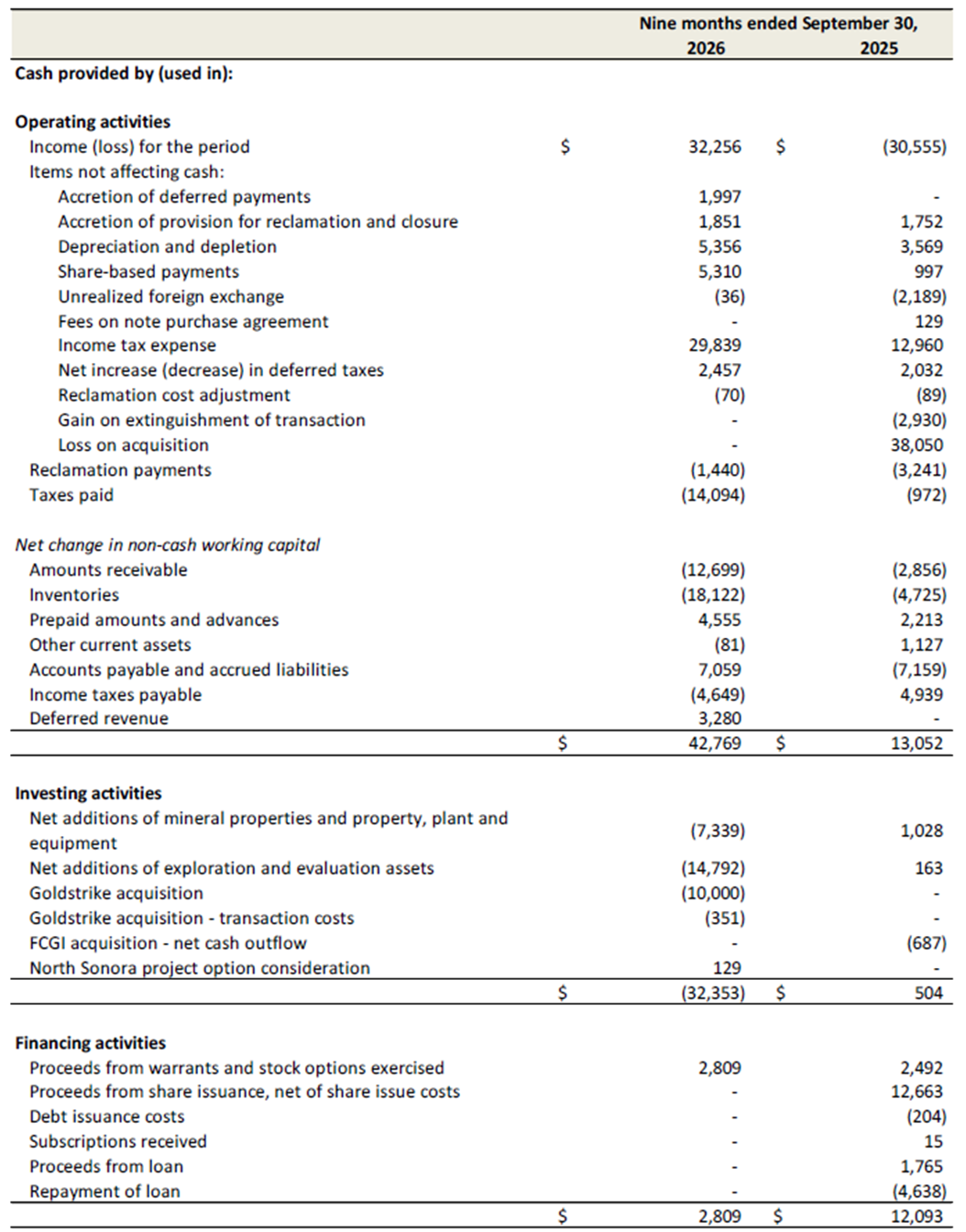
But no matter your interpretation and preference on how to deal with deferred taxes and working capital changes, the incoming cash flows were of course more than sufficient to cover all capex. Heliostar invested $32.4M in 9M 2026, of which $10.4M was directly related to the acquisition of the Goldstrike project in Utah.
This leaves a total project capex of almost exactly $22M. But only $3.1M of that amount is considered to be sustaining capex and capitalized exploration at both La Colorada and San Agustin. The majority of the 9M 2026 capex was spent on Ana Paula which will provide Heliostar’s next production bump.
At the end of September, Heliostar’s balance sheet indicated a positive working capital position of approximately $53M, while the company held almost $54M in cash as well. The recent expiration of 5M warrants at C$0.90 has likely added C$4.5M in cash to the balance sheet as well.
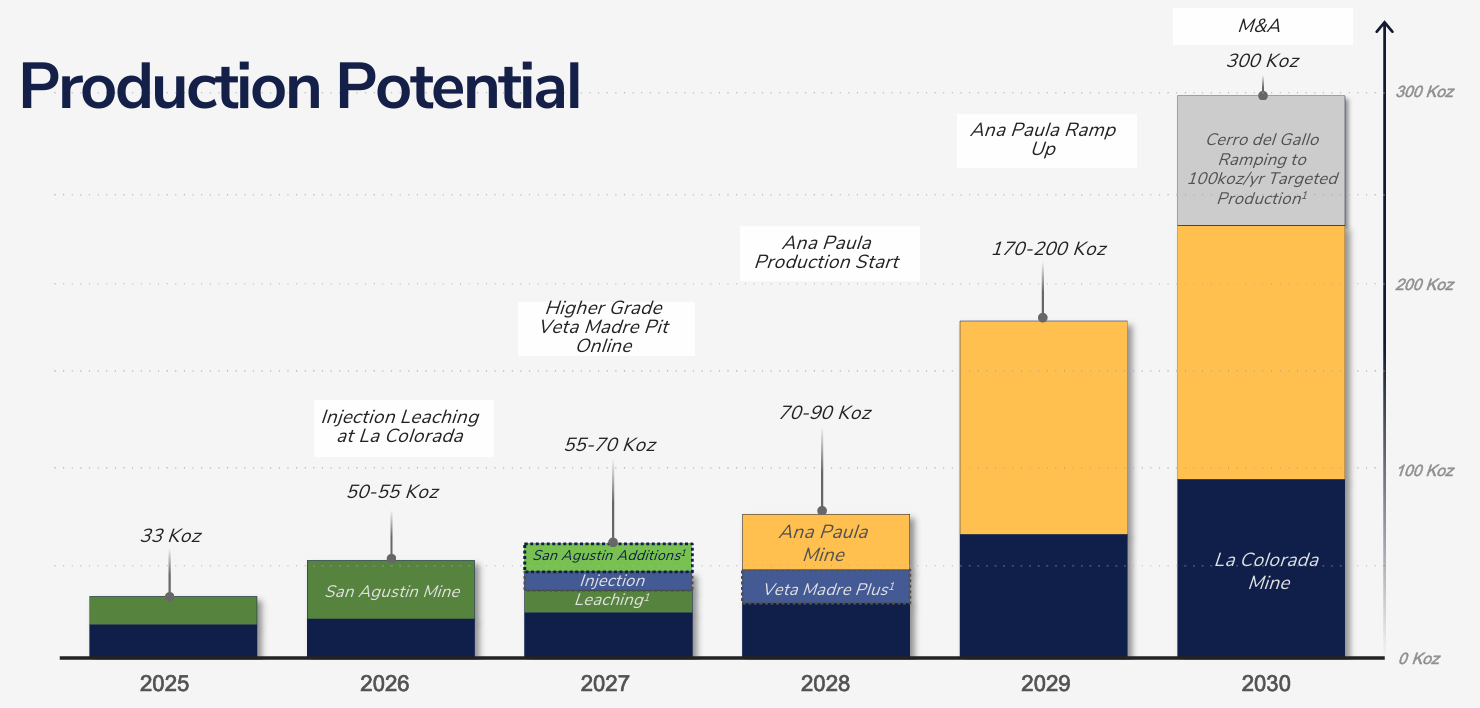
An update on the asset portfolio
This clearly indicates the company is in great shape, financially, to continue to aggressively advance its development pipeline.
Ana Paula
It goes without saying the high-grade Ana Paula project in Mexico’s Guerrero state remains the flagship asset in the development portfolio. So far in 2026, the company has completed in excess of 25,000 meters of drilling in 73 holes.
The updated resource calculation is now in the final stages and this will include the data from the additional drilling since the Preliminary Economic Assessment was published. The high-grade panel has now been traced over a 300 meter horizontal strike length, and is about 50-60 meters thick in its core. The down-plunge extension now reached 330 meters while the Expansion Zone now extends up to 200 meters down-plunge of the high-grade panel (and it remains open in all directions).
The company has also completed additional metallurgical test work on Ana Paula rock and initial results have been in line with the test work that supported the Preliminary Economic Assessment. The Ana Paula mineralization is amenable to be recovered using a standard grinding and flotation process, followed by bio-oxidation. The feasibility study will use a NSR-based cutoff value versus a gold value expressed in g/t, resulting in a variable cutoff model. This could pave the way for a higher production rate at Ana Paula, and Heliostar will ensure that the engineering phase of the feasibility study will be mindful of the option to further increase the throughput (subject to confirmation in the resource and feasibility study, of course). As it currently stands, Heliostar will be looking to upsize the plant to accommodate 2,000 tonnes per day versus the 1,800 tpd in the PEA. These circuits could then potentially be expanded to accommodate 2,500 tonnes per day.
Earlier this quarter, the company released assay results from both the high-grade panel (which were infill drill holes) as well as the Expansion Zone which is located at depth below the high-grade panel. The bullet points below summarize the highlights of the drill results. The true widths of the mineralization at the Expansion Zone remain unknown at this point.
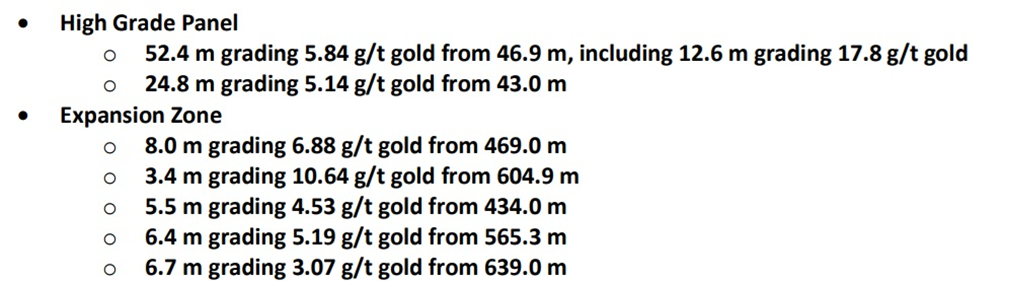
While the infill drill results shouldn’t come as a surprise, the assay results from the Expansion Zone drill program are very interesting as it confirms the presence of high-grade gold mineralization at depth. The expansion zone drilling was filling in the gaps in a large poorly tested zone located directly above and to the south of previously intercepted mineralization.
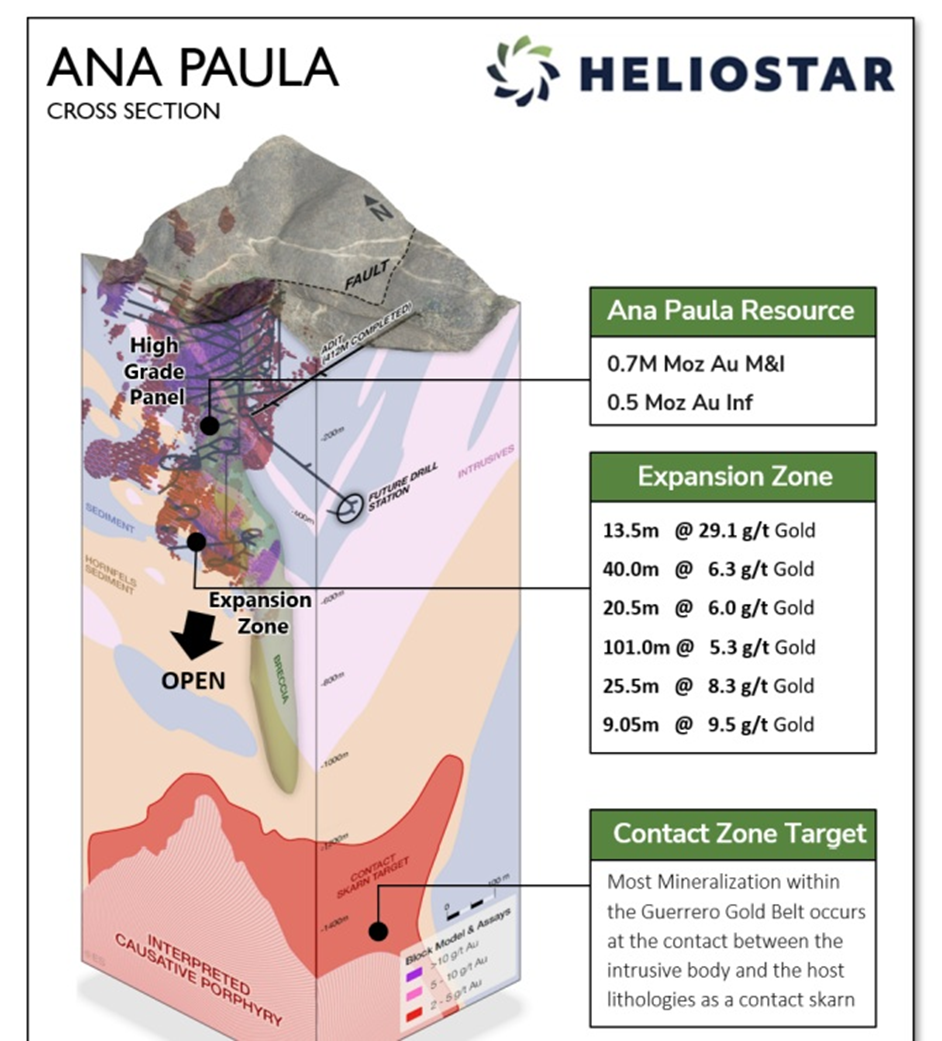
The company has now started to chase the gold deeper to a source intrusion and skarn targets. Those targets have been known to host multi-million ounce gold resources at nearby mines (Morelos, Los Filos), so it is starting to look like the Ana Paula project may become much bigger and/or offer a longer mine life than what’s currently on deck.
As a reminder, the upcoming feasibility study will focus on proving up a minimum 10 year mine life at an average production rate of 100,000 ounces of gold per year.
At the end of September, the engineering portion of the feasibility study reached a 34% completion rate while the metallurgical test work was nearing completion and the flow sheet has been finalized.
Goldstrike
During the third quarter, Heliostar completed an antimony-focused exploration program. It identified the Antimony Ridge and Antimony Knoll zones through a dedicated sampling and rock chip program. A drill program is currently underway to drill-test the mineralization beneath these surface exposures, which are located just 4 kilometers from the main gold resource on the property.
San Agustin
The producing assets are of course also getting quite a bit of attention as it is in Heliostar’s best interest to extend the mine life of La Colorada and San Agustin.
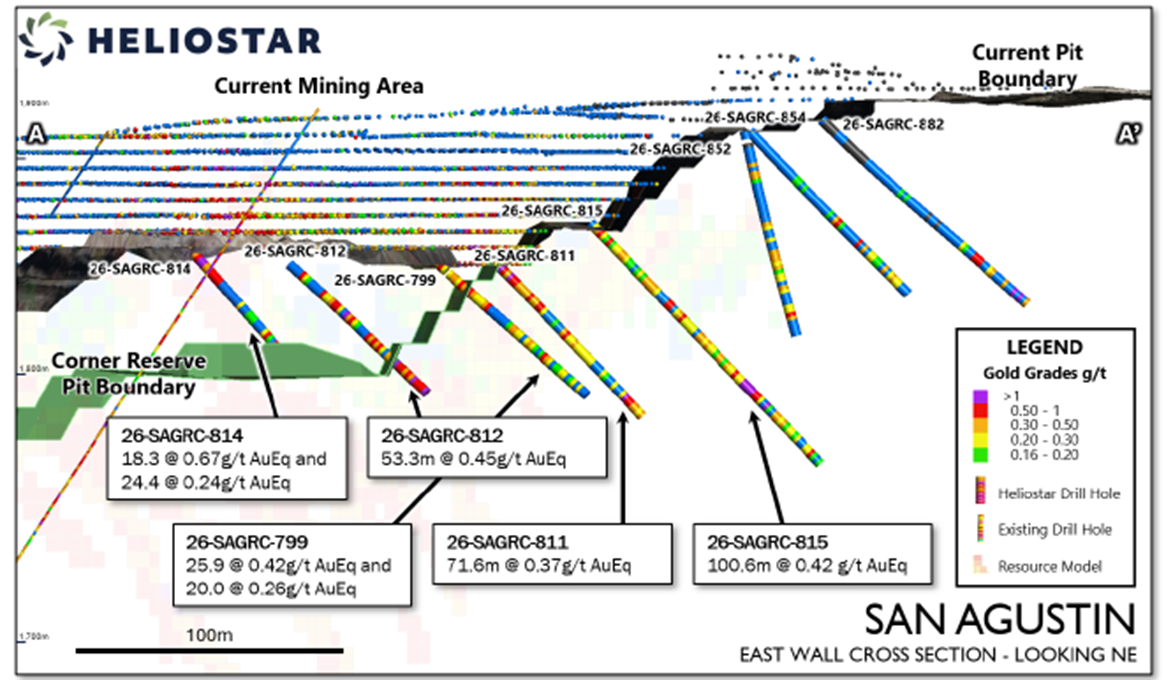
At San Agustin, Heliostar has now confirmed that drill results indicated the oxide gold mineralization is extending by at least 200 meters in the Corner Expansion zone, while the limits of the additional mineralization have not yet been encountered. Additionally, the East Wall Zone, located directly east of the current mining operations, yielded nice thick layers of oxide-hosted gold mineralization such at 94.5 meters of 0.33 g/t gold-equivalent and almost 101 meters of 0.42 g/t gold-equivalent.
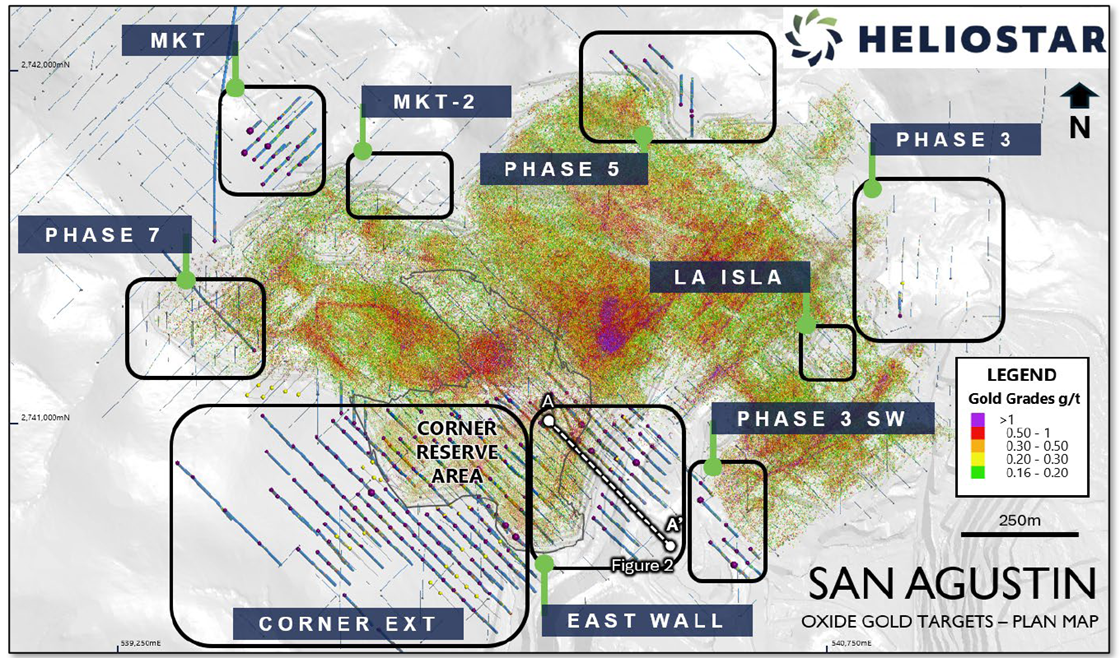
The purpose of this 25,000-30,000 meter drill program is clear: Heliostar aims to add about two years of resources and reserves at San Agustin. Resource modelling and permit modification applications on the two aforementioned zones are underway, and Heliostar thinks these will already account for an additional year of production. Drilling is ongoing, and the company hopes to see an expanded resource (effectively extending the mine life by two years) in 2027. Needless to say this would be a positive catalyst as the closure costs are pushed back in time while 1-2 years of additional cash flow will help Heliostar to continue to strengthen its balance sheet. The additional cash flow that’s generated ahead of and during the Ana Paula construction process (assuming a positive feasibility study will be delivered and a Final Investment Decision will be made) will of course help the company to maintain its financial flexibility.
Conclusion
Heliostar Metals is making hay while the sun shines. With an all-in sustaining cost of approximately $2,000 per ounce of gold (net of by-product credits), the company is still generating superior margins at $3750 gold. While we would of course prefer to see gold trading at $4000+ or even $5000+ (pretty please), Heliostar remains more than self-sufficient at the current gold price. All exploration and development activities are fully financed thanks to the incoming operating cash flow, while the company is still able to put some money aside that will help to fund the pipeline of development projects.
Disclosure: The author has a small long position in Heliostar Metals. Heliostar Metals is a sponsor of the website. This post is for educational purposes only; be mindful investing in junior mining stocks is risky and you may lose your entire investment if things go wrong. Please read our full disclosure.