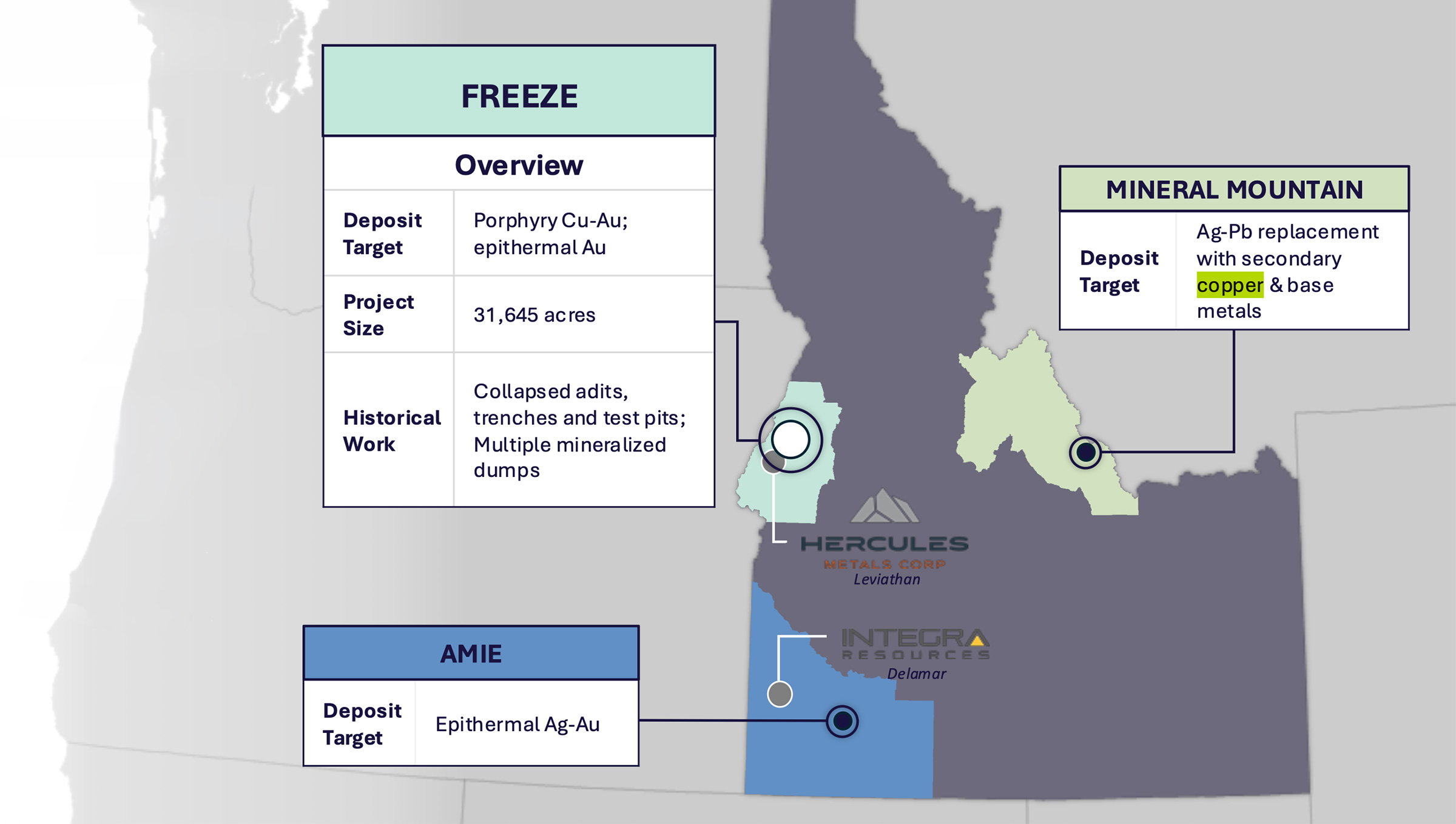
It’s rare to see a company hit mineralization in all holes drilled as part of a maiden drill program yet that’s exactly what happened to IDEX Metals (IDEX.V). After securing a substantial land package in the Idaho Copper Belt in 2025, the company immediately started drilling the Kismet Tourmaline Breccia target, part of its flagship Freeze copper project in Idaho.
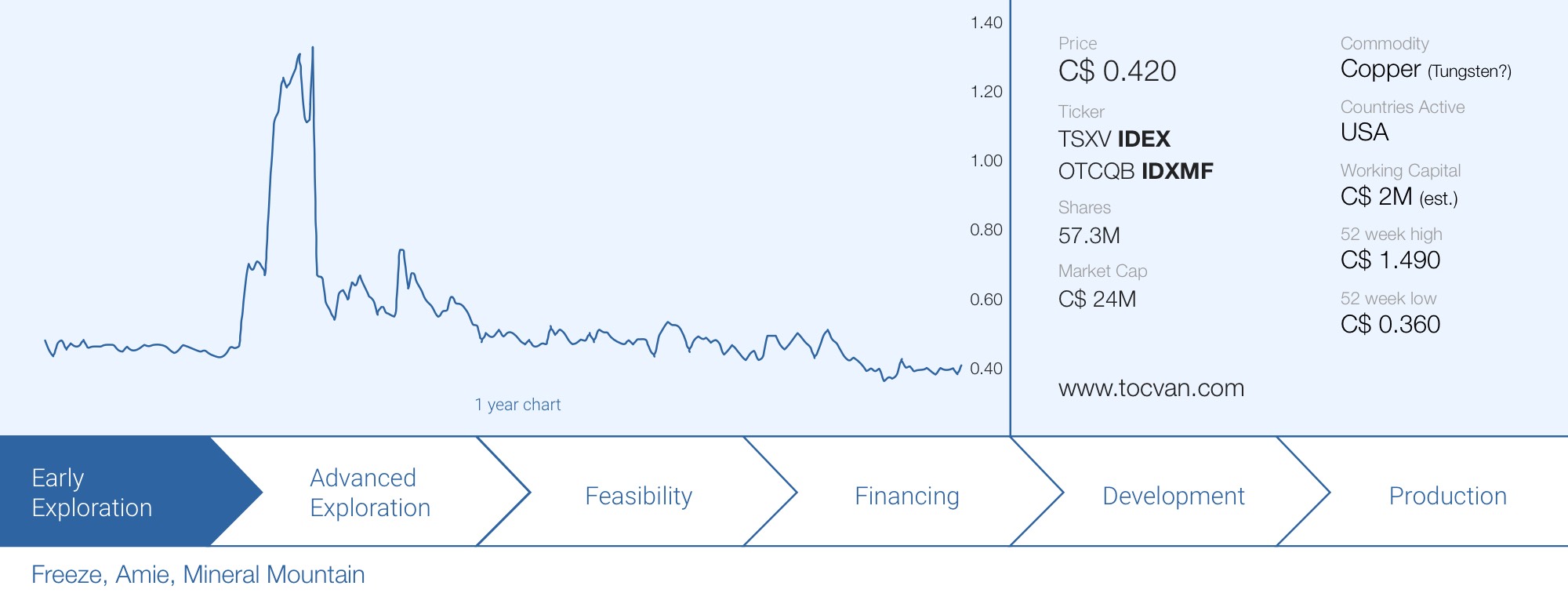
All six holes that were drilled encountered mineralization, yet the company was not rewarded by the market for this success, and the share price is currently lower than where IDEX completed its IPO financing at, ànd lower than the recent C$0.60 financing. And that’s a bit of a headscratcher as the company has successfully advanced the Freeze project by hitting mineralization in all six holes.
The successful drill program in 2025 should also pave the way for an efficient 2026 campaign as there are plenty of targets to follow up on. The discovery of what appears to be an intrusive porphyry system directly beneath the North Breccia zone is the most important element to keep an eye on, but let’s also not forget the tungsten that was discovered in one of the drill holes.
IDEX Metals is ready to hit the ground running this year.
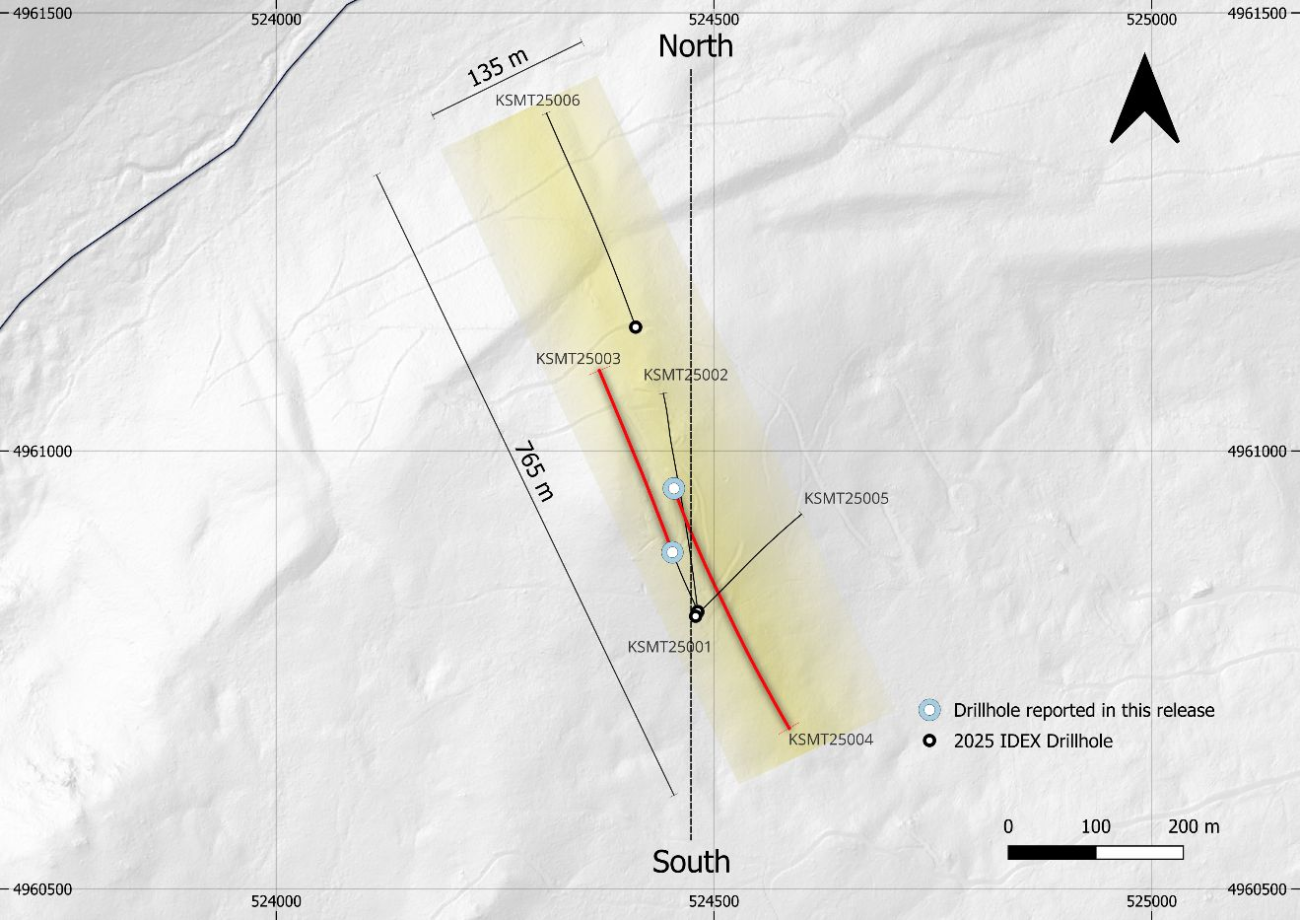
An overview of the 2025 drill results
It’s rare to see a company immediately hit a thick mineralized interval in its very first hole, yet that’s exactly what IDEX Metals did. The company’s first hole (KSMT2025001) immediately intersected mineralization, returning just over 182 meters containing 0.32% copper and 1.08 g/t silver, almost starting from surface (the mineralization started at 1.5 meters down hole). The highest grade was actually found the closest to surface as the second layer of mineralization started at 189 meters and returned 0.26% copper and 2.25 g/t silver over that interval. The table below however, indicates there are three distinct zones of higher grade copper mineralization with 3.2 meters of 1.44% copper, 1 meter of 1.41% copper, 7 meters of 1% copper and 5 meters of 1.39% copper.
The first drill hole was a technical success: the thickness of the known mineralization was expanded by 200-300% and the fact the mineralization starts almost at surface is a clear positive as well.
The second hole of the campaign (KSMT2025002) was even more interesting. That hole combined thickness, grade ànd the presence of tungsten, an element listed on pretty much all of the critical mineral lists of countries around the globe.
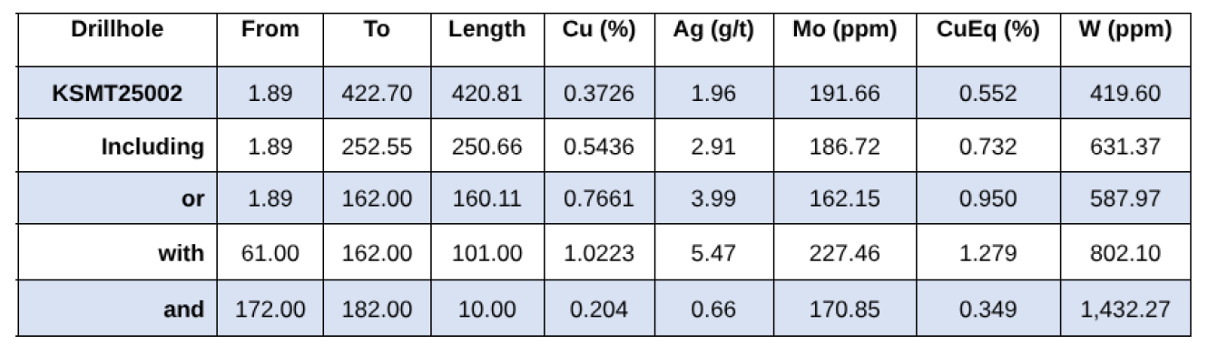
Hole 2 encountered almost 421 meters containing 0.552% copper-equivalent, with an additional 420 ppm of tungsten in scheelite over the entire mineralized interval, which started less than 2 meters from surface. This thick interval also hosted higher grade zones with for instance 160 meters at 0.95% copper-equivalent (in combination with almost 600 ppm W) almost starting at surface, including 101 meters of 1.28% copper-equivalent (and 802 ppm W) starting at just 61 meters down-hole.
Hole 2 was an excellent hole, and perhaps even the best hole of the drill program, even if you would ignore the tungsten. But we’ll explain later in this update why you should definitely keep an eye on the tungsten-bearing zone.
Fast forward to the company’s update on holes 5 and 6. Hole 5 intersected 87 meters of 0.36% copper-equivalent while hole 6 encountered almost 110 meters of 0.54% copper-equivalent. These thicknesses and grades sound like ‘business as usual’, but it’s what’s not in the numbers that makes hole 6 very relevant. The mineralized interval encountered in that hole (which was drilled approximately 340 meters north of holes 1, 2 and 5) is the largest intersection of intrusive-hosted copper-molybdenum mineralization, after penetrating a pyrite rich shell.
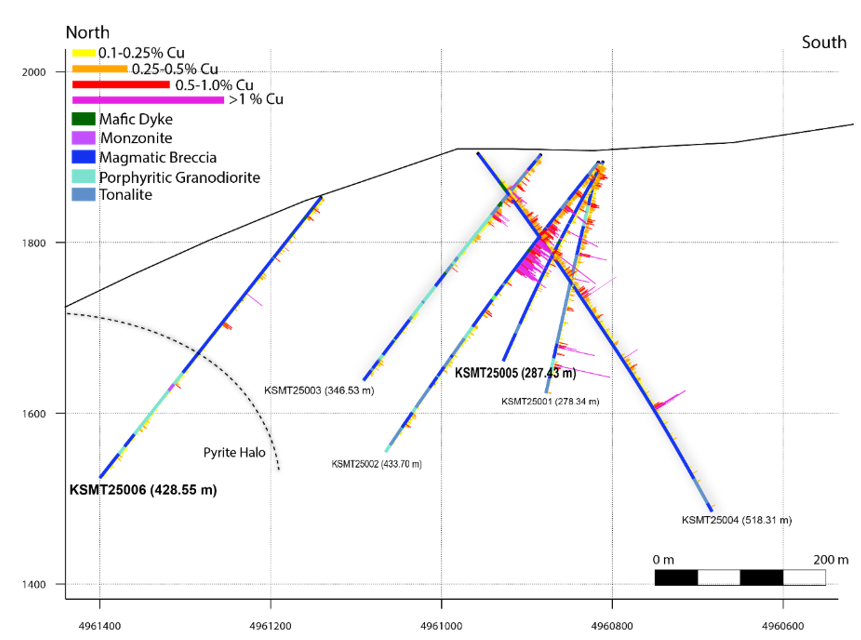
This is another piece of the exploration puzzle as the 2025 drill program now established the consistent presence of copper mineralization from surface to depth, while the two tourmaline breccias (which are exposed at surface) further confirm the technical picture at the Kismet breccia complex.
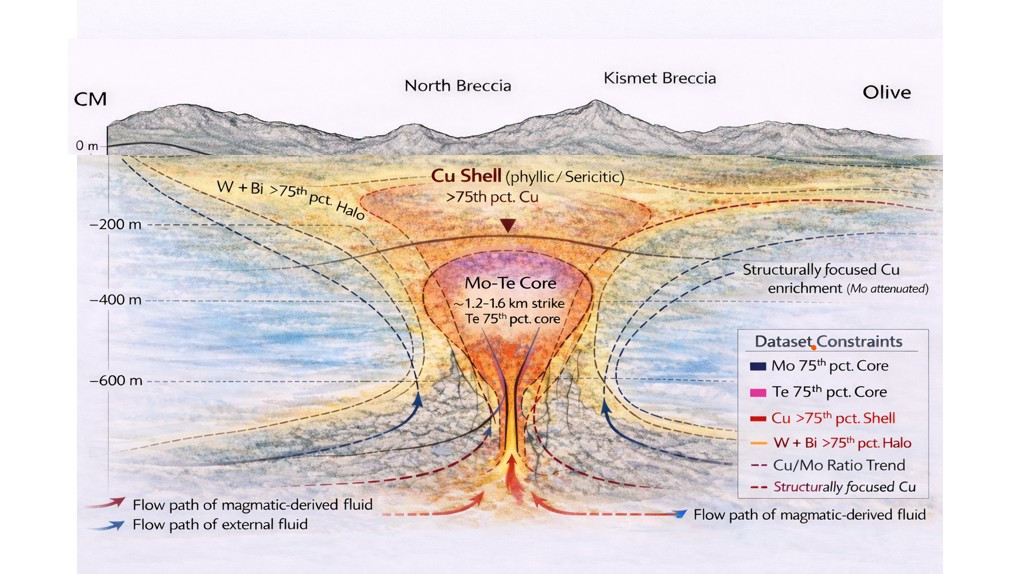
Long story short, the assay results of the six holes confirmed the Freeze system extends from a tourmaline breccia zone that’s exposed at surface into a deeper intrusive-hosted mineralization. In fact, seeing hole 006 intersecting intrusive-hosted copper-molybdenum mineralization following the penetration of a pyrite-rich shell represents a key geological transition within the system as the company’s technical team interprets the data as geochemical vectors pointing to a deeper magmatic-hydrothermal source, which could very well be a porphyry zone.
This interpretation is supported by new geophysical data which has now defined a large conductivity anomaly at depth between the North Breccia trend and Kismet, which now represents the Porphyry Target.
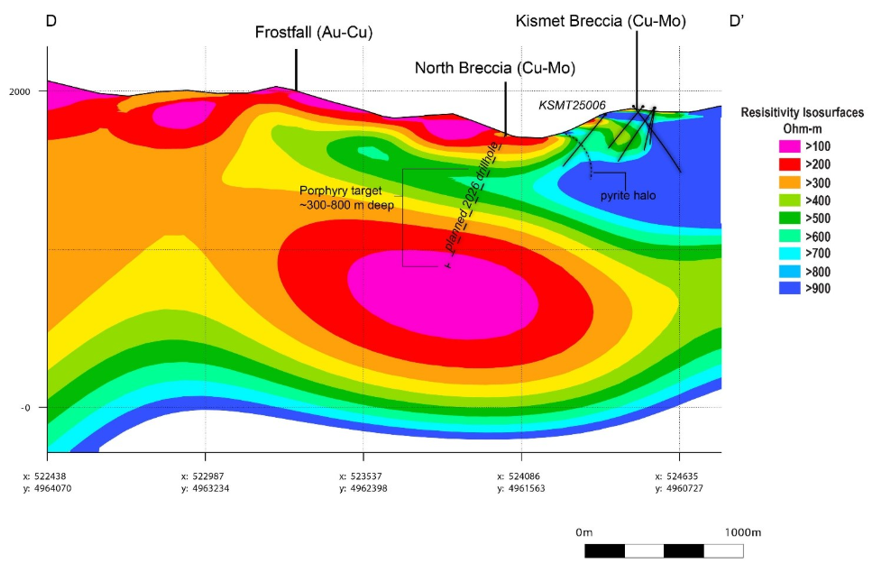
The company followed up on the discovery of the intrusive and released a comprehensive technical update (the bullet points are shown below). The interpretation of three different data sets all results in the same conclusion: the highest priority drill target is located directly beneath the North Breccia, and this target will effectively be drilled this year.
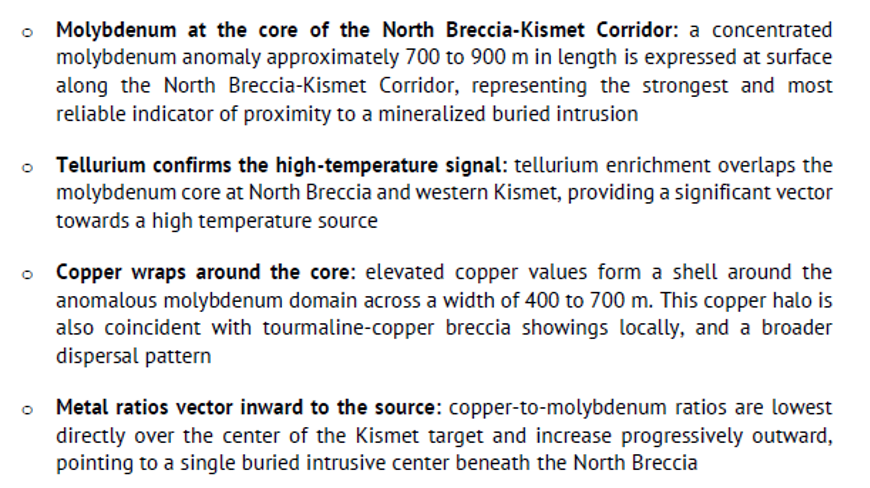
In a nutshell: the soil Geochem data has corroborated what the geophysical anomalies and the visual observations from the drill core were already pointing at: there is a potential buried mineralized intrusive zone directly beneath North Breccia.
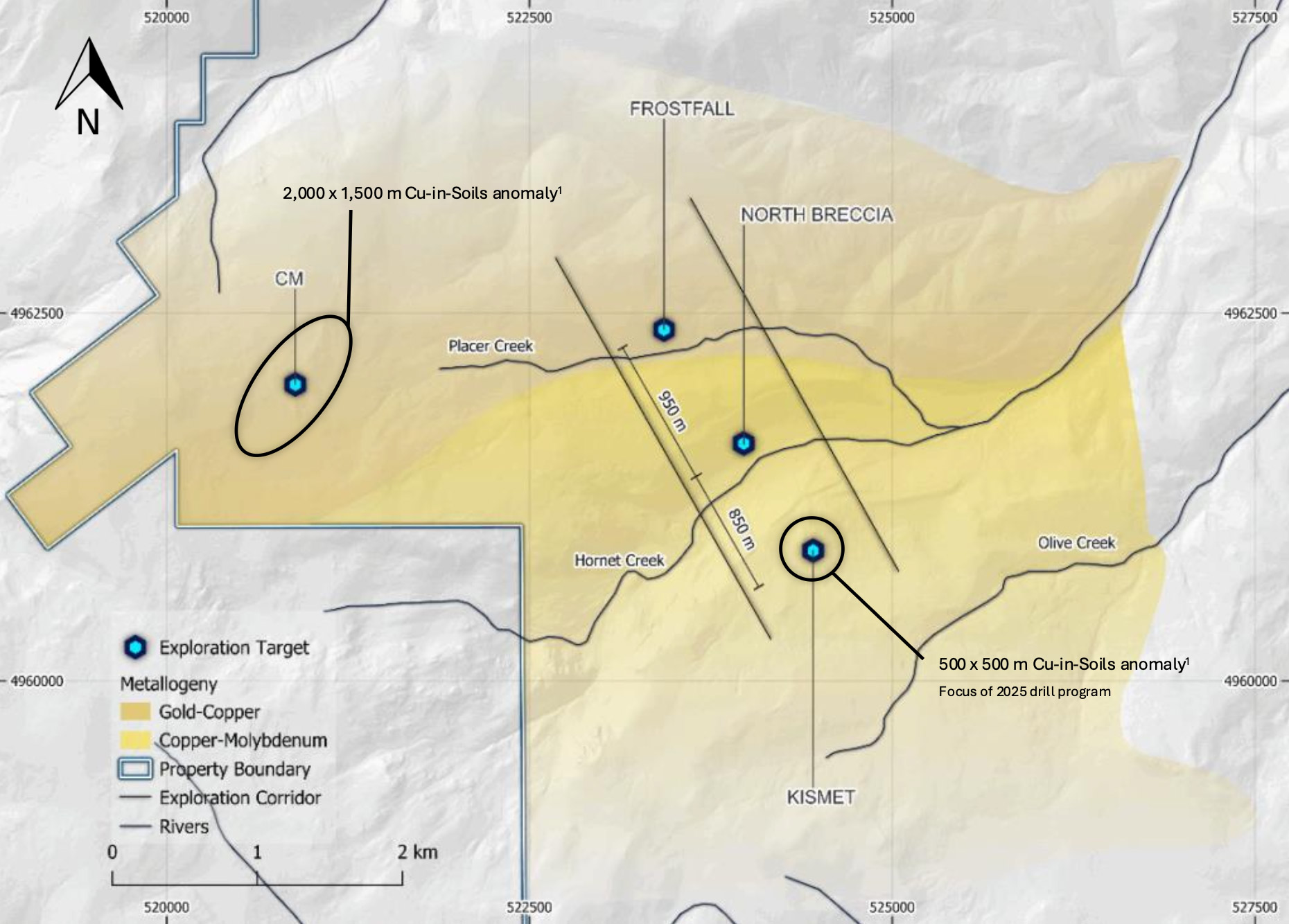
It’s perhaps also interesting to highlight the discovery of a new breccia body, less than a kilometer north of the 2025 drill program location. Additionally, besides discovering an additional breccia structure, the company’s field teams discovered a new gold-bearing zone (now called the Frostfall Zone) approximately 950 meters further to the north.
The company has summarized all key elements in these bullet points:
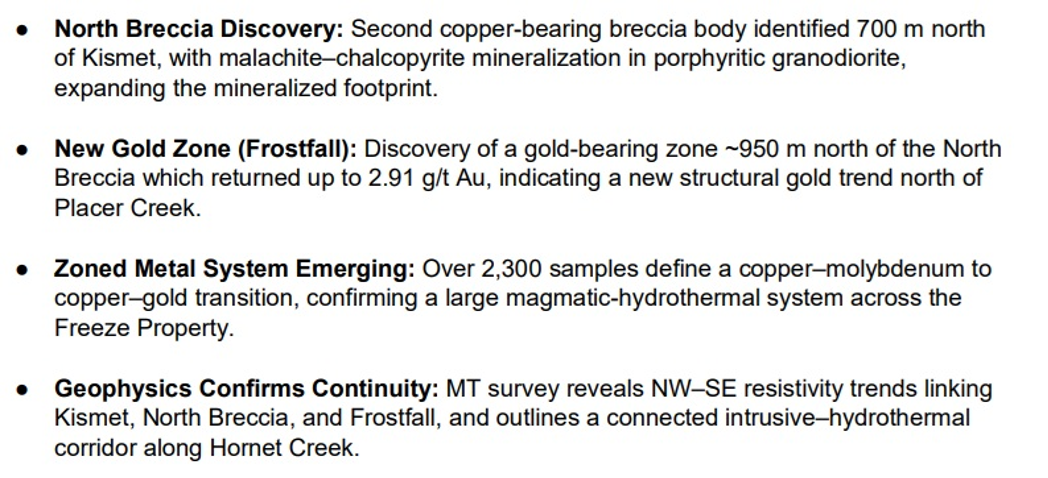
The North Breccia zone was discovered approximately 700 meters north-northwest of the Kismet target, and it appears to be a pretty similar type of mineralization to the magmatic breccia system that’s visible at the Kismet target. According to the company, the existence of a second breccia body, this close to Kismet, has several implications;
“it remains to be determined whether the breccia system is part of the same breccia system as Kismet, or whether it represents a separate magmatic hydrothermal system entirely. Secondly, there may be an important relationship between NW-trending structures at Placer Creek, Hornet Creek and Olive Creek, and exposures of mineralized intrusive lithologies.”
The newly discovered Frostfall zone was discovered under the root systems of newly-fallen trees and the extent of the mineralization remains unknown at this point. But it is interesting to see that the alteration and style of this new zone appears to be identical to the CM zone, which is located about 2,500 meters to the west of Frostfall.
The key elements to keep an eye on in 2026
A. Tungsten
What’s better than encountering two Critical Minerals? Encountering three different critical minerals. The list of 60 Critical Minerals in the USA (although IDEX is a Canadian company, its asset is located in the USA, so the US list of Critical Minerals trumps the Canadian list) includes copper and silver as a critical mineral. But IDEX Metals encountered a third critical mineral in the second drill holes at Kismet: Tungsten.
As a reminder, hole KSMT25002 encountered almost 421 meters of 0.37% copper, 1.96 g/t silver, 192 ppm molybdenum and 419 ppm Tungsten, including a higher grade interval of 101 meters of 1.02% copper, which also included 805 ppm Tungsten. Tungsten was encountered in all six holes that were drilled on the property, with varying grades.
While 805 ppm doesn’t sound important, it actually is. The price of tungsten is expressed per metric tonne unit, which represents 10 kilograms (basically encountering a grade of 1% WO3 in rock represents 1 metric tonne unit). 805 ppm represents 0.08% (rounded) and thus 0.08 mtu tungsten.
With the tungsten price trading at a record high of approximately US$3000 per mtu, the gross metal value of an interval with 0.08% WO3 is approximately US$240 per tonne.
And although the spot price for tungsten may be overheated right now (the supply chain risk is real though, so perhaps we are entering into a ‘new normal’ when it comes to pricing) but if we would use a long-term price of US$1000/mtu (1/3rd of the current spot price) and apply an 80% recovery rate and a 75% payability percentage, 805 ppm Tungsten still represents a rock value of US$48 per tonne of rock. And in this scenario, it would add about 0.4% to the copper-equivalent grade.
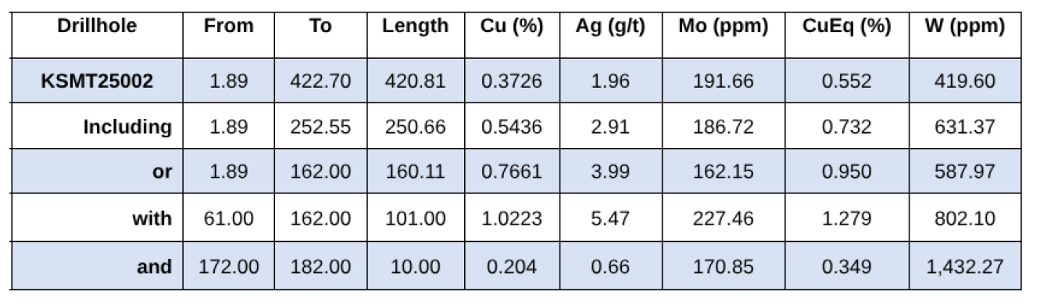
Keep in mind the copper-equivalent grade shown in the table above is solely based on the copper, silver and molybdenum. If we would add a tungsten credit (using the aforementioned base case scenario with $1000/mtu as price, including the anticipated recovery rate and payability percentage), the 421 meters of 0.55% CuEq would be boosted to approximately 0.75% copper-equivalent. Meanwhile, the 101 meters of 1.28% copper-equivalent would be boosted to almost 1.7% in this scenario. While this is just a back of the envelope calculation, it confirms the tungsten credit could be interesting, going forward.
While a lot more work needs to be done to get a better understanding of the tungsten zone, it could be a game changer for the company as it could present itself as a valuable by-product credit, while it could also draw the attention from the right people at the US Department of War.
B. The porphyry target
While the tungsten offers an interesting angle, we expect the attention this year to go towards the quest to discover the intrusive-centered porphyry copper-molybdenum system. As discussed earlier in this update, IDEX’s technical team saw a lot of interesting data points at the bottom of hole number 6.
The evaluation of the lithology, alteration and geochemistry at the bottom of hole 6 indicates a vector towards a potential heat source. This interpretation is further validated by seeing increasing molybdenum values and the development of localized potassic alteration overprinted by phyllic alteration. That’s all quite technical but the main takeaway is that the interpretation of the data supports the exploration theory that a deeper, mineralized magmatic-hydrothermal system may be present in the greater Kismet corridor.
The proof of the pudding is in the eating, and we are looking forward to seeing an update on this high-priority drill target later this year.
C. The CM Zone
The focus of the 2025 drill program was centered around the Kismet target. Rightfully so, as the company intersected mineralization in all six holes. But while IDEX Metals was drilling the Kismet zone, it received the approval for its plan of operations for the CM target from the US Forest Service. The CM target contains a very large copper-in-soil anomaly which also coincided with the IP chargeability and resistivity response that were encountered in a 2024 survey.
The 2026 exploration program will kick off this month
The company has now kicked off its 2026 exploration season at Freeze and the first point of order is completing an Induced Polarization geophysical survey. This survey will focus on the Kismet-North Breccia – Frostfall targets and should define near-surface structures and alteration zones.
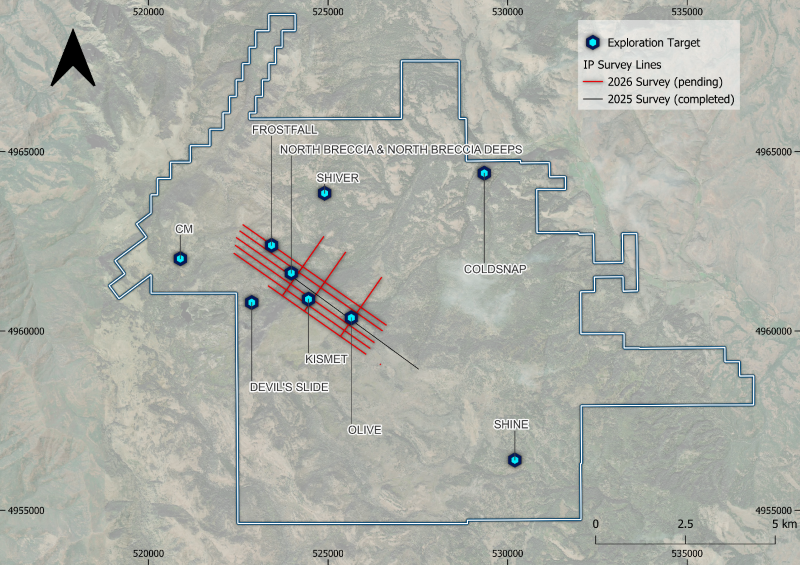
The data from this 37 line kilometer IP survey will help to get a better understanding of the depth of the mineralization at the aforementioned three targets, while also gathering more details on the continuity and geometry of the mineralized structures. The key element here is of course trying to pinpoint the locations of the next few holes to drill-test the large conductive body that’s located directly beneath the North Breccia location.
Once the IP survey has been completed and the data and results have been interpreted, IDEX Metals will kick off its 2026 drill program with drill holes specifically designed to drill-test the intrusive centre.
Conclusion
IDEX Metals applied a very methodological approach on its Kismet tourmaline breccia target in 2025, and that approach is paying off. Not only did the drill bit intersect copper mineralization in all six holes, the assay results indicate the presence of tungsten, which could be an interesting by-product credit further down the road.
The company also ended the 2025 exploration season on a strong note as hole 6 intersected intrusive-hosted copper-molybdenum mineralization, with increasing molybdenum grades towards the bottom of the hole. This indicates there’s a high-priority porphyry target right underneath the North Breccia zone. And as IDEX Metals is ready to kick off its 2026 exploration program, we should soon have a much better understanding about the potential of this porphyry zone.
Disclosure: The author has a long position in IDEX Metals. IDEX Metals is a sponsor of the website. This report is for educational purposes only; be mindful that investing in junior mining stocks is risky, and you may lose your entire investment if things go wrong. Please read our disclaimer.