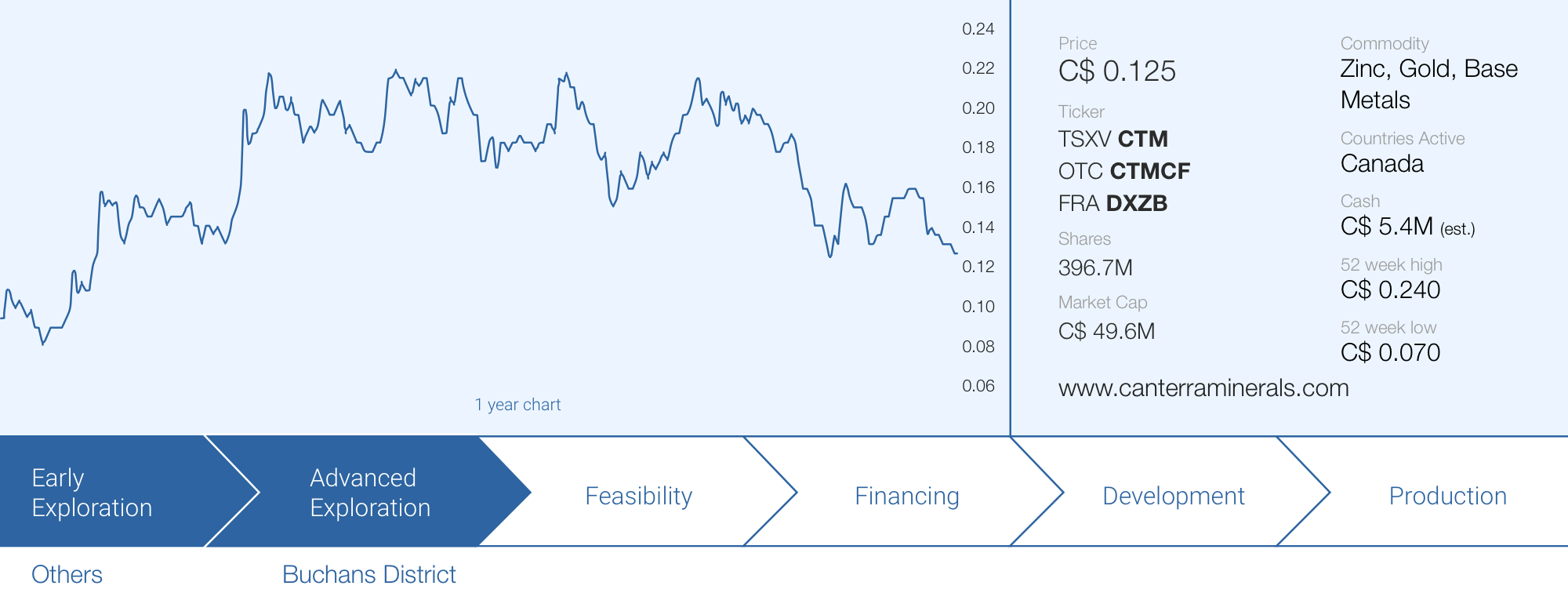
The next few months will be important for the future of Canterra Minerals (CTM.V). The company will complete an additional 2,000 meters of drilling and include the data in an upcoming resource calculation, while the rigs will start working on the regional targets to prove up additional mineralization elsewhere in the Buchans critical minerals district with an additional 6,000 meters of drilling.
While there is an existing resource at Buchans, the company aims to surpass the 20 million tonnes mark on its quest to prove up critical mass at Buchans. The company is fully funded to complete the 8,000 meter drill program as well as the resource update, which means the second half of the year will be catalyst-rich.
Canterra recently kicked off its 8,000 meter drill program
Canterra recently announced it has started its 8,000 meter Phase 2 diamond drill program on its flagship Buchans critical minerals project in Newfoundland.
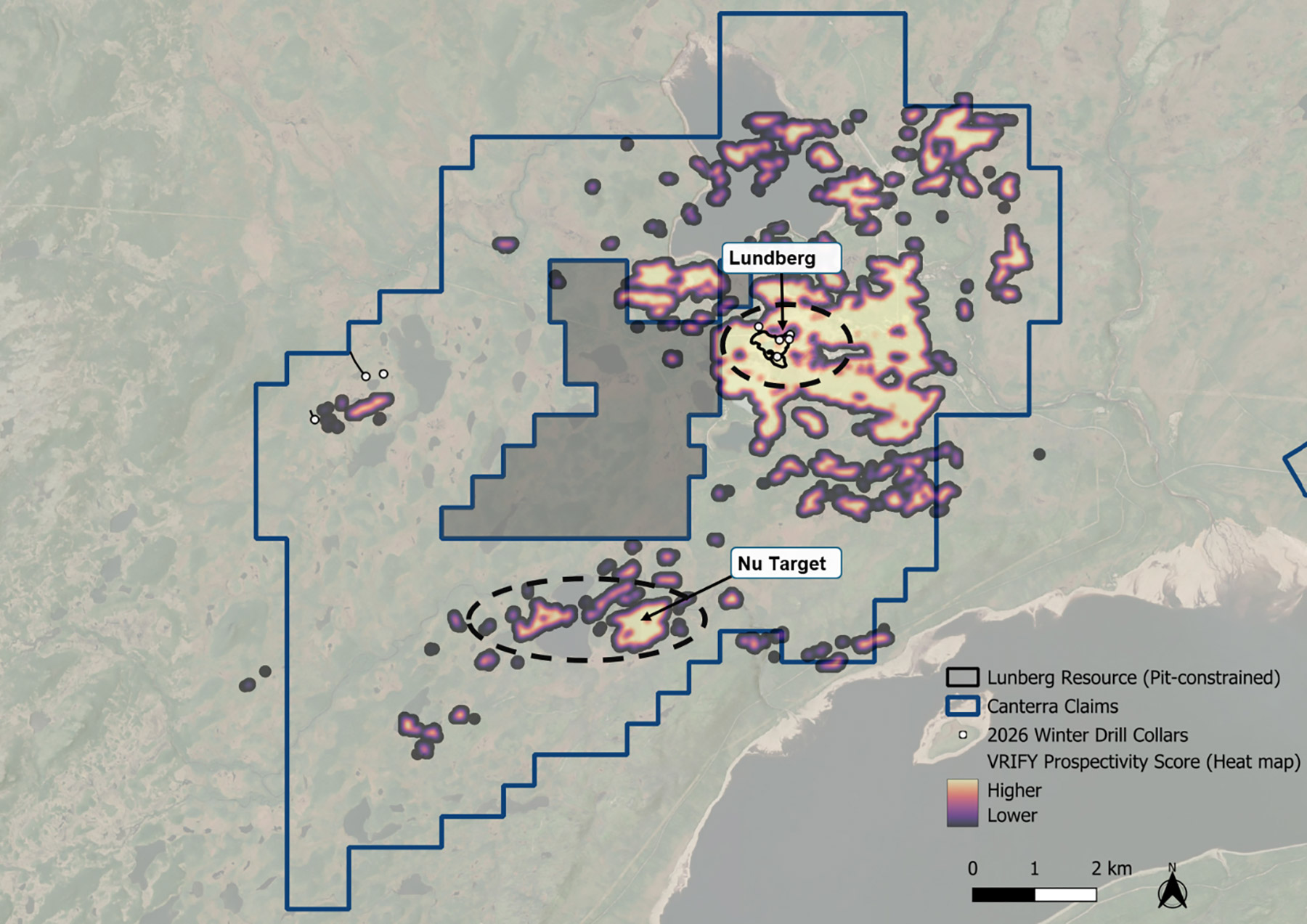
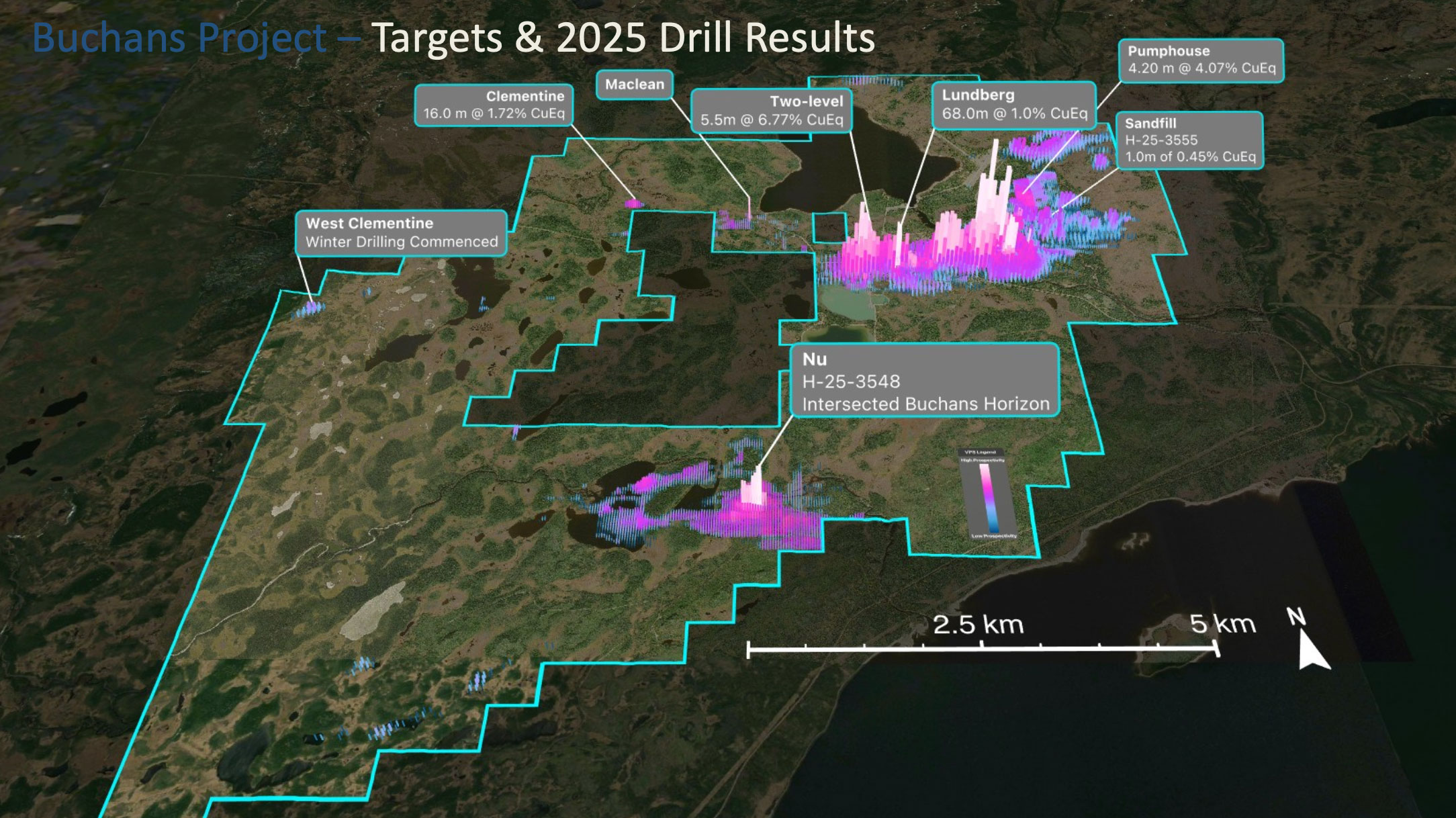
Of the 8,000 planned meters, 2,000 meters are earmarked for the Lundberg deposit, with a specific focus on further defining potential extensions to the southwest of recently completed drilling. The 2,000 meter allocation will also be helpful to further define the Two Level zone, the high-grade area where drilling last year encountered 5.35 meters of 6.77% copper-equivalent.
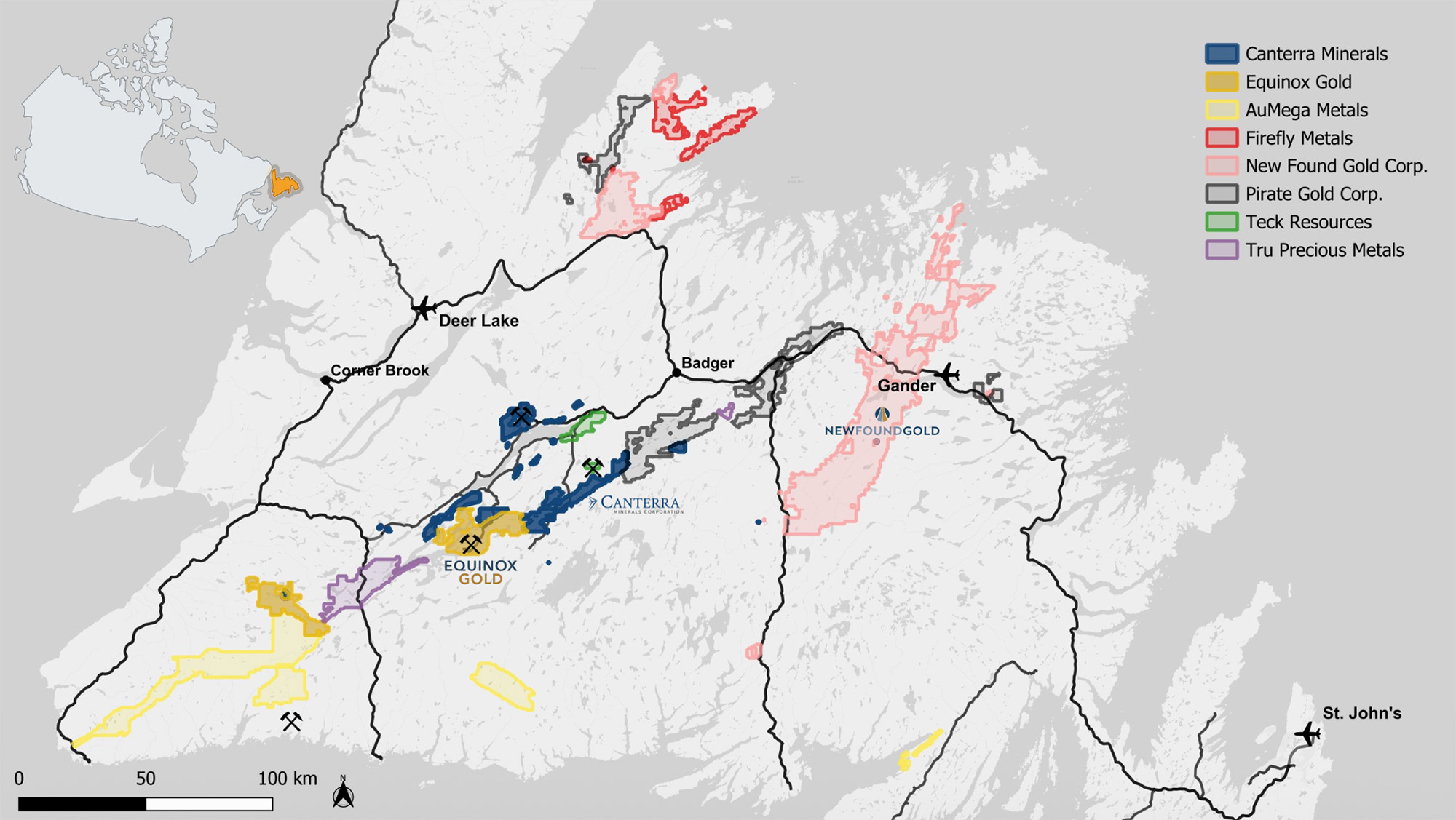
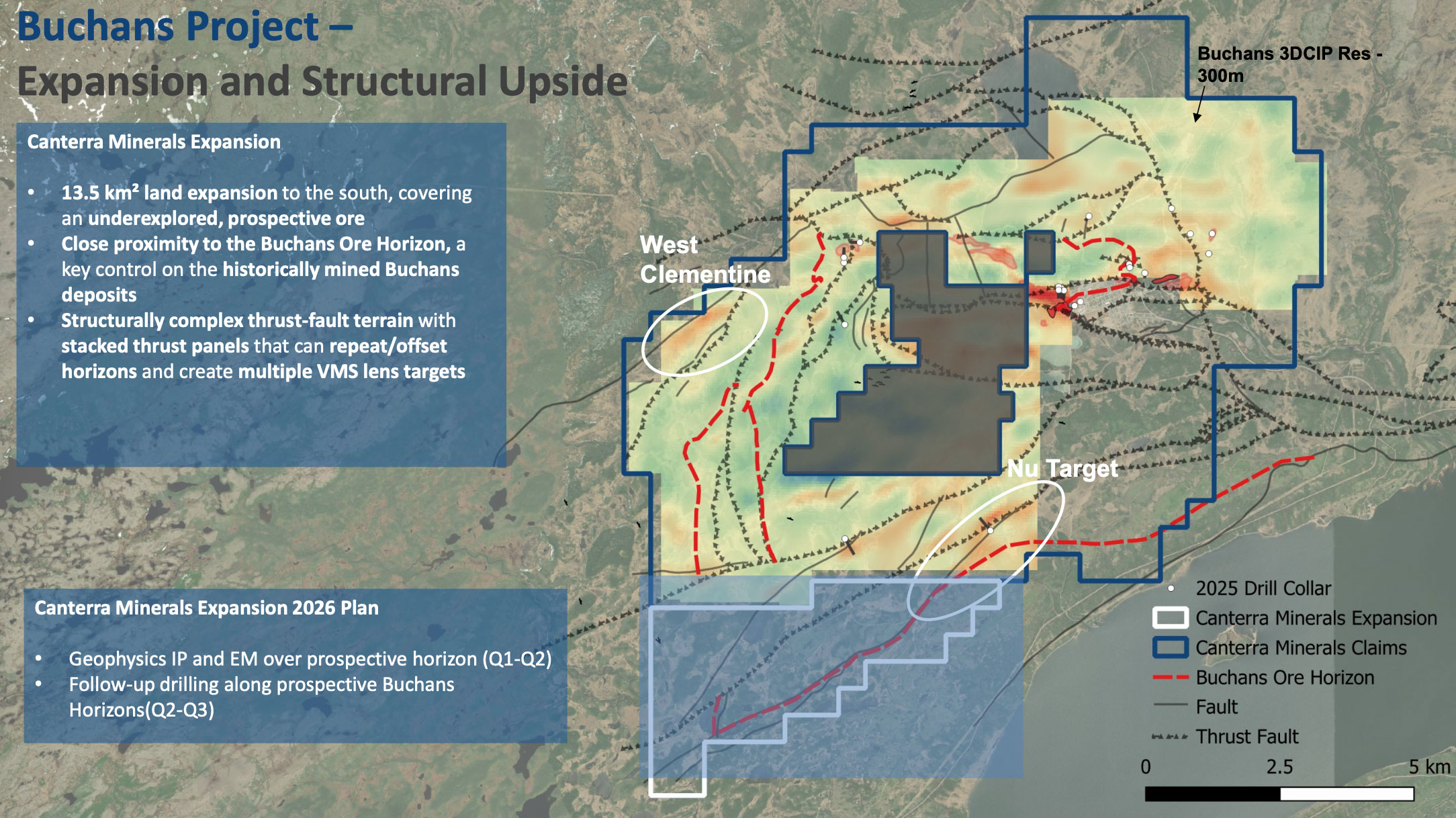
The remaining 6,000 meters will be allocated to the greater Buchans district. The company plans to drill some of its higher priority copper-zinc targets including the Tulks, Long Lake, Boomerang and Lemarchant deposits with a goal of demonstrating the growth pipeline of the district. This further lends credibility to the company’s exploration and investment thesis that the Buchans district should be seen as a true district rather than a collection of standalone past-producing deposits.
This drill program will be important for the company’s future plans, as Canterra Minerals expects to complete an updated resource calculation at Buchans, which will help to underpin the company’s valuation.
It goes without saying we expect the news flow to be strong in the second half of this year, and that’s why we caught up with CEO Chris Pennimpede to discuss the drill plans at Buchans and the next steps at the Wilding Gold Project.
Sitting down with Chris Pennimpede, CEO
Buchans
You recently started the 8,000 meter Phase 2 drill program at Buchans. Will the assay results from the 2,000 meters allocated to Lundberg/ the Two Level Zone be received in time to be included in your resource calculation?
Yes, we will include the 2,000 m and are drawing a line in the sand so to speak with respect to the resource update. These are the last of the holes that will go into our maiden resource estimate. The results will be received in plenty of time to make it into the resource.
As your understanding and interpretation of the Two Level Zone continues to improve, has this changed your exploration strategy and tactic?
Yes, the delineation of the Two Level zone/horizon has reemphasized the exploration potential in the mine trend which extends to the northwest from the Lundberg deposit.
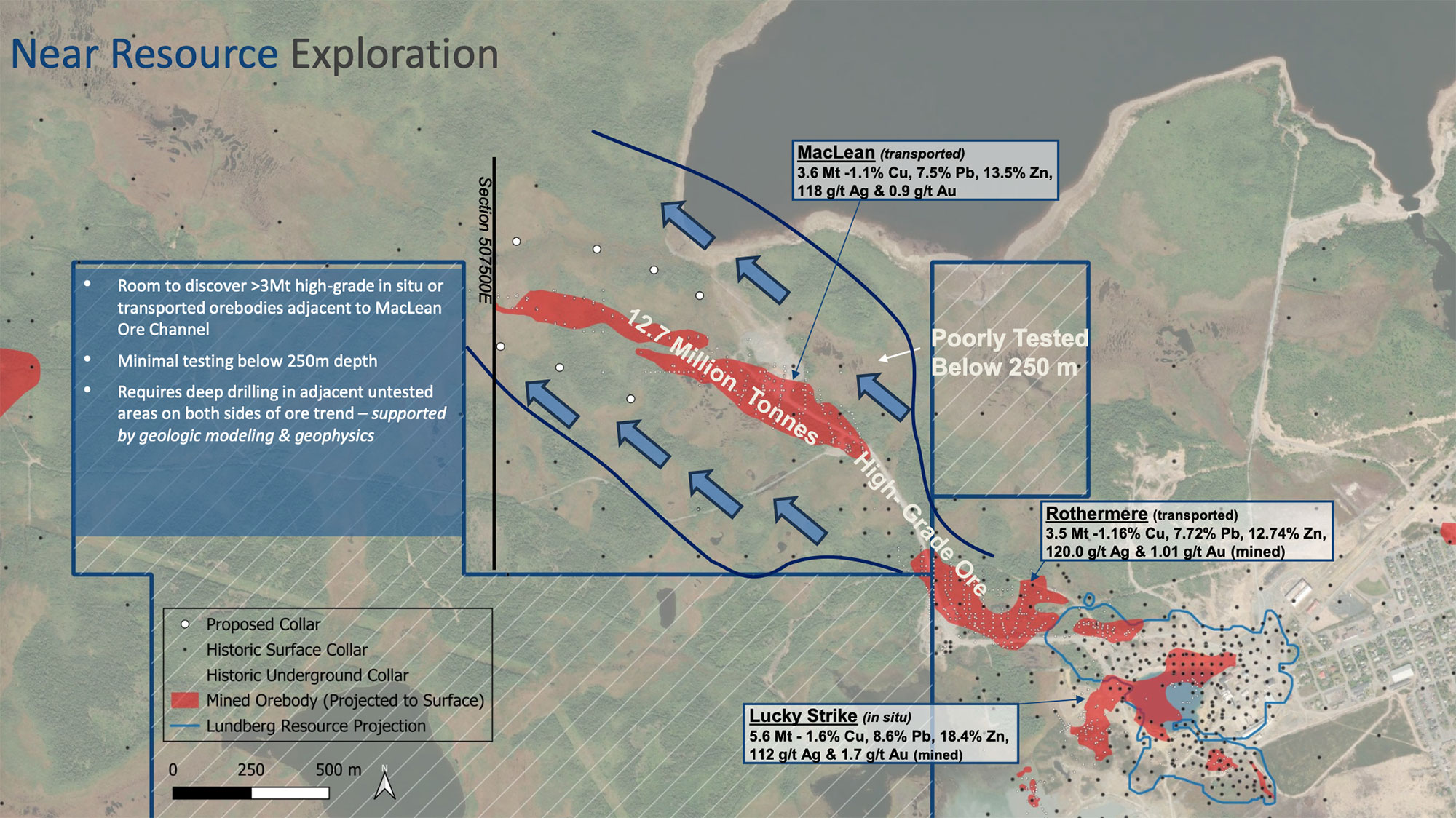
In this trend, Asarco mined almost 13 million tonnes of ultra high grade transported or debris flow mineralization (from the Rothmere, McLean and McLean extension ore bodies). TwoLevel is a mixture of in situ massive sulfide and particularly to the northwest – transported or debris flow massive sulfide material (clasts of massive sulfide derived from an in situ black smoker or vent that has collapsed and been transported down across the sea floor and mixed in with sediments along the seafloor).
In the future, the obvious exploration target in this trend is to discover the source of all this transported mineralization as the in situ massive sulfide ore body that they originally mined, Lucky Strike, was only 5 Mt. The furthest transported orebody that they mined at McLean extension is almost 2 kilometers away. So, the question is where did all of the other 7+Mt of transported mineralization come from? It implies that there is in another in situ massive sulfide source for all this transported mineralization. Future drill campaigns will focus on the mine trend in trying to make a new in situ massive sulfide discovery would be the source for all the historically mined transported mineralization in the mine trend, but that will be a 2027 target.
What’s the rationale behind allocating 6,000 meters of drilling to the greater Buchans district, rather than focusing on Lundberg/Two Level to maximize the tonnage that ends up in the resource?
We believe our last 2 years of drilling the depth and Northwest extensions of the Lundberg stockwork deposit has identified substantially more mineralized material than was included in predecessor owner’s resource in 2019. We believe that our drilling has demonstrated the resource is materially bigger and could underpin a lot of value for CTM and the greater Buchans district in acting as the anchor deposit that could underpin future development. After that has been demonstrated we believe it’s important to also demonstrate that there’s a high grade growth pipeline in the district that could add tons to Lundberg in the hub and spoke mining scenario.
This means the rig will move to the satellite deposits where we are allocating upwards of 6,000 m. If you look at our peers in the VMS space (Foran, Firefly, Abitibi) this is the exact same exploration and development track they all went down. Step 1 – prove the big massive sulfide deposit in the camp is bigger and can underpin development. Step 2 – prove there is a robust growth pipeline of satellite deposits and/or exploration potential for new massive sulfide lenses within the district. This is exactly what we are seeing develop in the Buchans district.
Fun fact, Foran was at approximately the same tonnage and same market cap as CTM is today before they published their big resource increase, which was the first significant re-rating of the stock, which allowed them to attract funding for much bigger drill budgets, which they then put towards some of their satellite deposits and outlined more tons and ultimately continued to drill McIlvenna Bay and made the Tesla discovery. So we are at that pivotal inflection point on the cusp of our maiden resource in the district – the same re-rate opportunity that Foran went through as a stepping stone to the ultimate multibillion-dollar buyout.
The mine trend exploration will be deep drilling and will be metre intensive, equivalent to what you see in some of the Québec orogenic gold camps where explorers drill down 500 to 900 m adjacent to historic underground mining workings to make new discoveries. We will need 10 – 20,000 meters of drilling to adequately test the mine trend targets and at this present moment, we have developed a robust targeting framework at the satellite deposits starting with Lemarchant. Ultimately, we did not have the budget to effectively drill the mine trend targets this year, but at Lemarchant the targets are less metre intensive and so they will be prioritized.
You recently went on record, aiming for a 20 million tonne resource. The existing 2019 resource already hosts 17.2 million tonnes (16.8Mt indicated, 17.2M inferred), does this mean you’ll only add about 3 million tonnes to the existing resource? Will that be sufficient to gather more interest and excitement from the market?
I believe I was arm waving that we would be well north of 20Mt +, which would bring the Buchans district total tonnage to almost 30Mt. That excites me a lot. It’s a very significant milestone for a massive sulfide district. 30 million tonnes is the tonnage that sees a VMS district start to be considered a strong development opportunity (we saw this with Foran and Firefly) it’s basically critical mass for development and acted as the major re-rate opportunity for all three of those previously mentioned peers that saw them significantly grow in market capitalization. Aand then more importantly, this paved the way for them to be able to conduct large drill programs, which again for all three resulted in more and more discoveries and more and more tons. I expect the growth pipeline (the satellite deposits) drilling will demonstrate it is only the beginning of new tons to be discovered in the district.
How easy was it to secure drill rigs for this summer’s campaign? Are activities slowing down in Newfoundland in general? What is your anticipated drill cost per meter?
Very difficult, fortunately my experience taught me last time we were in the bull market in 2010 that you need to act quickly to secure rigs for the entire year basically at the end of the preceding year, which we did. Things are actually ramping up significantly in Newfoundland with new discoveries out of Equinox at the Valentine gold mine, Firefly aggressively exploring their growth pipeline and Pirate Gold planning to drill quite a bit this year., It is very busy and I would hazard to bet that if you went looking for drill rig at this very moment you would not get one on the island. Our costs have crept up since last year, but we still maintain C$200 all in a metre when we’re drilling at the former Buchans mine in the Lundberg deposit, but they go up to C$250 per meter at the satellite deposits as your commuting distance has gone up from 0 in Buchans to up to an hour or more on forest service roads.
Wilding
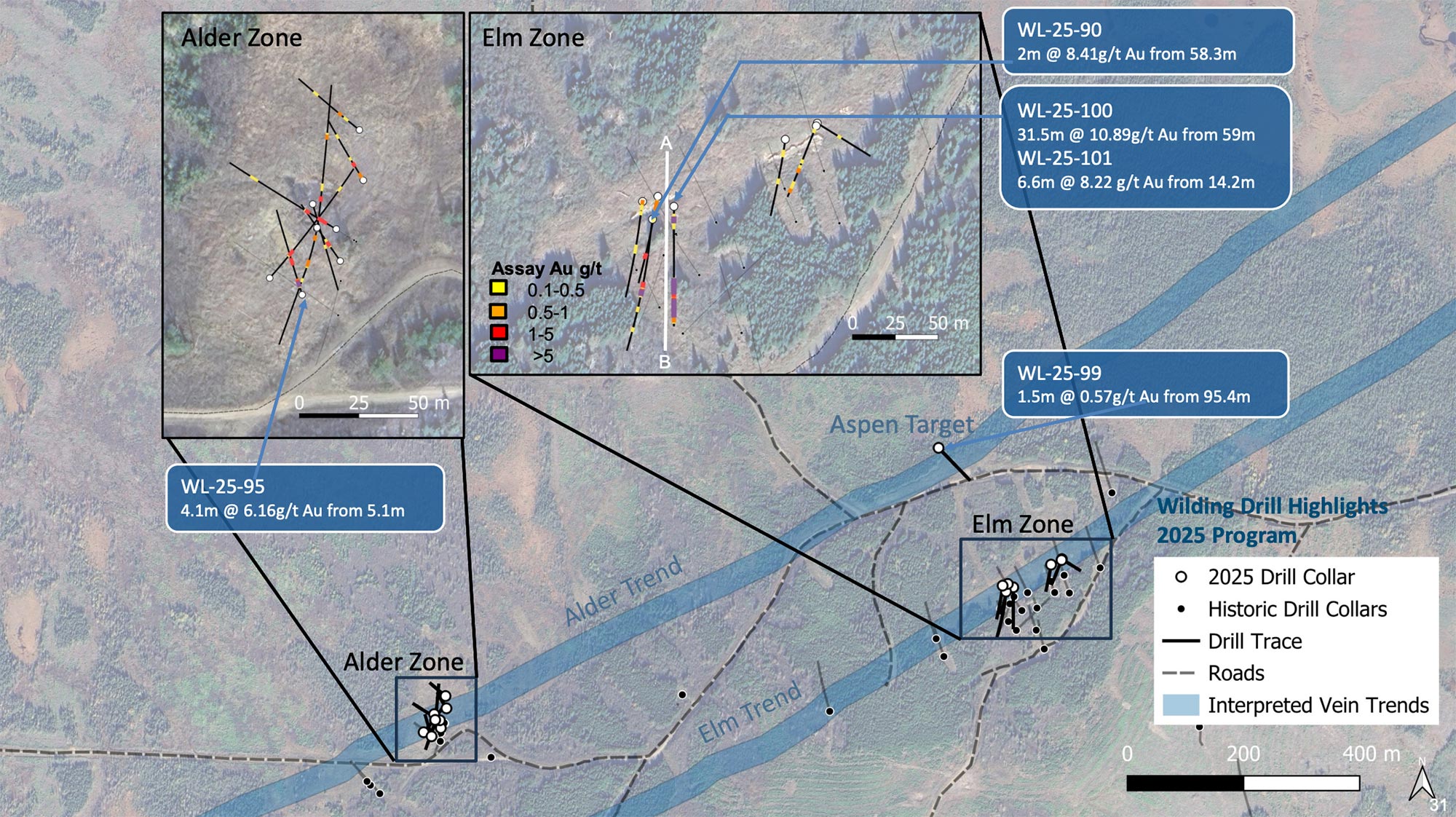
It has been a bit quiet around the Wilding gold project since you released the final batch of assay results in January. The highlight was of course intersecting 31.5 meters at almost 11 g/t gold (including 5.4 meters of 41 g/t gold) which the market (almost inexplicably) shrugged off. And it wasn’t a one-hit wonder as you also intersected 6.6 meters of 8.2 g/t gold and 4.1 meters of 6.2 g/t gold. Given this was a very limited drill program (18 holes and less than 1,250 meters drilled), you surely must be encouraged here?
Unfortunately we put those holes out the day that Trump announced significant tariffs everywhere and the big boards slid dramatically and took everything with it. We did record volume, but were fighting the downward trend all day and ended up unchanged, which was a bummer for ourfirstt Valentine -like intercept.
We are still very encouraged about the drill results from Wilding, but because of the cover it’s been difficult to target outside the known outcropping mineralization. That is the reason we embarked on the basal till drill program plus the detailed magnetic survey as we needed more layers of data to help us target through the cover to see the extent or possible extent of the identified vein networks at surface.
Relative to the Buchans district, Wilding is very early stage, grassroots exploration whereas there’s a lot of low hanging fruit in the Buchans district. Thus, the bulk of this year’s drilling budget was directed to the Buchans district because of the higher confidence in the targets delivering new discoveries and/or tons.
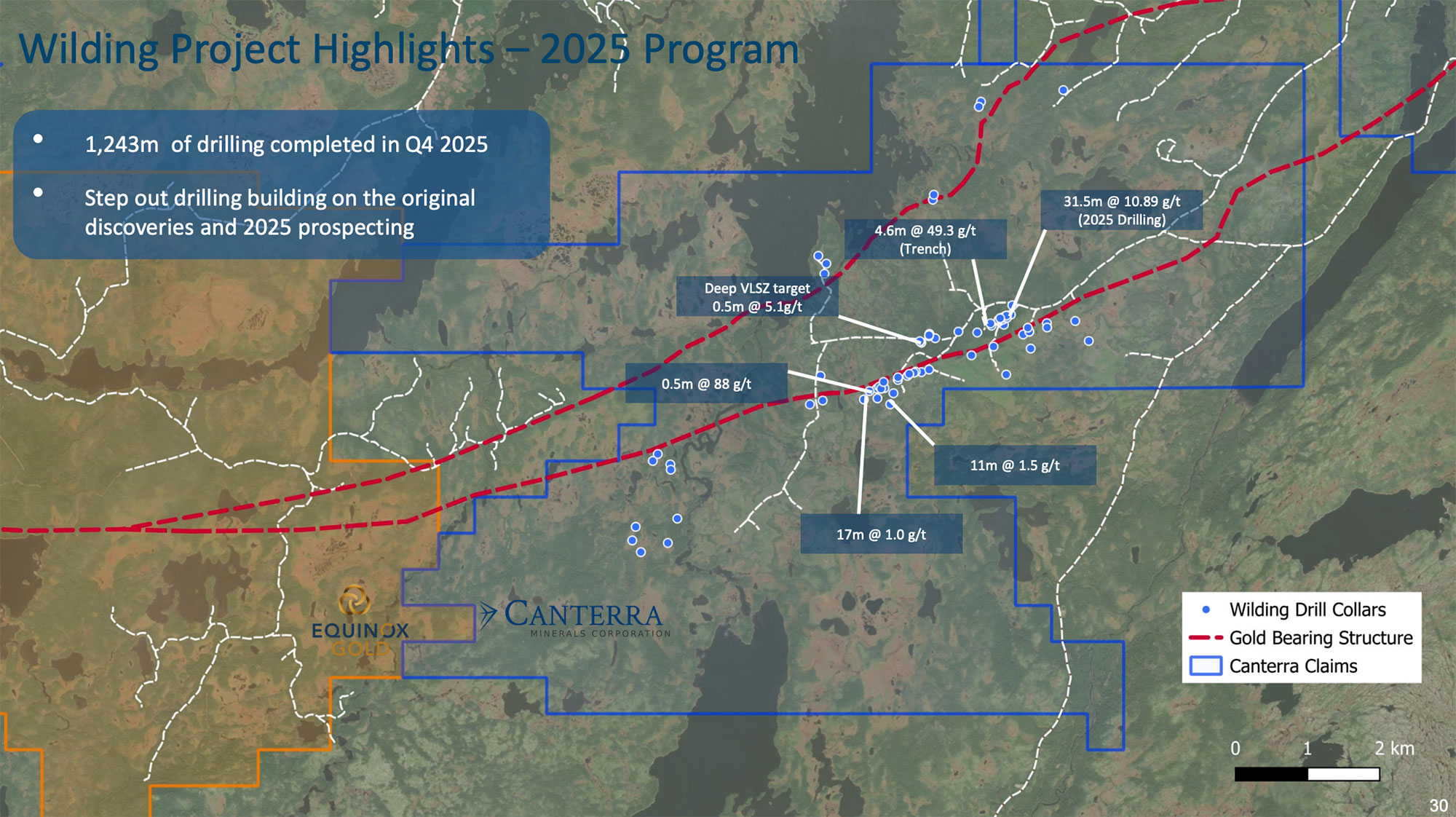
Subsequent to the diamond drill program, you completed a basal till drill program, with 181 percussion holes along the structural trend. This of course is a cheap way to explore for gold. When can we expect the assay results from the percussion drill program?
Because we employed a subcontractor to complete this program they used their preferred off island lab (Eastern Analytical on the island doesn’t provide a full suite of multi-element assays, which are important when you’re analysing basal till results) so the samples are in the backlog with the rest of Canadian exploration stories and thus we are still waiting unfortunately. Thankfully the diamond drilling is not impacted because those samples all go to Eastern Analytical for assaying.
Your airborne magnetic survey will also help to refine your drill targets. Could you elaborate on the decision-making process?
The Valentine Lake intrusion (the host of all 5 million ounces of goldz at the Valentine mine) is so far only known to exist in two places on the Wilding Gold Project. in the first occurrence is in the northern part of the property where we drilled a few holes, hit the right rocks and veining but where we did not identify any mineralization just yet. And a second occurrence was found at 200 metres under a magnetic anomaly in the centre of the project, where one historic hole drill intersected mineralization in the Valentine Lake intrusion suite at the bottom of the hole.
It’s the exact analog to Valentine where we see intense shearing throughout the Rogerson Lake conglomerate (which is the marker horizon) and then the hole intercepts the Valentine Lake intrusion suite. Instead of blindly drilling this 1.5 kilometer magnetic anomaly that represents the intrusion, we decided we needed a higher resolution magnetic survey to hopefully outline that contact between the shear zone and the intrusion and to identify areas where cross structures and potential mafic dikes are prevalent (a key ingredient to emplacement of gold mineralization at Valentine) and also where the anomaly is shallower and thus the drilling should be shallower to reach the intrusion. So we conducted a high-resolution Helicopter-supported magnetic survey (remarkably the Heli mag came out significantly cheaper than using a drone) at 25 m spaced lines versus the original survey that was 70 m+. We are evaluating that data now and should have results imminently.
Corporate
You adopted semi-annual reporting, which makes it a bit more difficult to gauge your cash position. How is the balance sheet doing, and how much (flow-through) cash do you still have?
We just went through the exercising of over 7 million warrants, which was a significant overhang for the stock as those warrants (which were priced at 6 cents and 9 cents) expired at the end of June. So that helped bolster our cash position on the hard dollar side of things. We are now forecasting to finish the year with just over C$1M. All the warrants were exercised except for one holder. With the announcement of phase II drilling and those 8,000 m,all the flow-through funds will be consumed by the end of 2026.
Conclusion
The next three months will be very important for Canterra Minerals. Although there is an existing resource at Lundberg, that resource is almost 10 years old, and the upcoming update will incorporate all the valuable data gathered by Canterra. As it is clear from CEO Pennimpede’s answers, having a robust tonnage at Lundberg is just the first step, and the 6,000 meters of (initial) drilling earmarked for the satellite deposits could add a tremendous amount of value.
Canterra aims to publish the updated resource calculation by the end of the current quarter, and we hope the company will be rewarded for its exploration efforts. At the very least, a 20-25 million tonne resource update should underpin the current C$52M market capitalization of the company. But hopefully the market will also realize there are plenty of mineralized bodies (some with existing resources!) in the immediate vicinity that could be seen as satellite deposits in the ‘hub and spoke’ model, a classic way to develop VMS projects.
We hope the updated resource will result in a rerating of Canterra Minerals. Peer Abitibi Metals (AMQ.C) for instance, currently has a market capitalization of approximately C$170M (and an enterprise value of approximately C$135M), backed by a resource of 13 million tonnes at 2.1% CuEq in the indicated resource category, and 12.4 million additional tonnes at 2.2% CuEq in the inferred resource category. With approximately 25 million tnones across all resource categories combined, this could be a good comparable for Canterra Minerals as the resource size and grade could be quite similar. We will know more in just a few months!
Disclosure: Canterra Minerals is a sponsor of the website. The author has no position in Canterra Minerals. This post is for educational purposes only; be mindful investing in junior mining stocks is risky and you may lose your entire investment if things go wrong. Please read our full disclosure.