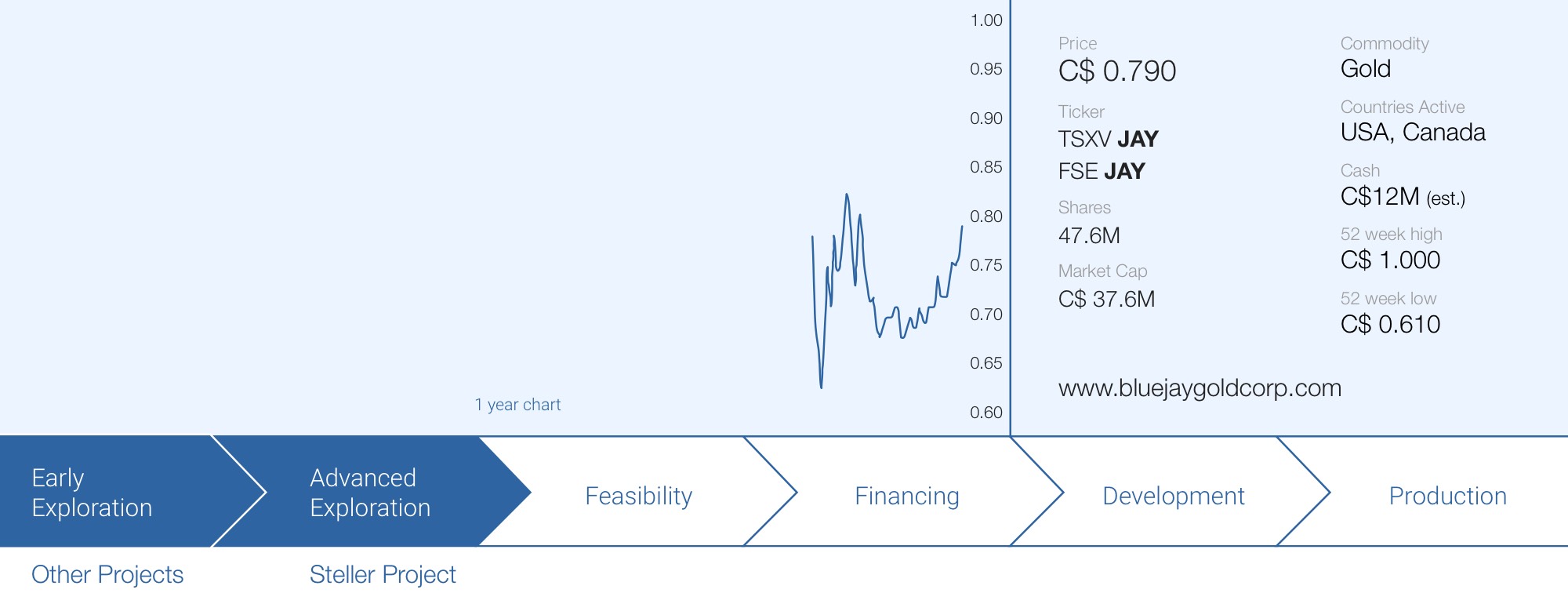
Blue Jay Gold (JAY.V) was initially created to host the Ontario-based exploration assets of Riverside Resources (RRI.V), but the picture (and appeal) changed drastically when the company announced the acquisition of the Skukum gold project (now renamed to the Steller gold project) from Tincorp Metals in the summer of last year.
Not only was the timing of the acquisition excellent, the agreement was also signed before the gold price started its run, and before the exploration potential of the Yukon started to resurface. And this means Blue Jay was able to secure ownership of the project at exceptionally advantageous terms. Sometimes it’s okay to be lucky.
It changed the magnitude of the investment thesis for Blue Jay overnight. Rather than being the umpteenth exploration company with early-stage exploration assets, it acquired a past-producing project with an existing NI43-101 compliant high-grade underground gold-silver resource in the Yukon Territory. A project that had been dormant for a while and has never been explored to the fullest extent.
It’s now up to the Blue Jay management and exploration team to pursue resource growth at Steller and perhaps push the project towards an economic study. But with 120,000 meters of historical drill data, an existing resource and a road that links the project straight to Whitehorse, a lot of important pieces of the puzzle to create value are already in place.
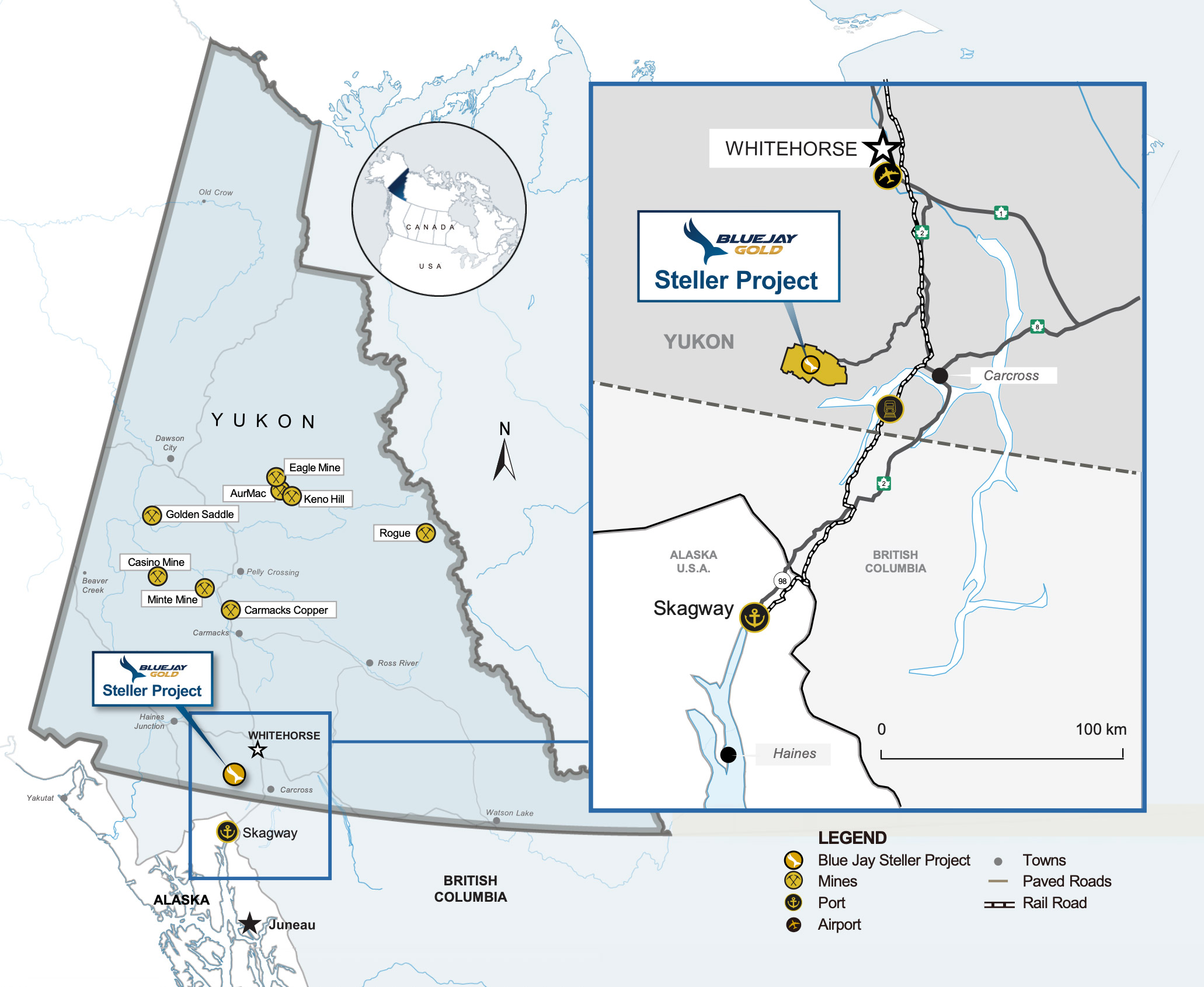
The Steller Project: clearly the company’s flagship asset
The Steller project consists of a 170 square kilometer land package (including the past-producing Mt Skukum gold mine), located within just 84 kilometers from Whitehorse in Canada’s Yukon Territory. The project comes with the data from in excess of 120,000 meters of drilling.
The past-producing portion project was first staked in the early 1980s and brought in production later that decade, producing almost 80,000 ounces of gold in just two years using mining and processing methods that likely were not as efficient as today’s methods and approach. The greater Skukum Creek area has been subject of exploration activities for over 100 years as initial prospectors discovered anomalous gold and antimony.
The most recent drilling activities were performed by Whitehorse Gold (the subsidiary of Tincorp, which sold the asset to Blue Jay Gold), with a 2,091 meter drill program in 2020 followed by 16,554 meters of drilling in 44 holes in 2021. No drilling has taken place since 2021, and the current resource estimate is based on all available drill data to date.
The access to the historical drill data is a real asset. A program of this scope, more than 120,000 metres drilled intermittently over four decades, would take most companies years and tens of millions of dollars to replicate from scratch, but also because the technical team was able to methodologically go through the data with a fresh set of eyes and formulate the best approach to thoroughly and efficiently explore the land package, using a district-focused approach.
So let it be clear: this is a brownfields project, and it even comes with an existing resource estimate that was published in 2025 (so it is fully up to date to today’s standards). As you can see below, the project hosts 1.37 million tonnes in the indicated resource category at 7.57 g/t gold and 127 g/t silver for 334,000 ounces of gold and 5.6 million ounces of silver. An additional 2.17 million tonnes can be found in the inferred resource category at a slightly lower grade of 5.6 g/t gold and 70 g/t silver for 392,000 ounces and 4.9 million ounces respectively.
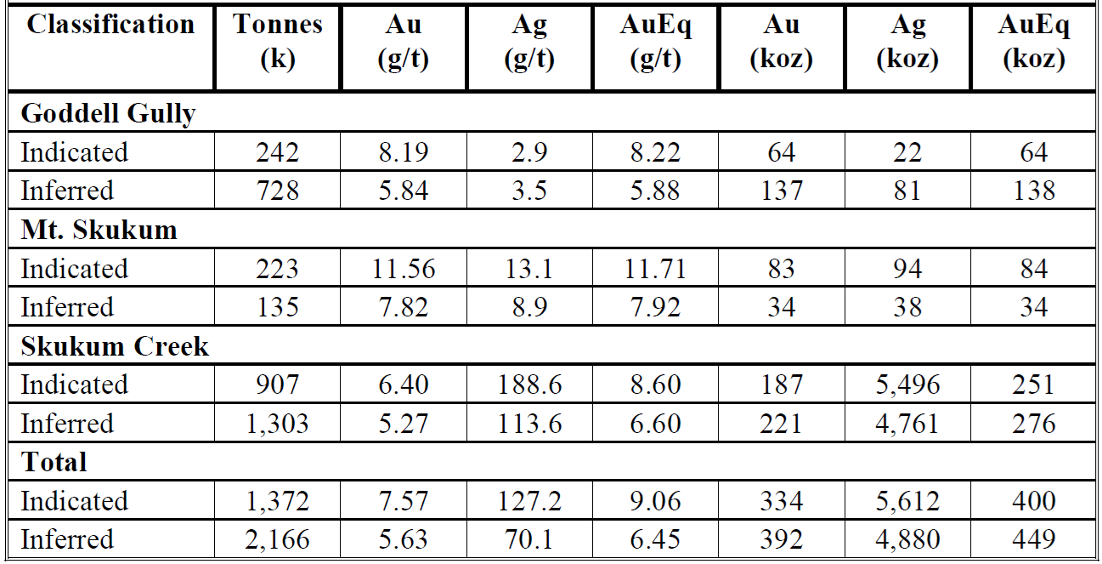
On a gold-equivalent basis (using a silver:gold ratio of almost 86:1), this results in 400,000 ounces gold-equivalent in the indicated resource category and 449,000 ounces gold-equivalent in the inferred resources. Note: this resource is solely based on the gold and silver values and does not take any base metals or antimony values into account. The entire technical report can of course be found on the SEDAR+ website under Blue Jay’s profile. 1
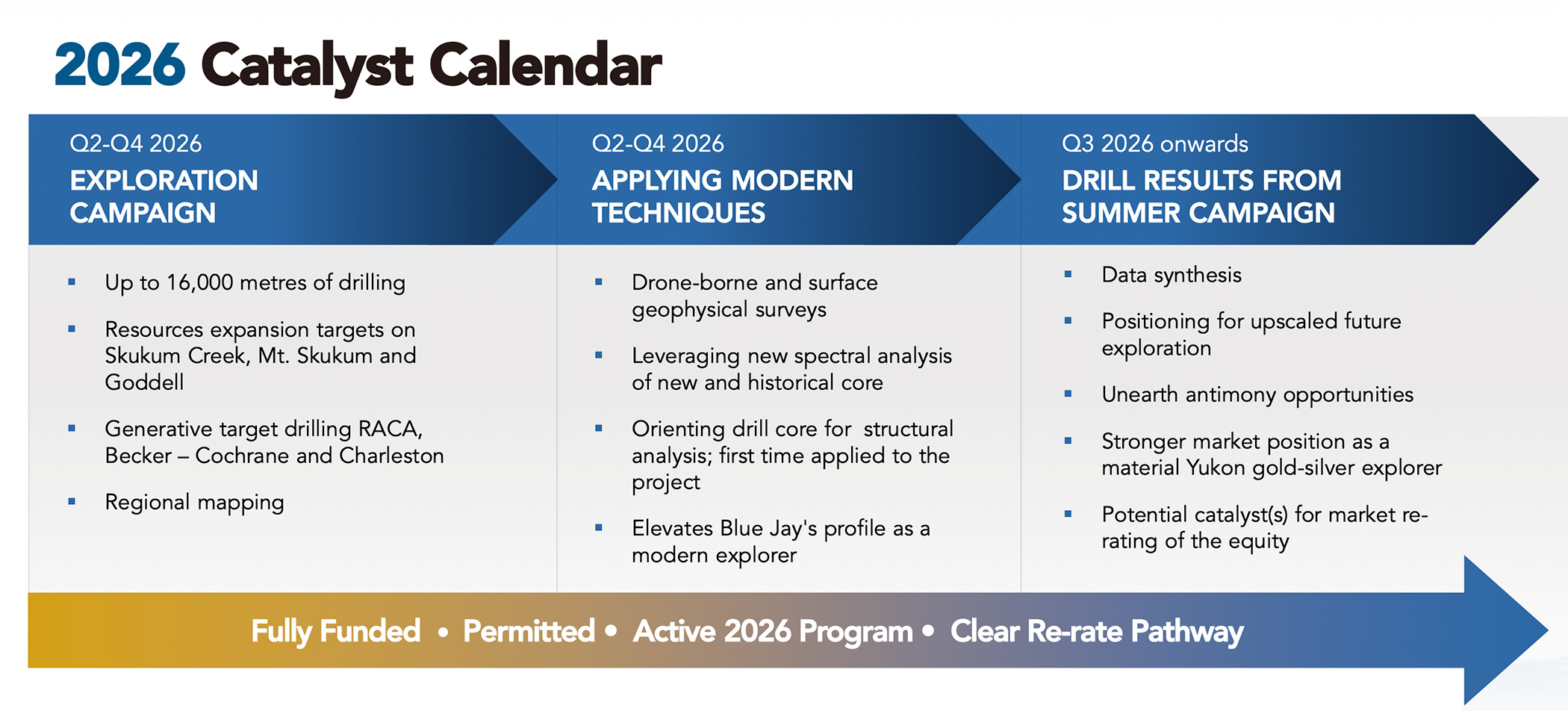
This resource of course provides an excellent starting point to pursue additional resource growth. Blue Jay Gold is planning to complete up to 16,000 meters of drilling (at an estimated cost of approximately C$400/meter – a very reasonable number for Yukon exploration thanks to the project’s vicinity to Whitehorse) and has plenty of drill targets to choose from.
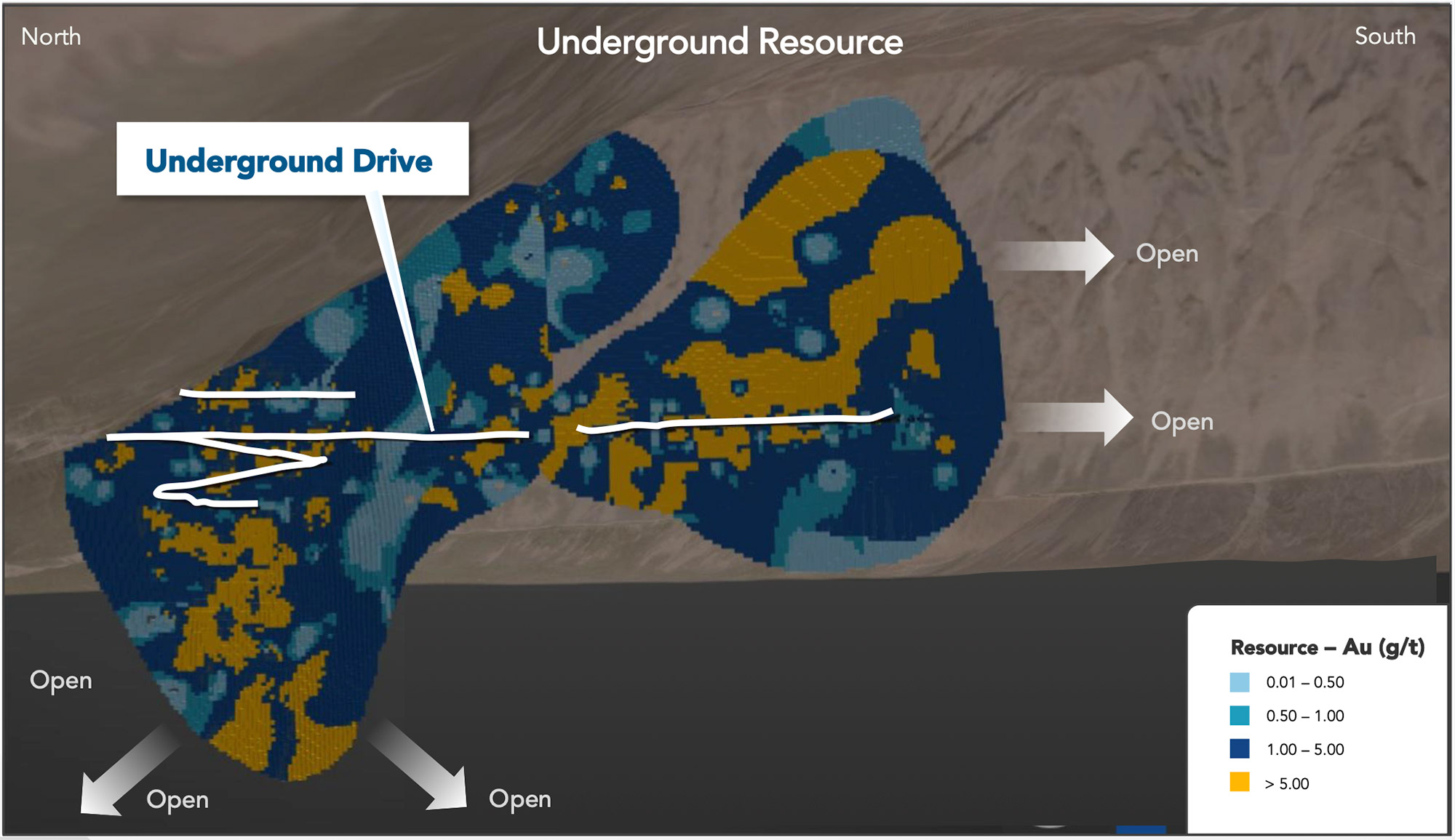
The image below shows the resource at Skukum Creek, which hosts the bulk of the total resource. As you can see, the mineralization remains open in multiple directions, as the limits have not yet been found.
1. 2026 Technical Report. TECHNICAL REPORT AND UPDATED MINERAL RESOURCE ESTIMATE OF THE STELLER GOLD PROJECT, WHITEHORSE MINING DISTRICT, YUKON TERRITORY, CANADA. P&E Mining Consultants Inc. Effective Date: Oct. 31, 2025. Cut-off: 3.0 g/t AuEq. Au: US$2,850/oz. Ag: US$34.20/oz. AuEq ratio = Au:Ag 85.6:1
But as mentioned before, we should consider the Steller project to be a ‘District Play.’ The existing resource already spans three separate deposits, Mt. Skukum, Skukum Creek and Goddell Gully, and that’s before accounting for the largely untested ground across the rest of the property. The pyramid below clearly shows the dozen exploration targets, ranked in order of their importance.
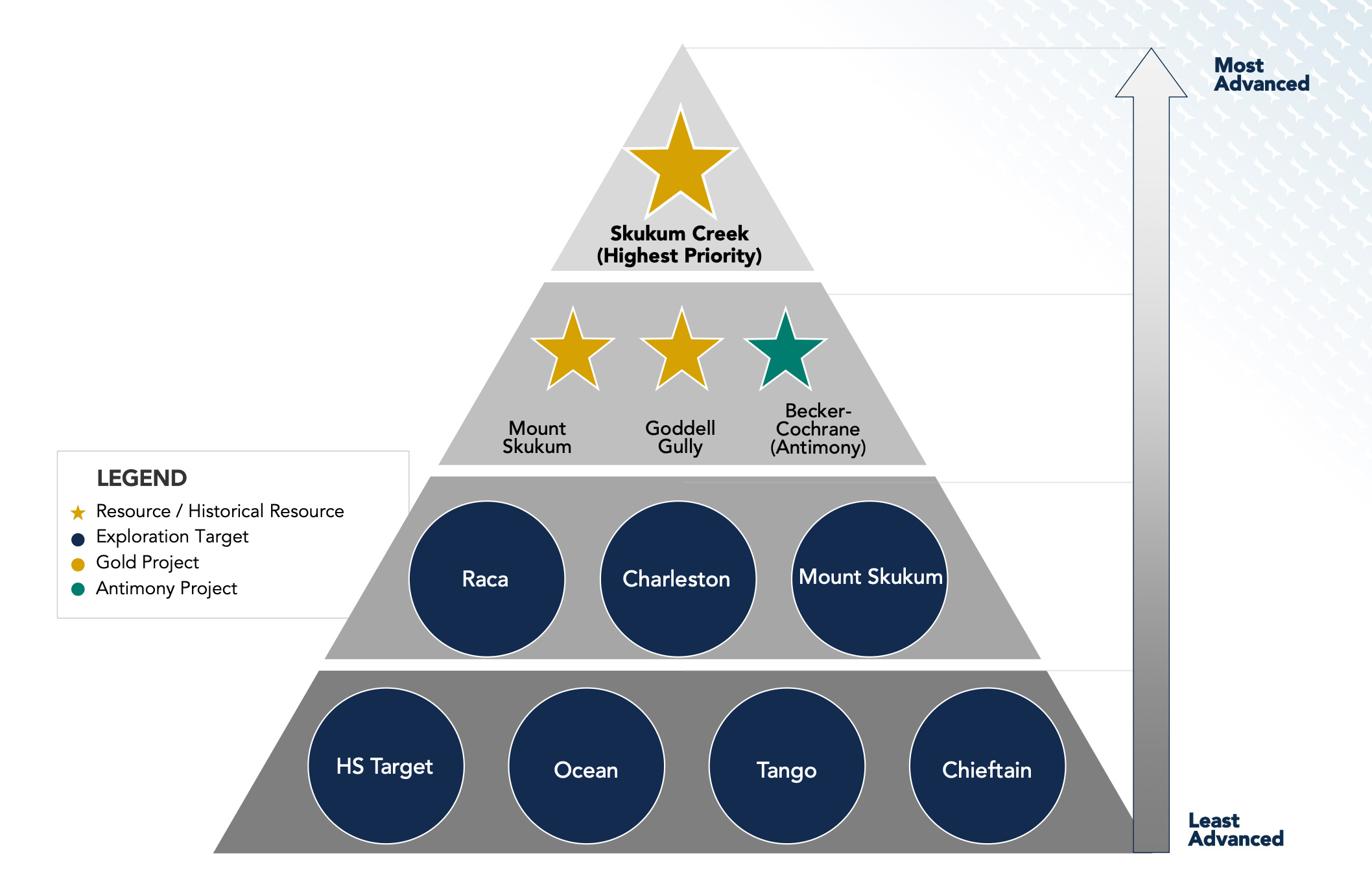
2026 Steller Exploration Roadmap
You may have noticed the Becker-Cochran exploration target is highlighted in green instead of gold. That’s mainly because this target hosts an antimony anomaly.
While two adits were driven into the Becker-Cochran showing in the 1900s, this area only got more recognition in the Sixties when an antimony-bearing zone of approximately 350 meters long, 1.5-7 meters wide and a depth of 120 meters was identified, as per the technical report. A subsequent trenching program encountered antimony values between 2.5% and 27.5%. 2
As China became the world’s leading low-cost producer of antimony in the 90s, this area of the project ended up a bit on the backburner but given the recent geopolitical turmoil, Western nations are rushing to reduce their reliance on China-supplied antimony. As per the US Geological Survey, approximately 85% of the worldwide antimony production in 2025 was supplied by China, Russia and Tajikistan. The Pentagon recently deployed cash to push North American antimony projects forward (with the Perpetua Resources owned Stibnite project in Idaho as best known asset), so the interest in North American antimony assets is real, and we hope to see more details on the Becker-Cochran antimony target.
2. Further detail regarding the Becker-Cochran occurrence, including its discovery, historical exploration, development and sampling, and regarding the Steller Gold Project and its current Mineral Resource Estimate, is set out in the technical report entitled “Technical Report and Updated Mineral Resource Estimate of the Steller Gold Project, Whitehorse Mining District, Yukon Territory, Canada,” prepared for the Company by P&E Mining Consultants Inc. with an effective date of October 31, 2025, available under the Company’s profile on SEDAR+ at www.sedarplus.ca. The historical metallurgical results quoted above are drawn from reports prepared for or on behalf of Yukon Antimony Corporation Ltd. between 1964 and 1966, including the concentration report of the Mineral Processing Division, Department of Mines and Technical Surveys, dated July 6, 1965. https://data.geology.gov.yk.ca/assessment-report/202 https://data.geology.gov.yk.ca/mineral-occurrence/12812 https://data.geology.gov.yk.ca/assessment-report/3639
The acquisition terms
As mentioned in the introduction, sometimes it’s okay to get lucky. The negotiations to acquire the Steller project were started quite early in 2025 and this resulted in a rather advantageous purchase price for Blue Jay Gold.
At closing, Blue Jay issued 500,000 common shares (and 250,000 warrants with an exercise price of C$0.90) to Tincorp, the seller. A final payment of C$275,000 payable in either cash or stock (at the discretion of Blue Jay) will be payable on the first anniversary of the closing date.
That’s it. The total purchase price was just C$575,000 (based on the C$0.60 valuation of the units issued to Tincorp). Tincorp didn’t even request to be assigned a royalty as part of the agreement, and the entire project remains completely royalty-free right now. Needless to say this is an additional advantage, unlocking further less-dilutive financing possibilities further down the road.
The exploration plans for this year
Blue Jay Gold is currently operating under a Class 4 exploration permit, which remains valid until the end of this year. The company has obviously been proactive, and has filed a Class 3 permit request with the relevant authorities. This will allow it to expand the scope of its activities and keep the project in good standing for the next decade. We expect to hear more on this in the near future.
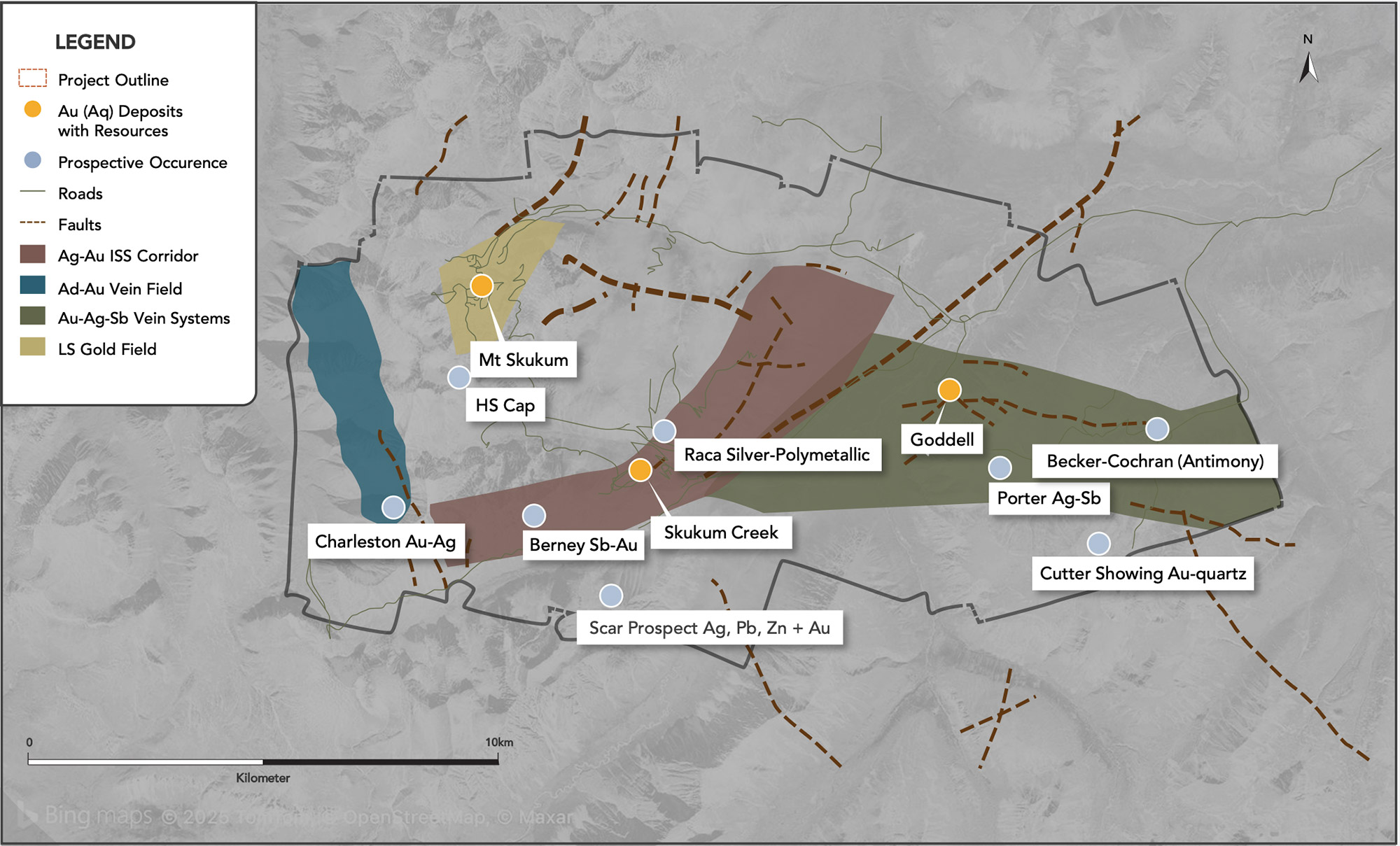
Blue Jay Gold has kicked off an up to 16,000 meter drill program in June, and initial drilling is focusing on the Skukum Creek structural corridor, where historical drill programs have encountered the highest grade gold-silver mineralization. These holes are drill-testing the continuity of the mineralization between the different zones, while the Raca Zone, located approximately 300 meters to the north of the Skukum Creek resource, will also see some holes being drilled. At Raca, Blue Jay will be following up on historical drill results – which were silver-weighted – like 3.23 meters of 581 g/t silver and 0.76 g/t gold. 3
3. 2026 Technical Report. TECHNICAL REPORT AND UPDATED MINERAL RESOURCE ESTIMATE OF THE STELLER GOLD PROJECT, WHITEHORSE MINING DISTRICT, YUKON TERRITORY, CANADA. P&E Mining Consultants Inc. Effective Date: Oct. 31, 2025. Cut-off: 3.0 g/t AuEq. Au: US$2,850/oz. Ag: US$34.20/oz. AuEq ratio = Au:Ag 85.6:1
A second rig has arrived on site and drilling will continue throughout the exploration season with an anticipated wrap-up in date October. We hope to see initial assay results in the next few weeks, and we expect the news flow to be pretty consistent from then on (subject to lab turnaround times), into 2027.
The metallurgy at Steller isn’t an open question, it’s already been answered once. The Mt. Skukum mill ran for two and a half years processing this exact mineralized material, proving the flowsheet works at scale. Building on that foundation, historical test work points to strong recovery potential: gold and silver recoveries anticipated to reach 95% in a high-grade bulk concentrate. 4 Further test work is part of the roadmap to refine concentrate quality ahead of a feasibility study. As processing techniques have improved drastically in the past few decades, we expect the Blue Jay-led test work further down the road to at least confirm the historical data, and hopefully there will be some small improvements as even a 1% bump in the recovery rate could have a meaningful impact.
4. Further detail regarding the Becker-Cochran occurrence, including its discovery, historical exploration, development and sampling, and regarding the Steller Gold Project and its current Mineral Resource Estimate, is set out in the technical report entitled “Technical Report and Updated Mineral Resource Estimate of the Steller Gold Project, Whitehorse Mining District, Yukon Territory, Canada,” prepared for the Company by P&E Mining Consultants Inc. with an effective date of October 31, 2025, available under the Company’s profile on SEDAR+ at www.sedarplus.ca. The historical metallurgical results quoted above are drawn from reports prepared for or on behalf of Yukon Antimony Corporation Ltd. between 1964 and 1966, including the concentration report of the Mineral Processing Division, Department of Mines and Technical Surveys, dated July 6, 1965. https://data.geology.gov.yk.ca/assessment-report/202 https://data.geology.gov.yk.ca/mineral-occurrence/12812 https://data.geology.gov.yk.ca/assessment-report/3639
The Ontario projects
While this year’s focus will of course be on the Steller gold-silver project, Blue Jay Gold of course still has the Ontario-based exploration assets. The Pichette, Oakes and Duc projects will remain in the asset portfolio, but understandably have been put on the backburner. The company ran a small geophysics program at Pichette this summer, but we anticipate the attention to shift towards the Yukon-based Steller project.
Oakes and Pichette are located on the Beardmore-Geraldton gold belt, with a history of mining and prospecting spanning for over 100 years, sparking a real gold rush in the 1920s. Rising gold prices during the Great Depression made this area more attractive than ever, and as per the historical documents, there were over a dozen active gold mines before the second world war started. But after the war, as gold prices were fixed and the low-hanging fruit of the shallow deposits had been mined out, the district got ‘forgotten’, until the Greenstone Gold Mine was drilled out and opened in 2024.
The Duc project is located in the Wawa greenstone belt, close to the Island Gold mine (operated by Alamos Gold) and a past-producing phosphate mine.
While these exploration projects could be interesting further down the road, it is clear the current valuation of the company is underpinned by the Steller gold project in the Yukon Territory and the Ontario projects will have to take a back seat.
Blue Jay struck the iron while it was hot and raised C$14M
One of the most important things in junior mining is to tap the market at the right time for funding. That’s especially the case for non-revenue exploration companies, and a financing at the wrong time could be disastrous when the dilution cannot be overcome.
Blue Jay Gold took advantage of a financing window in the market, and in April 2026, it completed a C$14.7M financing (C$14.2M in net cash proceeds) which will allow the company to fund its activities in the foreseeable future.
Subsequent to that financing, there are currently 47.6M shares outstanding, while the fully diluted share count comes in at 66.7M shares. All 13.7M warrants are currently out of the money (4.5M at C$0.90 and 9.2M at C$1.20), and could bring in an additional C$16M should they end up in the money.
The Management team
Geordie Mark – CEO & Director
Geordie Mark contributes valuable dual expertise to Blue Jay Gold through his extensive mining industry background. With over 20 years of experience, he has successfully operated as both an exploration geologist and a top-rated North American mining equity analyst.
His global experience evaluating both early-stage projects and advanced operations gives him a comprehensive understanding of the mining lifecycle. This unique blend of technical geological knowledge and financial market insight enables him to effectively connect scientific discovery with investor value.
Geordie’s leadership approach centers on transparency and fiscal responsibility, creating value through methodical, evidence-based exploration strategies.
Freeman Smith – Vice President Exploration
Freeman Smith is a highly experienced exploration geologist with over 18 years dedicated to identifying and advancing mineral assets across North and South America. His work has spanned grassroots discovery, resource delineation, and project development, giving him a comprehensive understanding of the exploration lifecycle. Freeman’s expertise lies in interpreting complex geological systems, integrating modern exploration technologies, and leading field programs that efficiently convert targets into drill-ready prospects, maximizing the potential for discovery and resource expansion.
Freeman’s hands-on approach and deep technical knowledge ensure Blue Jay’s exploration programs are executed to the highest industry standards, with each exploration dollar allocated strategically to maximize discovery potential.
Scott Hicks – Chairman
Mr. Hicks is currently an Independent Director for Fuerte Metals. He served as VP Corporate Development and Communications of Lumina Gold, Luminex Resources and Anfield Gold. He played a key role in the sale of all three companies to CMOC, Adventus Mining and Equinox Gold respectively. He also served as CEO and Director of Strategic Resources. Prior to his executive roles, he was an investment banker working with RBC Capital Markets and BMO Capital Markets on their respective mining teams. Over the last 15+ years, he has worked on numerous equity and debt financings and mergers and acquisitions in Canada and Australia. Mr. Hicks holds a Bachelor of Commerce with Honours from the University of British Columbia.
Conclusion
Blue Jay’s ability to acquire the Steller gold project was quite a coup. It would be too easy to just attribute it to ‘luck’ as the Blue Jay management of course had to identify the opportunity and negotiate an agreement with the seller. But the bottom line is that a total acquisition cost of C$575,000 is an absolute bargain.
We don’t attach much value to a valuation based on ounces in the ground but on a gold-equivalent basis across both resource categories, the Steller purchase was completed at roughly US$0.65 per ounce of gold-equivalent. And even if you would only take the 330,000 ounces of gold in the indicated resource category into consideration (ignoring the silver and all inferred resources), the purchase price is still less than US$2 per ounce of gold in the ground.
Now, ounces in the ground are a useless metric if you cannot mine those ounces at a profit. That’s now the main task at hand for Blue Jay’s management team: drill the high-priority targets at Steller, expand the resource, and – if warranted – work towards a first economic study on the project. Blue Jay’s near-term opportunity comes down to a very simple element: grow the resource.
Despite more than four decades of exploration at Steller, modern exploration techniques have never been applied to the project as one connected system, and CEO Geordie Mark sees that as the low-hanging fruit ahead of the company. As the resource grows, it naturally lends itself to a larger potential production profile. Geordie has pointed to 1.5 million ounces as the kind of resource base that would support a 7-10 year mine life at roughly 100,000 ounces per year. While this isn’t an official exploration target, the logic holds: a mine life that’s too short or a production rate that’s too low won’t draw the attention of the right crowd.
With close to C$12M in cash on the balance sheet, Blue Jay is in an excellent position to hit the ground running and methodologically work towards increasing the resource. But at the current valuation of C$38M (and an enterprise value of less than C$26M), we like the risk/reward ratio Blue Jay offers its investors.
Qualified Person
The scientific and technical content of this news release has been reviewed and approved by Freeman Smith, P.Geo., VP Exploration of Blue Jay Gold Corp., who is a Qualified Person as defined by National Instrument 43-101 – Standards of Disclosure for Mineral Projects.
Disclosure: The author has a long position in Blue Jay Gold. Blue Jay Gold is a sponsor of the website. This report is for educational purposes only; be mindful that investing in junior mining stocks is risky, and you may lose your entire investment if things go wrong. Please read our disclaimer.